Stop Polishing the Silver While the Kitchen is on Fire
Look, I’ve seen it a hundred times. An owner realizes the bank account is trending toward zero, panics, and decides it’s time for a "turnaround." They hire a new social media manager, paint the walls a trendier shade of sage green, and maybe add a "fusion" taco to the menu. Three months later, they’re still bleeding cash, but now they have a more expensive Instagram feed.
Here’s the cold truth: most restaurant turnarounds fail because operators treat the symptoms instead of the disease. They focus on the "top line", more guests, more buzz, while the "bottom line" is being eaten alive by invisible inefficiencies. In 2026, with labor costs at historic highs and supply chains still shivering from volatility, you cannot "vibe" your way out of a failing P&L.
This post answers why your recovery efforts are stalling for people trying to save their restaurant business from the brink.
In the next few minutes, we’re going to get honest about:
- Why your financial data is likely lying to you.
- How your menu is actively sabotaging your labor model.
- The specific milestones required to actually move the needle on profitability.
The Context: A Landscape of Razor-Thin Survival
The restaurant industry has always been a game of inches, but the current economic climate has turned it into a game of millimeters. According to the National Restaurant Association, the average profit margin for a full-service restaurant hovers between 3% and 5% [1]. When food costs spike by 10%, as they have periodically over the last 24 months, that entire margin evaporates [2].
Historically, restaurants failed because of bad locations or poor food quality. Today, they fail because of "operational drift", the slow, quiet erosion of systems that eventually leads to a catastrophic cash crunch [3]. If you are in a turnaround phase, you aren't just fighting for customers; you are fighting against the inertia of your own bad habits.

1. You’re Flying Blind Without Real-Time Data
Most owners check their P&L at the end of the month. By then, it’s an autopsy, not a diagnosis. If you don't know your daily prime cost (labor + COGS), you aren't managing a turnaround; you’re guessing. Successful operators in 2026 use integrated POS and inventory systems to track theoretical vs. actual food costs every single day [4].
The Fix: Implement a "Flash Report." This is a simple daily summary of sales, labor percentage, and estimated food usage. If your labor hit 40% on a Tuesday, you need to know Wednesday morning, not three weeks later.
2. Your Menu is a Creative Masterpiece but a Financial Disaster
We see this constantly: a chef-driven menu with 40 items that requires four prep cooks and five different stations. In a turnaround, your menu is your primary tool for margin optimization. Every dish that doesn't contribute a high "weighted margin" is a liability.
According to the Cornell SC Johnson College of Business, menu engineering, the process of evaluating items based on popularity and profitability, can increase profits by up to 15% without increasing guest counts [5]. For a deeper dive into this, check out The Restaurant Menu Engineering Playbook.
The Fix: Cut the bottom 20% of your menu. Focus on "cross-utilization." If an ingredient is only used in one dish, and that dish isn't a top seller, kill it.
3. The "Labor Leak" is Drowning You
It’s easy to blame the minimum wage, but the real profit killer is inefficient scheduling. Many restaurants schedule for "coverage" instead of "demand." If your kitchen is fully staffed at 4:00 PM but the rush doesn't hit until 6:30 PM, you are throwing money into the trash [6].
The Fix: Use "Staggered Scheduling." Bring in the prep team early, but don't bring in the full line until 30 minutes before the rush. More importantly, cross-train your staff so your server can help run food and your dishwasher can help with basic prep.
4. Prime Costs are Out of Control
Your "Prime Cost", the sum of your Cost of Goods Sold (COGS) and total labor, should ideally sit between 55% and 60% [7]. In a failing restaurant, we often see this number climbing toward 70% or 75%. At that level, you aren't a business; you’re an expensive hobby. You can see how we handle this in our guide on how restaurant consultants dramatically lower prime cost.
| Cost Category | Failing Restaurant | Optimized Restaurant |
|---|---|---|
| Cost of Goods Sold (COGS) | 35% – 38% | 28% – 31% |
| Labor Costs | 35% – 40% | 28% – 30% |
| Total Prime Cost | 70% – 78% | 56% – 61% |
| Occupancy/Operating | 25% | 25% |
| Net Profit | -3% to 5% (Loss) | 14% to 19% (Healthy) |
| Data derived from industry benchmarks for full-service dining in high-cost urban markets [1, 4, 7]. |
5. You’re Buying Like a Consumer, Not a Business
If you are still calling in orders to a sales rep based on "what looks low," you are losing money on every delivery. Procurement is where the battle for margins is won. Without bid sheets and regular price comparisons, your suppliers will slowly creep their prices up [8].
The Fix: Set up a formal "Bid Sheet." Every two weeks, compare prices for your top 10 highest-spend items (usually proteins and dairy) across three different vendors.
6. Tech Stagnation and Friction
If your POS system is ten years old and doesn't talk to your inventory software, you are paying for that friction in labor hours. Modern platforms automate the tedious stuff, like calculating plate costs or tracking employee clock-ins, allowing you to focus on the floor [9].
The Fix: Audit your "Tech Stack." If your staff is spending more than an hour a day on manual data entry or paper-based inventory, it’s time to upgrade.
7. Brand Confusion (Who Are You, Anyway?)
A turnaround often involves an identity crisis. Are you a high-end steakhouse or a casual neighborhood bar? Trying to be everything to everyone results in a bloated inventory and a confused customer base. Even a 500 dollar steak dinner can fail if the brand identity doesn't justify the price point.
The Fix: Define your "Unique Selling Proposition." If you can't describe why a guest should choose you over the place next door in ten seconds, your marketing will never work.
8. The Guest Experience Gap
You can have the best margins in the world, but if the service is surly and the food is inconsistent, guests won't return. In the age of Yelp and Google Reviews, one bad night can haunt you for months [10]. Consistency is the hallmark of a professional operation.
The Fix: Create "Standard Operating Procedures" (SOPs) for everything. From how to greet a guest to how the garnish is placed on the plate, nothing should be left to "vibe."
9. Owner Burnout and Micromanagement
When a restaurant struggles, owners often try to do everything themselves. They end up washing dishes and hosting, which means nobody is actually managing the business. You cannot fix the systems if you are stuck in the weeds of daily operations [11].
The Fix: Build a leadership team. Even if it's just one strong shift lead, you need someone who can run the floor so you can run the numbers.
10. Lack of Extreme Accountability
A turnaround requires a culture shift. If your staff sees you ignoring a dirty floor or a waste of food, they will do the same. Accountability starts at the top and filters down to every single prep cook and busser [12].
The Fix: Hold weekly "Manager Meetings" focused entirely on KPIs (Key Performance Indicators). Don't talk about "feelings": talk about the labor percentage and the food waste log.
A Typical 12-Month Turnaround Timeline
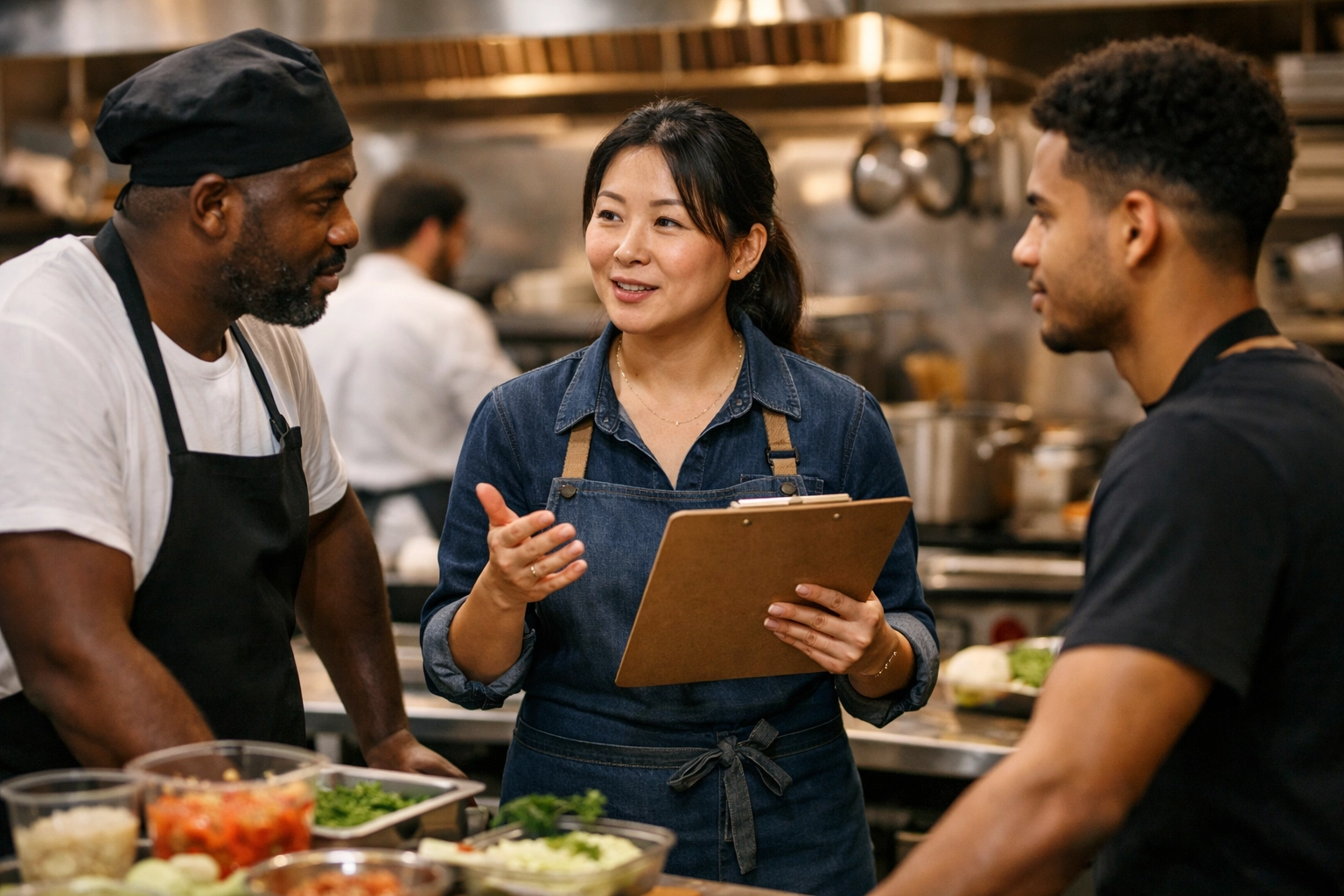
Recovering a failing restaurant isn't an overnight event. It's a structured sequence of interventions. Here is how a professional turnaround typically unfolds:
- Month 1: Financial Triage. Complete P&L audit. Identify the "cash leaks" and stop the immediate bleeding [13].
- Month 2: Menu Engineering. Analyze every dish for margin and popularity. Cut the dead weight [5].
- Month 3: Supplier & Inventory Overhaul. Renegotiate vendor contracts and implement strict inventory controls [8].
- Month 4: Labor System Implementation. Move to demand-based scheduling and cross-training [6].
- Month 5: Brand Realignment. Update the concept and marketing to match the new, leaner operation [10].
- Month 6: Service Standard Training. Launch new SOPs and train the team on the "new way" of doing things [12].
- Month 7-9: Testing and Refining. Monitor the new systems and make micro-adjustments to the menu and labor.
- Month 10-12: Stabilized Growth. Shift focus from "survival" to "marketing for volume" now that the house is in order [11].
Case Example: The Mid-Market Recovery
In early 2025, a legacy Italian concept in the Bay Area was facing a 4% net loss despite $2.2M in annual sales. The owner felt the problem was "not enough customers." However, an audit revealed their prime costs were at 74%. They were essentially paying guests to eat there.
The turnaround didn't focus on advertising. Instead, the team cut the menu from 62 items to 34, focusing on high-margin pasta dishes and removing underperforming seafood options that had high spoilage rates. They renegotiated their linen and chemical contracts and implemented a "no-overtime" policy for the kitchen staff.
Within six months, prime costs dropped to 59%. Even with a slight 5% dip in guest counts due to the menu changes, the restaurant shifted from a monthly loss of $7,000 to a monthly profit of $22,000. The stakes were clear: either change the math or close the doors. By focusing on operations rather than "hype," they saved 35 jobs and a 20-year legacy [MFRCG Internal Data].
What Smart Critics Argue
Some industry analysts argue that in a post-2024 economy, "you can't cut your way to greatness" [14]. They suggest that focusing too much on cost control can alienate your best staff and diminish the guest experience.
While there is merit to the idea that you need a "soulful" restaurant to succeed, the counter-argument is simple: a soulful restaurant that can't pay its rent is a closed restaurant. We believe that systems create freedom. When the margins are healthy, you actually have more money to spend on high-quality ingredients and better wages for your staff. You aren't cutting quality; you are cutting waste.
Other critics suggest that marketing should be the first priority in a turnaround. However, pouring more customers into a "leaky bucket": a restaurant with poor margins: only accelerates the failure. You must fix the operations before you turn on the marketing faucet.
Key Takeaways
- Stop Guessing: You need daily visibility into your prime costs.
- Murder Your Darlings: If a menu item isn't making you money, it doesn't matter how much you love it.
- Schedule for Demand: Stop staffing for "coverage" and start staffing for actual sales peaks.
- Procurement is Profit: Negotiate with your vendors like your business depends on it: because it does.
- Systems Over Vibes: Consistency is built through SOPs, not "feeling the room."
- Owner Engagement: You can't fix a business from the sidelines, but you also can't fix it if you're stuck on the dish pit.
- The 60% Rule: Keep your Prime Costs at or below 60% to maintain a healthy business.
Actions You Can Take Today
At Work
Audit your last three months of P&L statements. Circle every category that is higher as a percentage of sales than it was a year ago. That is your starting point for investigation.
At Home
Take 30 minutes to write down your restaurant's "Core Identity." If you find yourself listing five different cuisines or styles, you have a brand problem that needs narrowing.
In the Community
Visit your top three competitors. Don't look at their food; look at their staffing levels. How many people are on the floor? How fast is the table turnover? Use this as a benchmark for your own efficiency.
In Civic Life
Engage with local restaurant associations. Often, they have collective bargaining power or insights into local labor laws that can help you avoid costly compliance mistakes.
The Extra Step
Pick your top five highest-selling menu items and do a "Theoretical Food Cost" exercise. Weigh every ingredient. You might discover that a "bestseller" is actually costing you more than you’re charging.
FAQ
Q: Can I really lower my food cost without lowering quality?
A: Absolutely. Most food cost issues aren't about ingredient quality; they are about waste, theft, and poor portion control. Standardizing your recipes and monitoring prep waste can save 3-5% without changing a single supplier.
Q: Is it better to raise prices or cut costs during a turnaround?
A: Usually both. However, you should cut waste first. If you raise prices while still having high waste, you are just masking the underlying problem. For more on this, see our article on restaurant turnaround secrets revealed.
Q: How do I get my staff to care about margins?
A: Transparency. Share the numbers (at a high level) with your leadership team. When they understand that saving $100 in labor means more money for staff bonuses or new equipment, they are more likely to buy in.
Q: Should I fire my manager if the turnaround isn't working?
A: Not necessarily. A manager can only be as good as the systems you provide. If they don't have the tools to track labor or inventory, you are setting them up to fail. Fix the systems first, then evaluate the talent.
Q: How long does it take to see results?
A: You can see labor improvements in a week and food cost improvements in a month. A total "bottom line" reversal usually takes 3 to 6 months of disciplined execution.
Where Smart Strategy Meets Profitable Hospitality.
At McFadden Finch Restaurant Consulting Group, we help restaurant owners make sharper decisions, strengthen operations, and build businesses designed to perform. From feasibility studies and concept development to menu strategy and long-term operational consulting, we help your restaurant move beyond survival and into sustained growth.
McFadden Finch Restaurant Consulting Group
Lake Merritt Plaza
1999 Harrison St., 18th Floor
Oakland, CA 94612
(510) 973-2410
www.mcfadden-finch-group.com
executive.team@mcfadden-finch-group.com
Schedule your discovery call today and start building a stronger, smarter, more profitable restaurant. The corporate office address and email are listed on McFadden Finch Holdings’ contact page, and MFRCG is included in the company’s hospitality consulting portfolio.
Sources
[1] National Restaurant Association, "2024 State of the Restaurant Industry," February 2024, https://restaurant.org/research-and-media/research/state-of-the-industry/, Accessed April 14, 2026.
[2] U.S. Bureau of Labor Statistics, "Consumer Price Index – March 2026," April 10, 2026, https://www.bls.gov/cpi/, Accessed April 14, 2026.
[3] Cornell SC Johnson College of Business, "Why Restaurants Fail," 2023, https://sha.cornell.edu/faculty-research/centers-institutes/chr/research/hospitality-reports/, Accessed April 14, 2026.
[4] Toast, "Voice of the Restaurant Industry Report 2025," January 2025, https://pos.toasttab.com/news/restaurant-report, Accessed April 14, 2026.
[5] Kasavana, M., "Menu Engineering: How to Raise Sales and Profit," Michigan State University / Cornell Hospitality Quarterly, Updated 2024, Accessed April 14, 2026.
[6] Harvard Business Review, "The Relationship Between Labor and Profitability in Service Firms," June 2024, https://hbr.org/2024/06/service-firm-labor-economics, Accessed April 14, 2026.
[7] Restaurant Accounting Services Inc., "Understanding Prime Cost," 2025, https://rasiusa.com/blog/what-is-prime-cost/, Accessed April 14, 2026.
[8] Supply Chain Management Review, "Foodservice Procurement Volatility," March 2026, https://www.scmr.com/, Accessed April 14, 2026.
[9] Forbes Technology Council, "How Integrated POS Systems Are Saving Small Businesses," February 2026, https://www.forbes.com/sites/forbestechcouncil/, Accessed April 14, 2026.
[10] Journal of Hospitality & Tourism Research, "The Impact of Online Reviews on Independent Restaurant Failure Rates," 2025, https://journals.sagepub.com/home/jht, Accessed April 14, 2026.
[11] Entrepreneur, "The Founder’s Trap: Why Micromanagement Kills Growth," October 2025, https://www.entrepreneur.com/growing-a-business/, Accessed April 14, 2026.
[12] Gallup, "State of the Global Workplace: 2025 Report," 2025, https://www.gallup.com/workplace/, Accessed April 14, 2026.
[13] Wall Street Journal, "Restaurant Turnarounds in a High-Interest Rate Environment," January 2026, https://www.wsj.com/business/, Accessed April 14, 2026.
[14] Eater, "The Problem with Optimization Culture in Dining," March 2026, https://www.eater.com/, Accessed April 14, 2026.
Disclaimer: This content is for general informational purposes only and does not constitute legal, financial, tax, operational, employment, regulatory, or other professional advice. Reading this content does not create a client, consulting, or contractual relationship with McFadden Finch Restaurant Consulting Group. Because every restaurant, market, and business situation is different, you should consult qualified professionals regarding your specific circumstances. McFadden Finch Restaurant Consulting Group makes no warranties regarding the accuracy or completeness of this information and is not responsible for third-party content, links, products, or services referenced. Testimonials, examples, case studies, and projected outcomes are illustrative only and do not guarantee similar results.