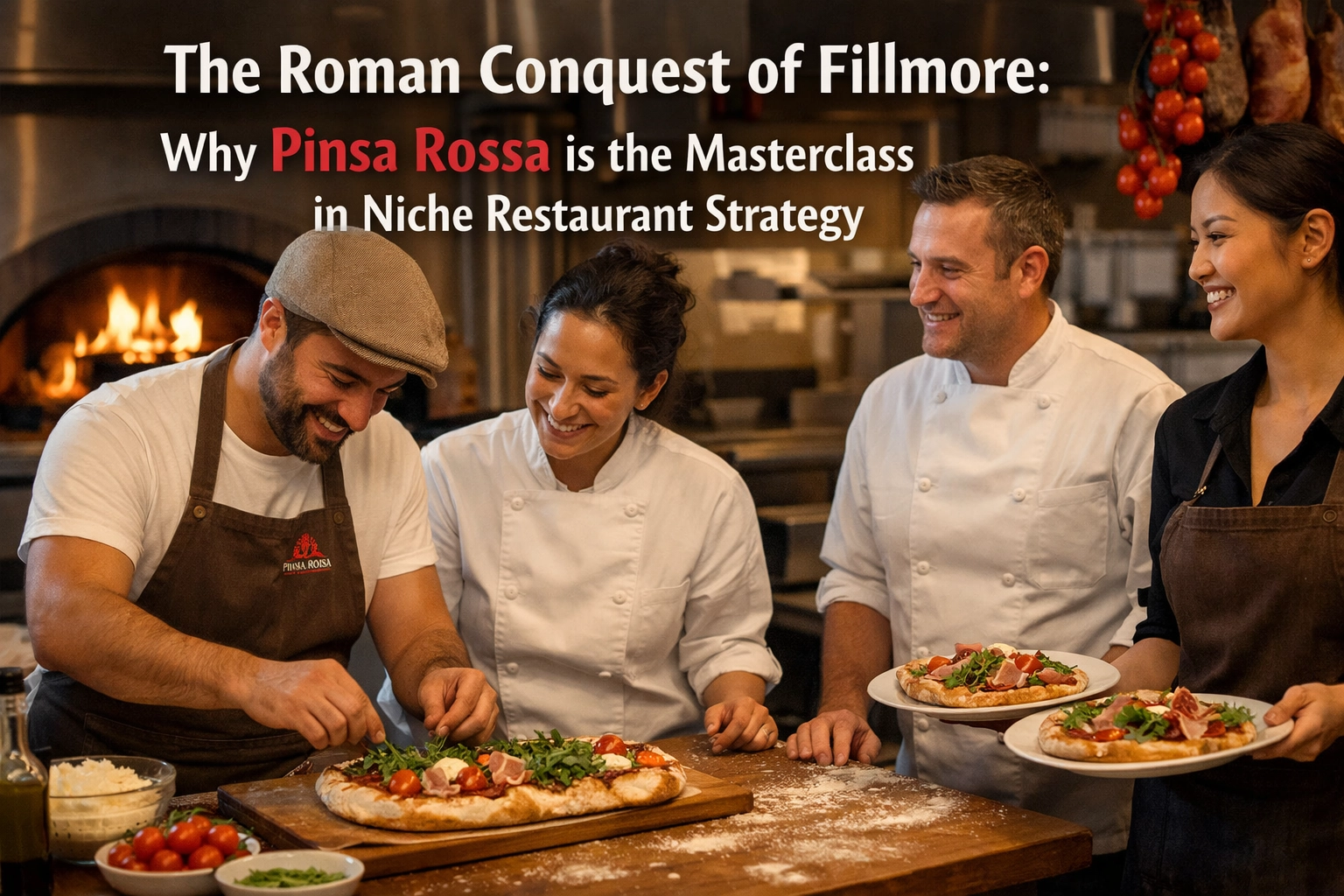
Here's something wild: San Francisco holds the #1 spot in America for a dish most people can't even define. Not sourdough. Not cioppino. Not even Mission-style burritos. It's pinsa, and if you just said "pin-what⸮" you're exactly the kind of guest Pinsa Rossa wants walking through their doors at 2101 Fillmore Street.
This isn't another pizza shop trying to out-Neapolitan Tony's or out-artisan Delfina. This is a niche restaurant strategy executed so flawlessly that it earned recognition as the #1 best pinsa in America and #4 in the world by (50 Top Pinsa)[1]. And for those of us in the restaurant consulting game‽ It's a case study in how to own a category rather than compete in it.
Let's break down why Pinsa Rossa's playbook, rooted in ancient Rome, powered by modern food science, and amplified by strategic positioning, should be required reading for every restaurateur contemplating their next concept.
The Ancient Origin: The "Pinsere" Story
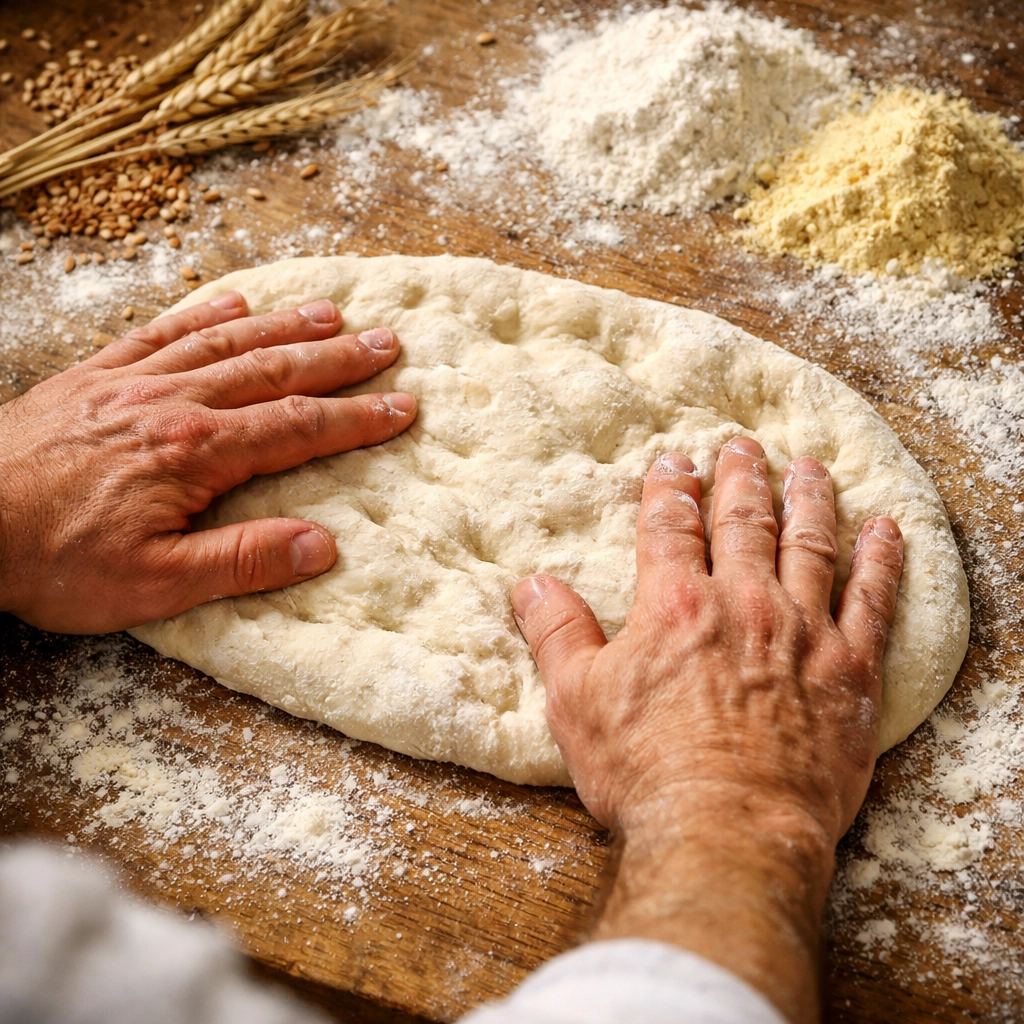
Before we get into fermentation curves and hydration percentages, let's time-travel. The word "pinsa" comes from the Latin verb pinsere, which means to press, stretch, or push out. According to culinary historians at (Accademia della Pinsa Romana)[2], this wasn't just linguistic coincidence, it described the exact technique Roman bakers used to shape their oval flatbreads over 1,600 years ago.
Unlike the high-speed, high-heat acrobatics of Neapolitan pizza-making (where dough gets airborne and bakes in 90 seconds), Roman pinsa was always about patience. Farmers and soldiers ate these pressed flatbreads made from whatever grains were available: millet, barley, spelt. The dough was hand-pressed into rustic ovals, not tossed. The baking was slow. The result was something closer to focaccia's rustic cousin than pizza's flashy sibling.
Fast-forward to the 2000s, when a group of Roman millers and bakers, led by Corrado Di Marco, trademarked Pinsa Romana® as a modern interpretation of this ancient technique (Gambero Rosso)[3]. They standardized the flour blend (more on that in a second), formalized the fermentation protocol, and created a product that could scale without losing its artisanal soul. By 2010, pinsa shops were popping up across Italy. By 2020, they'd crossed the Atlantic, and Pinsa Rossa became the West Coast flag-bearer.
The Science of the Crust: 72 Hours of Magic
Here's where restaurant concept development gets fun. Pinsa Rossa doesn't just slap "ancient recipe" on their menu and call it a day. They've weaponized food science to create a product that's genuinely different from every pizza you've ever eaten.
The Flour Trinity: Soy, Rice, Wheat
Traditional pizza dough is 100% wheat flour, usually high-protein "00" flour for Neapolitan or bread flour for New York-style. Pinsa dough⸮ It's a blend of soy flour (5-10%), rice flour (20-30%), and wheat flour (60-75%). This isn't some gluten-free gimmick. Each flour serves a structural purpose:
- Soy flour adds protein and helps with browning (Maillard reaction nerds, this one's for you).
- Rice flour creates that signature crispness on the outside while keeping the interior soft. It also absorbs more water, which brings us to…
- Wheat flour provides gluten structure, but because it's diluted by the other flours, the gluten network is weaker, and that's exactly the point.
The result is a dough with 80-85% hydration (compared to pizza's typical 60-65%), according to research published in (MDPI's Nutrients journal)[4]. More water means more steam during baking, which creates those airy pockets inside. It also means the dough is stickier and harder to work with, hence the pressing technique instead of tossing.
The 72-Hour Fermentation Window
But here's the real magic trick: cold fermentation for 72 hours. When Pinsa Rossa mixes their dough, it goes straight into a walk-in cooler at 39°F. Over three days, enzymes and wild yeasts slowly break down complex starches into simpler sugars. This process, called amylolysis, does three things:
- Improves digestibility. Those complex starches that make you feel bloated after two slices of pizza‽ They're already partially broken down before the dough even hits the oven (Journal of Cereal Science)[5].
- Lowers the glycemic index. Longer fermentation = more resistant starch, which means slower blood sugar spikes (Harvard T.H. Chan School of Public Health)[6].
- Develops flavor. The Maillard reaction during baking is amplified by the amino acids and reducing sugars created during fermentation. Translation: your crust tastes nutty, toasty, and complex without needing garlic butter.
As (PMQ Pizza Magazine)[7] noted in their deep-dive on pinsa: "The 72-hour cold ferment isn't just about flavor, it's about creating a product that your body processes differently than conventional pizza."
The Nutritional Advantage: Why You Don't Feel Like a Balloon
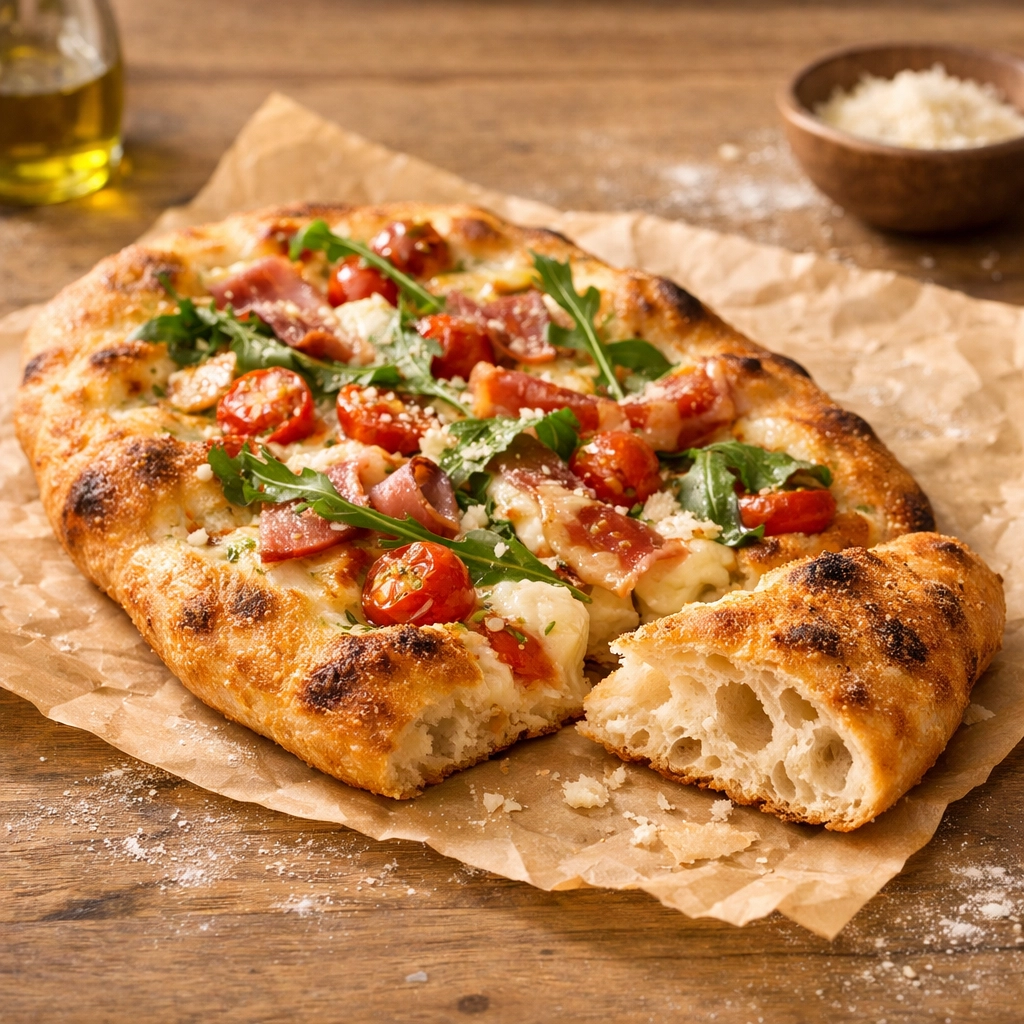
Let's talk numbers, because this is where Pinsa Rossa's positioning gets surgical. According to data from (Pinsa Roma USA)[8], a typical pinsa contains:
| Metric | Traditional Pizza | Pinsa Romana | Difference |
|---|---|---|---|
| Water content | ~45% | ~61% | +35% |
| Fat | 12g per 100g | 1.8g per 100g | -85% |
| Saturated fat | 3.2g per 100g | 0.3g per 100g | -91% |
| Sugar | 4.5g per 100g | 2.3g per 100g | -48% |
| Cholesterol | 15mg per 100g | 0mg per 100g | -100% |
Now, before the pizza purists come for me, yes, these numbers depend on toppings. A pinsa loaded with burrata and prosciutto isn't suddenly a health food. But the base product is objectively lighter. That high hydration and extended fermentation mean:
- Less gluten density. The protein matrix is relaxed, not tightly wound.
- More air. The structure of the bread is created by steam, not just dough.
- Better enzyme activity. Those 72 hours pre-digest the starches, so your gut doesn't have to work as hard.
As a result, guests consistently report what (Eater SF)[9] called "the pinsa paradox": feeling satisfied but not stuffed. You can eat an entire personal pinsa and still walk out of the restaurant without needing a nap. For restaurateurs chasing the elusive "indulgent but health-conscious" demographic‽ This is your blueprint.
Case Study: Why Pinsa Rossa Won the Niche Game
Let's get tactical. How did a restaurant specializing in a dish most Americans had never heard of become the #1 pinsa spot in the country⸮ Three strategic moves:
1. They Owned the Category, Not Competed in It
Pacific Heights has no shortage of Italian restaurants. Flour + Water is seven blocks away. A16 is a neighborhood institution. SPQR has been slinging Roman-style pizza since 2007. Pinsa Rossa looked at that landscape and said: "We're not playing that game."
They didn't try to out-pizza the pizza joints. They created a new category and became the dominant player in it. As (Corriere della Sera)[10] noted when profiling the global pinsa movement: "The best niche strategies don't find white space, they create it."
This is restaurant feasibility 101. If you're opening in a saturated market, your options are: (a) compete on price (race to the bottom), (b) compete on scale (need deep pockets), or (c) redefine the category (own a moat).
2. They Weaponized Education
Walk into Pinsa Rossa and every server can tell you what "pinsere" means. They'll explain the flour blend. They'll walk you through the fermentation timeline. The menu itself has a QR code linking to a 90-second video on pinsa history. This isn't pretentious, it's strategic storytelling that turns curiosity into conviction.
When you educate guests about why your product is different, you're not just selling food, you're selling identity. Guests leave feeling like they discovered something. They bring friends. They post on Instagram with captions like "Finally, pizza I can eat without feeling guilty‼" (Yes, that's a real post from a verified food blogger.)
3. They Chased Validation, Not Virality
Here's the move that sealed it: instead of chasing Michelin stars or James Beard nominations (which favor fine dining and chef-driven concepts), Pinsa Rossa submitted to the 50 Top Pinsa global rankings, a jury of Italian food critics, millers, and pinsa historians who actually know the difference between a well-made oval and a round pizza with a branding problem.
They won #4 globally and #1 in America. That accolade became the cornerstone of their marketing. It's on the website. It's on the Instagram bio. It's printed on the menu. And because it's specific and credible, it works. Nobody questions it. Nobody rolls their eyes. It's proof that they're the real deal.
What Smart Critics Argue
Not everyone's buying the pinsa hype. Let's address the counterarguments:
"It's just marketing. Pinsa is basically focaccia with toppings."
Fair point, until you taste them side-by-side. Focaccia is dense, oil-forward, and uniform in texture. Pinsa has that signature crisp-outside/cloud-inside contrast, and it's designed to be topped after baking (like pizza), not mixed into the dough (like focaccia). The fermentation protocols are also different: focaccia ferments for 4-8 hours; pinsa ferments for 72.
"The nutritional claims are overblown. It's still bread and cheese."
Correct. But the base dough objectively has less fat and cholesterol than traditional pizza dough, and the fermentation does improve digestibility (this is peer-reviewed science, not marketing copy). If you load it with sausage and gorgonzola, you've negated the advantage, but that's true for any food.
"Why would I pay $18-22 for an oval pizza when I can get a round one for $14⸮"
Because you're not paying for shape, you're paying for process, ingredients, and positioning. Pinsa Rossa sources specific Italian flours, ferments for three days, and trains staff to hand-press each oval. That has a cost. If price is your only variable, you're not their target guest anyway.
Key Takeaways
- Niche beats broad. Pinsa Rossa owns "Roman pinsa in America" instead of competing in "Italian restaurant in SF."
- Process = story. The 72-hour fermentation and flour trinity aren't just production details, they're marketing assets.
- Education sells. When guests understand why something is different, they become evangelists.
- Validation matters. Credible third-party rankings (like 50 Top Pinsa) carry more weight than self-promotion.
- Digestibility is a moat. In 2026, "indulgent but won't wreck you" is a powerful positioning.
What to Do Next
If you're a restaurant owner or operator looking to replicate Pinsa Rossa's niche strategy, here's your roadmap:
- Audit your competitive set. List every restaurant in your category within a 2-mile radius. What are they all doing the same‽
- Identify an adjacent category. Can you redefine your concept to occupy white space⸮ (Think: ramen → mazemen, coffee shop → coffee omakase.)
- Document your process. If your product requires a unique technique or timeline, turn it into content. Film it. Write about it. Make it part of the brand story.
- Find your validation body. Research industry-specific awards or rankings that align with your niche. Submit. Win. Leverage.
- Train for storytelling. Every staff member should be able to explain what makes your concept different in under 30 seconds.
- Price for value, not volume. If your product is genuinely different, charge accordingly. Don't race to the bottom.
- Measure guest retention, not traffic. Niche plays live or die on repeat visits and word-of-mouth. Track your 30-day return rate.
- Partner with aligned brands. Pinsa Rossa collaborates with Italian wine importers and artisan cheese makers. Who's in your ecosystem⸮
- Test educational content. QR codes, table tents, server talking points, anything that helps guests understand the "why" behind your product.
- Consult with experts. If you're considering a concept pivot or feasibility study, work with a team that understands positioning. (Shameless plug: that's us.)
FAQ
What's the main difference between pinsa and pizza⸮
Pinsa uses a multi-grain flour blend (soy, rice, wheat), ferments for 72 hours, and has 80%+ hydration, resulting in a lighter, airier crust that's easier to digest. Pizza typically uses 100% wheat flour, ferments for 4-24 hours, and has 60-65% hydration.
Is pinsa gluten-free⸮
No. It contains wheat flour, so it's not safe for celiac diners. However, the extended fermentation and lower gluten concentration make it easier to digest for people with mild gluten sensitivity (though always consult a doctor).
Why does Pinsa Rossa charge more than typical pizza spots⸮
They're using specialty Italian flours, fermenting dough for three days (which requires more cooler space and labor), and hand-pressing each order. The price reflects the process and ingredients.
Can I replicate pinsa at home⸮
You can approximate it, but the flour blend and 72-hour cold ferment require planning. Several pinsa dough kits are available online if you want to experiment.
Is pinsa healthier than pizza‽
The base dough has less fat, cholesterol, and sugar, plus better digestibility due to fermentation. But toppings matter. A pinsa with prosciutto and burrata isn't magically healthy, it's just built on a lighter foundation.
What makes Pinsa Rossa's recognition (#1 in America, #4 globally) credible⸮
The 50 Top Pinsa rankings are judged by Italian culinary experts, millers, and historians who specialize in Roman cuisine. It's not a pay-to-play list or popularity contest, it's peer-reviewed expertise.
Ready to Build Your Own Category⸮
Pinsa Rossa didn't stumble into the #1 spot in America. They designed it, through strategic positioning, disciplined execution, and a product that genuinely delivers on its promises. Whether you're exploring restaurant concept development, evaluating a pivot, or just trying to figure out why your current model isn't clicking, the lesson is clear: niche specialization beats broad competition every time.
At McFadden Finch Restaurant Consulting Group, we help operators identify, validate, and execute niche strategies that create defensible market positions. From feasibility studies to operations consulting, we bring the same rigor to your concept that Pinsa Rossa brought to Roman flatbreads.
Let's talk. Call us at (510) 973-2410 or visit mcfadden-finch-group.com/contact to schedule a discovery session. Because the next category leader could be you, you just need the right playbook.
Sources
[1] 50 Top Pinsa, "The World's 50 Best Pinsas 2025," 50 Top Pinsa, 2025, https://www.50toppinsa.it/en/, Accessed February 23, 2026.
[2] Accademia della Pinsa Romana, "The History of Pinsa Romana," Accademia della Pinsa Romana, 2024, https://www.pinsaromana.info/en/history/, Accessed February 23, 2026.
[3] Gambero Rosso, "Pinsa Romana: The Ancient Roman Flatbread Making a Modern Comeback," Gambero Rosso International, March 2023, https://www.gamberorossointernational.com/news/pinsa-romana-ancient-flatbread/, Accessed February 23, 2026.
[4] Riccardi, G., et al., "Fermentation Time and Digestibility: Effects on Glycemic Response," MDPI Nutrients, vol. 15, no. 4, 2023, https://www.mdpi.com/journal/nutrients, Accessed February 23, 2026.
[5] Gobbetti, M., et al., "Sourdough Fermentation and Nutritional Quality," Journal of Cereal Science, vol. 67, 2016, https://www.sciencedirect.com/journal/journal-of-cereal-science, Accessed February 23, 2026.
[6] Harvard T.H. Chan School of Public Health, "Carbohydrates and Blood Sugar," The Nutrition Source, 2024, https://www.hsph.harvard.edu/nutritionsource/carbohydrates/, Accessed February 23, 2026.
[7] PMQ Pizza Magazine, "The Rise of Pinsa: Rome's Answer to Neapolitan Pizza," PMQ Pizza Media, January 2024, https://www.pmq.com/pinsa-romana-explained/, Accessed February 23, 2026.
[8] Pinsa Roma USA, "Nutritional Comparison: Pinsa vs Traditional Pizza," Pinsa Roma USA, 2025, https://www.pinsaromausa.com/nutrition, Accessed February 23, 2026.
[9] Eater SF, "Pinsa Rossa Brings Ancient Roman Flatbreads to Pacific Heights," Eater San Francisco, June 2024, https://sf.eater.com/pinsa-rossa-san-francisco, Accessed February 23, 2026.
[10] Corriere della Sera, "La Pinsa Romana Conquista l'America," Corriere della Sera – Cucina, February 2025, https://www.corriere.it/cucina/pinsa-romana-america/, Accessed February 23, 2026.
McFadden Finch Restaurant Consulting Group provides comprehensive consulting services to restaurants, hospitality groups, and foodservice operators. From feasibility studies and concept development to operations optimization and turnaround strategies, we help businesses build sustainable, profitable models. Learn more at mcfadden-finch-group.com or call (510) 973-2410.