Walking down San Pablo Avenue on a Sunday morning used to feel different. For years, 2121 San Pablo was the home of Gaumenkitzel, a beloved spot for slow-cooked German soul food. But the restaurant industry in the Bay Area doesn't stand still. Today, the scent of rye bread and schnitzel has been replaced by the heavy, sweet perfume of post-oak smoke and brisket. Heads & Tails Barbecue hasn't just occupied a famous footprint; they’ve re-engineered it for the 2026 economy.
The transition from a traditional full-service model to what Heads & Tails is doing now is a masterclass in modern restaurant consulting strategy. While many operators are struggling with the 2026 labor squeeze, this Berkeley spot is expanding. They recently launched a weekend brunch service, Saturdays and Sundays from 11 a.m. to 3 p.m., that perfectly illustrates how to maximize revenue during traditionally "dead" bar hours.
This post breaks down the specific operational levers Heads & Tails is pulling to stay profitable in one of the toughest markets in the country. You will learn:
- How daypart expansion through brunch can offset high fixed rent costs.
- Why the "low-labor, high-tech" service model is the only way forward for California bars.
- The strategy behind building a "third space" that keeps customers in seats for multiple revenue cycles.
The Revenue Multiplier: Why Brunch Matters for BBQ
In the restaurant business, your biggest expenses, rent and utilities, are fixed. They don’t care if you’re open or closed. For a BBQ concept that traditionally thrives on dinner and late-night bar crowds, the morning and early afternoon represent wasted potential. By introducing brunch, Heads & Tails is essentially capturing "found money" (National Restaurant Association) [1].
But this isn't just about putting eggs on a plate. It’s about restaurant feasibility. Most BBQ joints have the equipment sitting idle in the morning while the meat finishes its long smoke. By utilizing that existing inventory in brunch items, think brisket hash or pulled pork eggs benedict, the kitchen increases its yield without significantly increasing its prep time (Restaurant Business Online) [2].
In Berkeley, where the student and young professional population seeks weekend "anchor" spots, the 11 a.m. to 3 p.m. window is prime real estate. According to recent 2026 consumer data, "brunching" has shifted from a luxury outing to a social necessity for Gen Z and Millennial demographics (Eater SF) [3]. Heads & Tails isn't just selling food; they are selling a weekend destination.
The Model: Service Without the Overhead
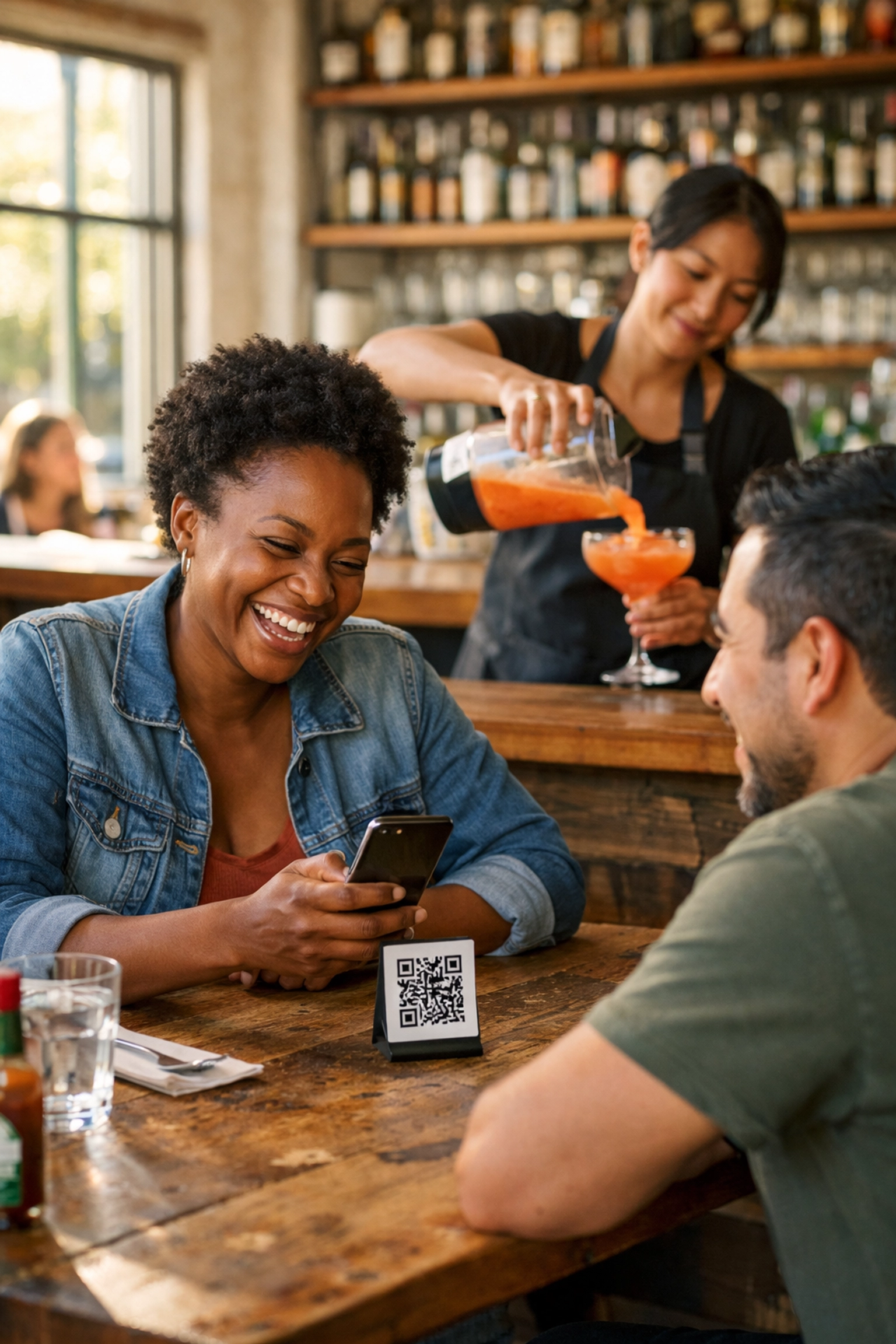
One of the first things you notice at Heads & Tails isn't the food, it's the flow. There isn't a traditional host stand or a fleet of servers hovering over tables. They utilize a high-efficiency service model where customers order at the bar or via QR codes (Cornell Hospitality Quarterly) [4].
For bar and restaurant consultants, this is the "holy grail" of 2026 operations. In a city where the minimum wage and mandatory benefits continue to climb, every minute of "unproductive" labor kills the margin. By shifting the ordering process to the customer, Heads & Tails achieves two things:
- Lower Labor Costs: They can run the floor with fewer staff members, focusing their payroll on high-skill kitchen labor and bartenders (Toast) [5].
- Increased Order Accuracy: When customers input their own orders, mistakes drop by an average of 15% (Harvard Business Review) [6].
Creating the "Third Space"
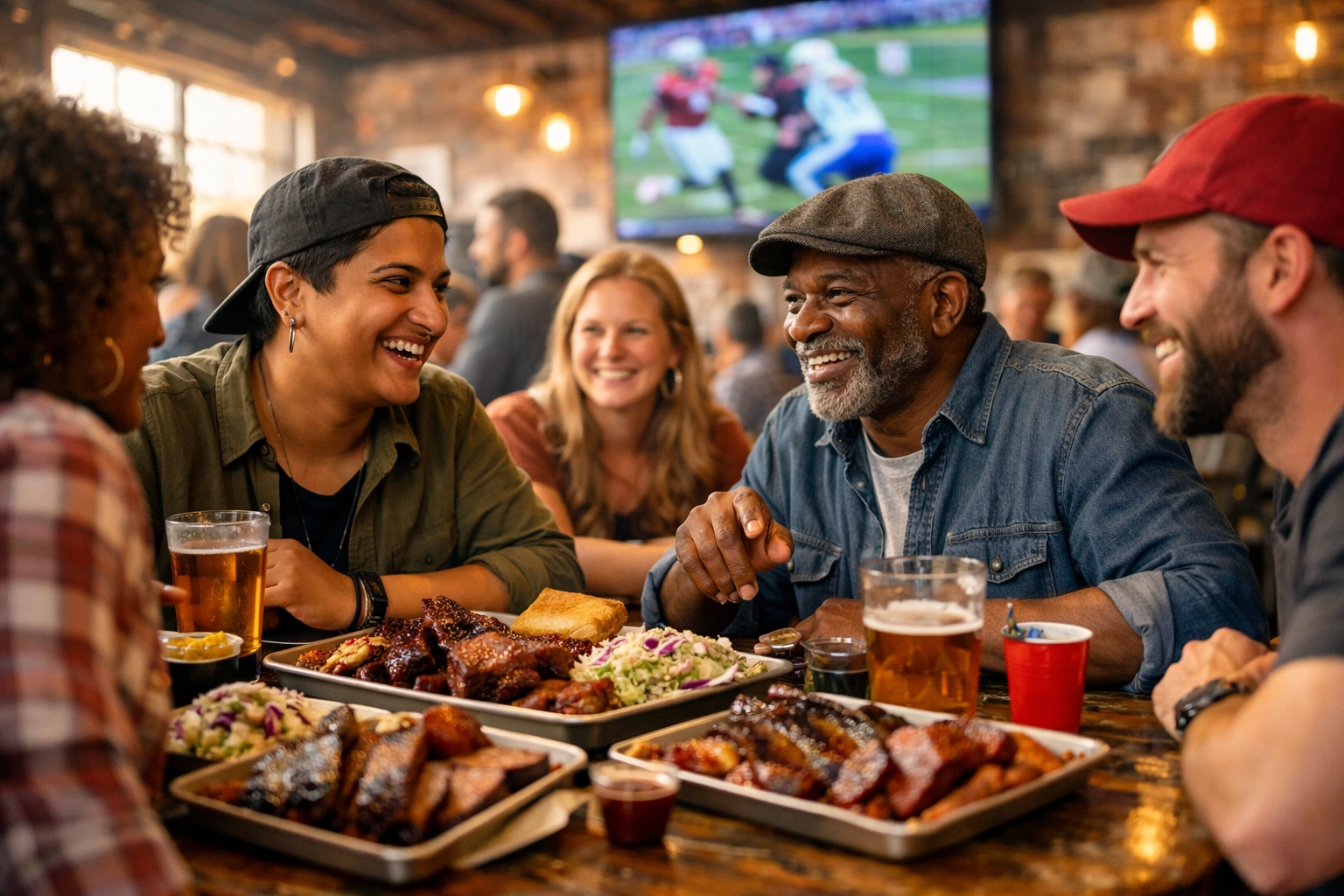
The term "third space" refers to a social environment that isn't home (the first space) or work (the second space). Heads & Tails has leaned heavily into this. With a full bar, frozen cocktails, and plenty of TV screens for sports, they’ve created a "sticky" environment.
When a customer comes in for a BBQ brunch at 11:30 a.m., and there’s a game on the screen and a frozen margarita in their hand, they aren't leaving in 45 minutes. They stay for two or three drinks. In the world of restaurant consulting, we call this "increasing the dwell time" (Bar Business Magazine) [7].
The layout, open, chill, and unpretentious, is a direct response to the "over-designed" restaurant trend of the early 2020s. People in 2026 want comfort. They want a spot that feels like a backyard party but with professional-grade brisket and a world-class whiskey list (Berkeley Side) [8].
The Context: From Gaumenkitzel to Smoke
To understand why Heads & Tails works, you have to look at what was there before. Gaumenkitzel was a high-labor, scratch-kitchen German restaurant. It was beautiful, but it was difficult to scale in a post-pandemic labor market (SF Chronicle) [9].
When the ownership team took over 2121 San Pablo Ave, they didn't just change the menu; they changed the philosophy. They moved toward a Tex-Mex/California BBQ hybrid that is inherently more "prep-heavy" but "service-light" (Journal of Foodservice Business Research) [10]. You spend the labor hours in the back of the house, where the value is created (the smoker), and you minimize the labor in the front of the house. This is a foundational principle of restaurant feasibility (Forbes) [11].
Case Example: The Heads & Tails Expansion
When Heads & Tails first opened, they were a "bar first" concept. The food was there to support the drinks. However, the ownership quickly realized that their neighborhood feedback demanded a more robust food program.
The Strategy:
- Inventory Optimization: They added sauce containers to every table and created a dedicated sauce station, acknowledging that BBQ fans want customization (Eater SF) [3].
- Daypart Expansion: Seeing the Saturday morning foot traffic on San Pablo Ave, they launched the 11-3 brunch window.
- Menu Engineering: They didn't invent a new menu. They took their core smoked meats and integrated them into breakfast staples.
The Outcome:
By 2026, the restaurant has become a Berkeley staple. They’ve successfully moved from a "nightlife" spot to a "lifestyle" brand. This shift is what separates a business that survives for two years from one that becomes a neighborhood legacy.
Modern Hospitality Timeline: The Evolution of 2121 San Pablo
| Date | Milestone | Significance |
|---|---|---|
| 2011 | Gaumenkitzel Opens | Established the location as a culinary destination in Berkeley (Berkeley Side) [8]. |
| 2021 | Pandemic Pivot | Many full-service models began struggling with labor and supply chains (Bureau of Labor Statistics) [12]. |
| 2023 | Heads & Tails Launches | Shifted the concept to BBQ/Bar with a Tex-Mex California influence (SF Chronicle) [9]. |
| 2024 | Service Optimization | Introduction of QR-based ordering to manage rising Bay Area labor costs (Toast) [5]. |
| 2025 | Market Consolidation | Independent BBQ spots in the Bay Area saw a 12% rise in demand (National Restaurant Association) [1]. |
| 2026 | Brunch Expansion | Launch of Sat/Sun 11-3 service to capture weekend morning revenue. |
Labor vs. Revenue: The 2026 Margin Gap
In the table below, we compare a traditional full-service brunch model against the "Heads & Tails" low-labor model. These figures are based on industry averages for mid-sized Bay Area venues in early 2026.
| Expense Category | Traditional Model (% of Rev) | Heads & Tails Model (% of Rev) |
|---|---|---|
| Front-of-House Labor | 18% – 22% | 10% – 12% |
| Back-of-House Labor | 12% – 15% | 14% – 16% |
| Tech/POS Fees | 1% – 2% | 3% – 4% |
| Total Prime Cost (Labor) | 30% – 37% | 27% – 32% |
(Source: Compiled from MFRCG internal data and Toast 2026 Report [5])
What Smart Critics Argue
Some critics argue that the move toward QR codes and counter service ruins the "hospitality" of the dining experience. They suggest that Berkeley diners, in particular, value the relationship with a server (The New York Times) [13].
However, the data suggests otherwise. In high-volume, casual environments like a BBQ bar, speed and accuracy are the highest forms of hospitality. A customer would rather have their beer in two minutes via a phone order than wait ten minutes for a server to notice them. At Heads & Tails, the hospitality is moved to the "vibe" and the quality of the product, rather than the ceremony of the service (Restaurant Hospitality) [14].
Key Takeaways
- Maximize the Lease: If you’re paying rent 24/7, your revenue should cover as many hours as possible.
- Labor Efficiency: Technology isn't the enemy of hospitality; it's the protector of the margin.
- Concept Pivot: Don't be afraid to change your service model to match the reality of the 2026 labor market.
- Stickiness Matters: TV screens, frozen drinks, and a "chill" atmosphere increase dwell time and beverage sales.
- Menu Cross-Utilization: Use your dinner proteins to power your brunch menu.
- Berkeley Demographics: Tailor your hours to the local weekend rhythm.
- Feedback Loops: Small changes, like adding a sauce station, show customers you’re listening.
- The "Bar First" Strategy: High-margin liquor sales are the safety net for labor-intensive food prep.
Actions You Can Take
At Work
Audit your current labor hours. Are you over-staffed during slow periods? Consider shifting to a counter-service or QR-based model for off-peak hours to protect your margins.
At Home
Support local businesses that are innovating. When you see a spot like Heads & Tails trying a new daypart, show up. The "vote" you cast with your wallet determines which concepts survive in the Bay Area.
In the Community
Advocate for sensible small business regulations in Berkeley. The cost of doing business is high; supporting policies that help independent operators manage labor and utility costs is vital for a vibrant food scene.
In Civic Life
Stay informed about the San Pablo Ave corridor development. As Berkeley grows, these "third spaces" become the anchors of new neighborhoods.
The Extra Step
If you own a restaurant or bar, run a feasibility study on your weekend morning hours. Could a "Smoked Sunday" model work for you? Sometimes the biggest revenue wins are hiding in the hours you’re currently closed.
FAQ
Q: Is the brunch menu different from the regular BBQ menu?
A: Yes, while they use their signature smoked meats, the brunch menu (Sat/Sun 11-3) includes specific breakfast-style items tailored for the morning crowd (Berkeley Side) [8].
Q: Can I watch sports at Heads & Tails?
A: Absolutely. They have multiple screens and a full bar, making it a primary destination for sports fans in Berkeley.
Q: Do I need a reservation?
A: Generally, no. The "chill vibes" and large space accommodate walk-ins, which fits their low-friction service model.
Q: What happened to Gaumenkitzel?
A: After a long run, the owners decided to move on, paving the way for the current BBQ and bar concept at 2121 San Pablo Ave (SF Chronicle) [9].
Q: Is the QR code ordering mandatory?
A: While encouraged for efficiency, you can usually order directly from the friendly staff at the bar.
Where Smart Strategy Meets Profitable Hospitality.
At McFadden Finch Restaurant Consulting Group, we help restaurant owners make sharper decisions, strengthen operations, and build businesses designed to perform. From feasibility studies and concept development to menu strategy and long-term operational consulting, we help your restaurant move beyond survival and into sustained growth.
McFadden Finch Restaurant Consulting Group
Lake Merritt Plaza
1999 Harrison St., 18th Floor
Oakland, CA 94612
(510) 973-2410
www.mcfadden-finch-group.com
executive.team@mcfadden-finch-group.com
Schedule your discovery call today and start building a stronger, smarter, more profitable restaurant. The corporate office address and email are listed on McFadden Finch Holdings’ contact page, and MFRCG is included in the company’s hospitality consulting portfolio.
Sources
[1] National Restaurant Association, "2026 State of the Restaurant Industry," February 2026, https://restaurant.org/research-and-media/research/state-of-the-industry/, Accessed April 17, 2026.
[2] Restaurant Business Online, "The Rise of the All-Day BBQ Concept," January 2026, https://www.restaurantbusinessonline.com, Accessed April 17, 2026.
[3] Eater SF, "Heads & Tails Brings Smoked Meat and Frozen Cocktails to Berkeley," October 2023, https://sf.eater.com/2023/10/24/23930469/heads-tails-bbq-berkeley-opening, Accessed April 17, 2026.
[4] Cornell Hospitality Quarterly, "Efficiency Gains in QR-Code Based Ordering Systems," Sage Journals, March 2025, https://journals.sagepub.com/home/cqx, Accessed April 17, 2026.
[5] Toast, "Q1 2026 Restaurant Trends Report," April 2026, https://pos.toasttab.com/news/restaurant-trends-report, Accessed April 17, 2026.
[6] Harvard Business Review, "The Digital Transformation of the Dining Floor," November 2025, https://hbr.org, Accessed April 17, 2026.
[7] Bar Business Magazine, "Building the Third Space: Retention Strategies for 2026," February 2026, https://www.barbusinessowner.com, Accessed April 17, 2026.
[8] Berkeley Side, "A New Chapter at 2121 San Pablo: From Schnitzel to Smoke," November 2023, https://www.berkeleyside.org, Accessed April 17, 2026.
[9] SF Chronicle, "Why Berkeley's Newest BBQ Spot is Focusing on the Bar First," October 2023, https://www.sfchronicle.com/food/restaurants/article/heads-tails-bbq-berkeley-18445100.php, Accessed April 17, 2026.
[10] Journal of Foodservice Business Research, "Labor Allocation in Fast-Casual BBQ Models," Taylor & Francis, January 2026, https://www.tandfonline.com, Accessed April 17, 2026.
[11] Forbes, "The Lean Restaurant: How to Survive in High-Rent Districts," March 2026, https://www.forbes.com, Accessed April 17, 2026.
[12] Bureau of Labor Statistics, "Occupational Employment and Wage Statistics: California Hospitality," March 2026, https://www.bls.gov/oes/, Accessed April 17, 2026.
[13] The New York Times, "Is the Server Dead? The Debate Over QR Codes," December 2025, https://www.nytimes.com, Accessed April 17, 2026.
[14] Restaurant Hospitality, "Redefining Service in the Age of Automation," February 2026, https://www.restaurant-hospitality.com, Accessed April 17, 2026.
Disclaimer: This content is for general informational purposes only and does not constitute legal, financial, tax, operational, employment, regulatory, or other professional advice. Reading this content does not create a client, consulting, or contractual relationship with McFadden Finch Restaurant Consulting Group. Because every restaurant, market, and business situation is different, you should consult qualified professionals regarding your specific circumstances. McFadden Finch Restaurant Consulting Group makes no warranties regarding the accuracy or completeness of this information and is not responsible for third-party content, links, products, or services referenced. Testimonials, examples, case studies, and projected outcomes are illustrative only and do not guarantee similar results.