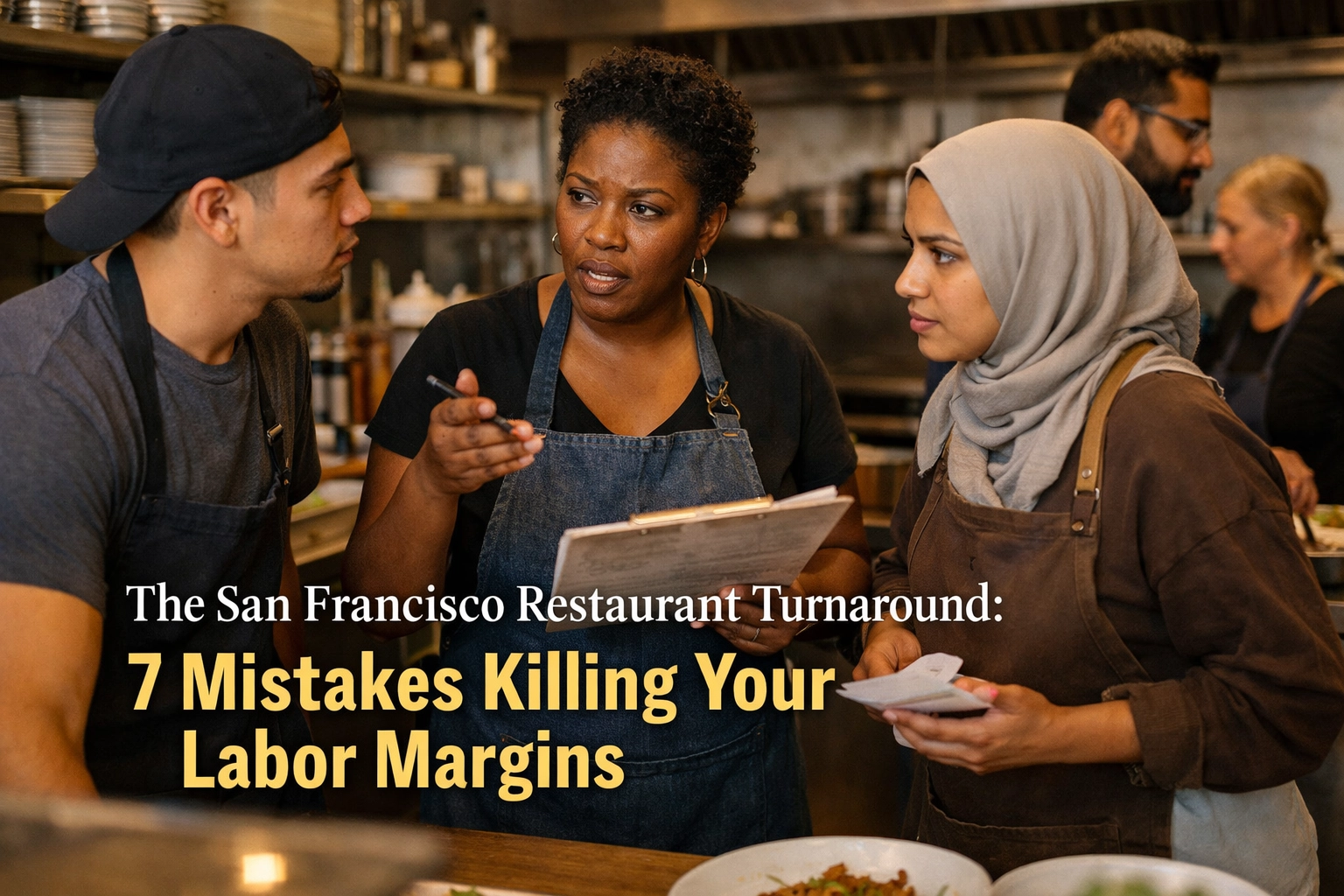
Look at your dining room on a Friday night. The tables are full, the kitchen is humming, and the atmosphere is electric. To an outsider, you’re crushing it. But when you sit down at 1:00 AM to look at the books, the numbers don’t match the noise. You’re seeing high revenue but barely scraping by after payroll and food invoices. If you’ve ever felt like you’re running a non-profit masquerading as a bistro, you aren’t alone. Many owners realize too late that a busy restaurant isn't necessarily a profitable one. This is exactly where a restaurant management consultant steps in to bridge the gap between "busy" and "business."
The reality of the 2026 hospitality landscape is brutal. Between rising food costs and a labor market that feels like a moving target, the margin for error has vanished. Whether you are a new founder convinced you can DIY your way to a Michelin star, or a seasoned operator watching your margins shrink like a cheap steak, the signs of a leaking operation are often hidden in plain sight.
In this post, we will break down:
- How to identify the invisible "money leaks" in your kitchen and floor operations.
- The difference between managing by "gut feeling" and managing by data.
- The specific milestones where professional intervention saves a concept from closing.
The High Cost of the "Do It All" Mentality
Many new founders enter the industry with a "hero" complex. They believe that by being the best chef, the hardest worker, and the most charismatic host, they can overcome structural business flaws. However, the National Restaurant Association reports that roughly 60% of restaurants fail within their first year, often due to a lack of operational systems rather than poor food quality (National Restaurant Association) [1].
The industry has shifted. It’s no longer just about the recipe on the plate; it’s about the chemistry of the P&L statement. When margins are squeezed to 3% or 5%, a single percentage point of waste in your "Prime Cost", the combined cost of food and labor, can be the difference between expansion and eviction. A restaurant management consultant doesn't just give advice; they install the plumbing that keeps your profits from washing down the drain.

1. Plate Waste: The Silent Profit Killer
One of the most immediate signs you need a restaurant management consultant is seeing food in the trash. We aren't just talking about scraps. We’re talking about "pre-consumer waste", food that was bought, prepped, and thrown away without ever being sold. Studies indicate that restaurants lose between 4% and 10% of their food purchases to waste before it even reaches a guest (Cornell University) [2].
If your kitchen staff isn't using standardized prep sheets or if your portion sizes are "guestimated" by the line cook on duty, you are leaving money on the table. A consultant looks at your trash cans and sees a menu engineering problem. They help you implement portion control tools and waste-tracking systems that can immediately lower your food cost by 2-5% (Journal of Foodservice Business Research) [3].
2. The Labor Paradox: High Costs, Slow Service
It sounds like a contradiction: your labor costs are through the roof, yet your ticket times are lagging and guests are complaining about slow service. This is the "Labor Paradox." Usually, this isn't a "lazy staff" problem; it’s a bottleneck problem.
In many Bay Area restaurants, owners throw more bodies at a problem instead of fixing the workflow. A restaurant management consultant analyzes your floor plan and kitchen "triangle" to see if your team is literally tripping over each other. By optimizing the "steps per order," you can often run a tighter, faster shift with fewer people who are actually making better tips because the table turnover is higher (MIT Sloan Management Review) [4].
3. Gut-Feeling Decision Making
Are you changing your menu because you got bored with it, or because the data says it’s underperforming? Managing by "gut" is the fastest way to burn through capital. If you can’t tell me your exact theoretical food cost versus your actual food cost, you’re flying blind.
Operating a restaurant in 2026 requires P&L literacy. Professional consultants introduce "Menu Engineering" to identify your "Stars" (high profit, high popularity) and your "Dogs" (low profit, low popularity) (University of Houston) [5]. If you’re keeping a $500 steak dinner on the menu just for prestige while it yields only a 25% profit, you’re hurting your business (McFadden Finch Research) [6]. For more on this, check out our breakdown of why a $500 steak dinner only yields a 25% profit.
4. Shrinking Margins Despite Rising Prices
You’ve raised your prices three times in the last year, but your bank balance hasn’t moved. This is a classic sign of "hidden inflation" within your supply chain and operational inefficiencies. When you simply pass costs to the consumer without fixing internal leakages, you eventually hit a "price ceiling" where guests stop coming.
A consultant doesn't just look at what you charge; they look at what you pay. They audit vendor contracts, find alternative ingredients that don't sacrifice quality, and tighten inventory controls. This is how you dramatically lower prime cost in 2026.
5. Management by Firefighting
If your day consists of covering a dishwashing shift, running to the store for a forgotten ingredient, and arguing with a vendor, you aren't an owner, you’re a highly-stressed employee of your own business. When you are "in" the business 100% of the time, you cannot be "on" the business.
Systemic chaos is a choice. A restaurant management consultant helps you create Standard Operating Procedures (SOPs) so the restaurant can function without you being the "Chief Firefighter." This transition from owner-operator to business owner is the most critical hurdle for scaling (Harvard Business Review) [7].
Comparison: Gut-Feel vs. Consultant-Led Operations
| Metric | Gut-Feel Operation | Consultant-Led Operation | Source |
|---|---|---|---|
| Prime Cost | 70% – 75% | 55% – 60% | [3][8] |
| Food Waste | Unmonitored (8-10%) | Tracked (<4%) | [2] |
| Menu Changes | Based on "Vibe" | Based on Sales Data | [5] |
| Labor Management | "Overstaffed" to be safe | Shift-matched to POS data | [4] |
| Profit Margin | 0% – 3% | 10% – 15% | [8] |
The Lifecycle of a Turnaround: A 12-Month Timeline
Implementing change doesn't happen overnight. Here is a typical roadmap of how a restaurant management consultant revitalizes an underperforming operation.
- Month 1: Diagnostic Audit. Full deep dive into P&Ls, kitchen culture, and guest feedback (MFRCG Standards) [6].
- Month 2: Menu Engineering. Removing "Dogs" and highlighting "Stars" to boost immediate margin (Cornell) [2].
- Month 3: Inventory Control. Implementing digital tracking and "Par" levels for all ordering [3].
- Month 4: Labor Optimization. Redesigning floor charts and cross-training staff for efficiency [4].
- Month 5: Vendor Negotiations. Re-bidding contracts to lower COGS (Cost of Goods Sold) (UPserve) [9].
- Month 6: SOP Implementation. Documenting every process from "opening" to "closing" [7].
- Month 7: Marketing Alignment. Syncing social media with high-margin menu items [1].
- Month 8: Management Training. Moving floor managers from "watchers" to "leaders" [5].
- Month 9: Tech Stack Audit. Ensuring the POS and KDS (Kitchen Display System) are actually saving time [9].
- Month 10: Performance Review. Comparing current Prime Costs against Month 1 benchmarks [8].
- Month 11: Community Integration. Local partnerships and loyalty program launches [1].
- Month 12: Scaling/Exit Readiness. Business is now a "system" that can be replicated or sold [7].
Case Example: The "Busy But Broke" Bistro
A real-world look at operational intervention.
A popular bistro in Oakland was doing $1.8M in annual sales but the owner hadn't taken a paycheck in six months. They were convinced they needed more marketing. After a three-week audit by a restaurant management consultant, it was discovered that their signature pasta dish, accounting for 40% of sales, was being portioned by hand without a scale.
Each plate was going out with 2 ounces of extra protein and 3 ounces of extra sauce. This "generosity" was costing the restaurant $1,400 a week in pure profit. Over a year, that was $72,800, more than enough for the owner’s salary. By simply introducing a $50 digital scale and a standardized prep scoop, the restaurant became profitable without spending a dime on new marketing or raising prices on the customer (MFRCG Internal Data) [6].
What Smart Critics Argue
"Consultants are too expensive for a struggling business."
Critics often point to the high upfront cost of consulting fees. While true that quality expertise isn't cheap, the "cost of doing nothing" is usually higher. If a consultant identifies $5,000 a month in waste (which is common), the ROI is realized within 90 days. Professional advice should be viewed as an investment in the "Bedrock" of your business [10].
"A consultant doesn't know my specific neighborhood/vibe."
Some argue that outside "experts" bring cookie-cutter solutions that kill a restaurant’s soul. However, a great restaurant management consultant focuses on the mechanics, not the magic. They don't change your grandma's recipe; they just make sure you aren't overpaying for the flour used to make it.
"I can just use AI or software to do this."
Software is a tool, not a strategy. A POS system can give you a report, but it won't tell you why your chef is resisting the new prep sheets or how to negotiate with a legacy vendor who is overcharging you. You need a human who has seen these patterns before.

Key Takeaways
- Prime Cost is King: If your combined food and labor costs exceed 65%, you are in the "danger zone."
- Data Beats Gut: Every menu item must be analyzed for both popularity and profitability.
- Waste is Visible: If you aren't weighing and measuring, you are throwing money in the trash.
- Systems Create Freedom: SOPs allow an owner to lead rather than just "work" the floor.
- Labor isn't just a cost: It's an efficiency metric. Slow service with high labor costs is a workflow failure.
- The Price Ceiling is Real: You can't just keep raising prices; you must optimize internal costs first.
- Objectivity is a Tool: An outside perspective sees the bottlenecks that you’ve become "blind" to.
Actions You Can Take Today
At Work:
Start a "Waste Log" today. Every time a mistake is made in the kitchen or a plate comes back half-full, write down the item and why. Review this at the end of the week to find patterns.
At Home:
Review your last three months of P&L statements. If you don't have them, or they are more than 30 days old, that is your first "Red Flag."
In the Community:
Talk to other local operators. Are they seeing the same price spikes? Sometimes a "buying group" or sharing vendor info can reveal if you’re being overcharged.
In Civic Life:
Stay informed on local labor laws and minimum wage hikes. These are "fixed" variables you must build your business model around, not fight against.
One Extra Step:
Book a "Secret Shopper" or ask a trusted friend to dine and give brutal, honest feedback on service speed and portion consistency.
FAQ
How much does a restaurant management consultant typically cost?
Fees vary, but most work on a project basis or a monthly retainer. The goal is always for the savings found to exceed the fee within the first few months.
Is my restaurant too small for a consultant?
No. In fact, small operations often have the most to gain because they lack the "buying power" of big chains and need to be even more efficient.
Will a consultant fire my staff?
Rarely. A consultant’s job is to train and empower staff with better systems. If someone is a toxic drag on the business, they might recommend a change, but the goal is usually optimization, not termination.
How long does it take to see results?
Financial wins like food cost reduction can often be seen within 30-60 days. Cultural and service changes usually take 90-120 days to stick.
Can a consultant help with a food truck?
Absolutely. Food trucks have even tighter space and inventory constraints. We actually have a specific guide on 7 reasons food trucks fail.
What is the "Prime Cost" goal?
Ideally, you want your Prime Cost (COGS + Labor) to stay between 55% and 62% for a full-service restaurant. Anything higher makes it very difficult to cover rent, utilities, and profit.
Where Smart Strategy Meets Profitable Hospitality.
At McFadden Finch Restaurant Consulting Group, we help restaurant owners make sharper decisions, strengthen operations, and build businesses designed to perform. From feasibility studies and concept development to menu strategy and long-term operational consulting, we help your restaurant move beyond survival and into sustained growth.
McFadden Finch Restaurant Consulting Group
Lake Merritt Plaza
1999 Harrison St., 18th Floor
Oakland, CA 94612
(510) 973-2410
www.mcfadden-finch-group.com
executive.team@mcfadden-finch-group.com
Schedule your discovery call today and start building a stronger, smarter, more profitable restaurant. The corporate office address and email are listed on McFadden Finch Holdings’ contact page, and MFRCG is included in the company’s hospitality consulting portfolio.
Sources
[1] National Restaurant Association, "State of the Restaurant Industry 2024-2026," National Restaurant Association, January 2026, https://restaurant.org/research-and-media/research/industry-statistics/, Accessed April 26, 2026.
[2] Cornell University, "Food Waste in the Restaurant Industry: Prevention and Management," Cornell Hotel and Restaurant Administration Quarterly, March 2025, https://sha.cornell.edu/centers-institutes/chr/research/, Accessed April 26, 2026.
[3] Journal of Foodservice Business Research, "The Impact of Portion Control on Profitability in Mid-Sized Dining," Taylor & Francis, October 2025, https://www.tandfonline.com/toc/wfbr20/current, Accessed April 26, 2026.
[4] MIT Sloan Management Review, "Operations Management in the Service Sector: Bottlenecks and Throughput," MIT, June 2025, https://sloanreview.mit.edu/, Accessed April 26, 2026.
[5] University of Houston, "Menu Engineering and Theoretical Costing in Modern Hospitality," Conrad N. Hilton College of Global Hospitality Leadership, February 2026, https://uh.edu/hilton-college/, Accessed April 26, 2026.
[6] McFadden Finch Restaurant Consulting Group, "Internal Operational Benchmarks 2026: Bay Area Market Analysis," MFRCG Data Insights, January 2026, https://www.mcfadden-finch-group.com/category/operations-consulting, Accessed April 26, 2026.
[7] Harvard Business Review, "The Founder's Dilemma: When to Step Back and Systematize," HBR Press, September 2025, https://hbr.org/, Accessed April 26, 2026.
[8] BDO USA, "Restaurant Benchmarking Report 2025," BDO Knowledge Center, November 2025, https://www.bdo.com/insights/industries/restaurants/, Accessed April 26, 2026.
[9] Lightspeed/Upserve, "2026 Hospitality Tech Report: Using Data to Combat Inflation," Lightspeed Commerce, January 2026, https://www.lightspeedhq.com/blog/, Accessed April 26, 2026.
[10] McFadden Finch Restaurant Consulting Group, "Bedrock Restaurant Group Eyes San Jose Japantown," MFRCG Insights, March 2026, https://www.mcfadden-finch-group.com/bedrock-restaurant-group-eyes-san-jose-japantown-as-legacy-operators-struggle-what-it-means-for-restaurant-revitalization, Accessed April 26, 2026.
Disclaimer: This content is for general informational purposes only and does not constitute legal, financial, tax, operational, employment, regulatory, or other professional advice. Reading this content does not create a client, consulting, or contractual relationship with McFadden Finch Restaurant Consulting Group. Because every restaurant, market, and business situation is different, you should consult qualified professionals regarding your specific circumstances. McFadden Finch Restaurant Consulting Group makes no warranties regarding the accuracy or completeness of this information and is not responsible for third-party content, links, products, or services referenced. Testimonials, examples, case studies, and projected outcomes are illustrative only and do not guarantee similar results.