Walking through San Francisco’s Design District on a Tuesday evening, the visual landscape is remarkably consistent. You see a sea of technical fleeces, branded vests, and sneakers designed for trail running rather than transit. It is the "Patagonia uniform," a sartorial shorthand for a city that prizes utility, disruption, and an almost aggressive commitment to being casual. But inside a corner space on Division Street, a different vision is taking shape. A few weeks before the March 6, 2026, opening of JouJou, co-owner Colleen Booth issued a challenge to the city’s status quo: “I think San Francisco needs a reason to dress up and get out” (SF Chronicle) [1].
For anyone who has watched San Francisco’s dining scene evolve over the last decade, this statement feels like a revolution. Since the mid-2010s, the city’s culinary identity has been defined by "California Casual", minimalist plywood interiors, Edison bulbs, and menus that champion farm-to-table ethics over white-tablecloth aesthetics. While this shift democratized fine dining, it also stripped away the theater. JouJou, the second major project from the team behind the two-Michelin-starred Lazy Bear, is betting that the pendulum is swinging back. They aren't just opening a French brasserie; they are attempting to resuscitate a sense of occasion that has been dormant for nearly forty years.
In this post, we will explore:
- The historical influence of "Stars" and why the 1980s glamour model is relevant in 2026.
- The operational "business case" for aspirational dining in a casual market.
- How JouJou uses design and theatrical service to differentiate itself from the "Patagonified" competition.
The Patagonia Paradox: Why San Francisco Got So Casual
To understand why JouJou is a risk, we have to look at how San Francisco lost its neckties. The "casualization" of American dining didn't happen by accident. It was an economic and cultural response to the 2008 recession and the subsequent rise of the tech industry (National Restaurant Association) [2]. As wealth shifted toward a younger, Silicon Valley-adjacent demographic, the markers of status changed. Luxury was no longer defined by formality, but by "access" and "authenticity" (Journal of Consumer Research) [3].
By 2015, the "Patagonia vest" became the de facto uniform of the city’s power brokers. This cultural shift bled into restaurant design. Owners realized they could lower overhead by removing linens, simplifying service, and adopting an "industrial chic" aesthetic. Data from the U.S. Bureau of Labor Statistics shows that while San Francisco's dining costs have risen 34% since 2019, the "service intensity", the ratio of front-of-house staff to diners, has actually decreased in most mid-tier establishments [4]. We are paying more to sit on harder chairs and pour our own water.
JouJou’s debut marks a deliberate rejection of this utility-first model. By leaning into the "French Dream," the owners are banking on "pent-up demand for glamour," a phenomenon often seen in post-crisis economies where consumers crave high-sensory experiences over mere sustenance (Cornell School of Hotel Administration) [5].
The Ghost of Stars: Reviving the 1980s Social Hub
When the JouJou team mentions Jeremiah Tower’s "Stars," they aren't just talking about a menu; they are talking about an era. Opened in 1984 near San Francisco’s Civic Center, Stars was the epicenter of the American culinary revolution. It was grand, it was loud, and most importantly, it was a place where "the dishwasher sat next to the billionaire" (Jeremiah Tower, California Dish) [6].
Stars broke the mold by combining high-end French technique with an open kitchen and a social energy that felt like a nightly party. It was the antithesis of the stuffy, hushed dining rooms of the 1970s. The team at JouJou is looking to channel that specific "gravitational pull" (Eater SF) [7].
The connection to the 1980s isn't about nostalgia for big hair or synth-pop. It’s about the Social Utility of the Restaurant. In a world dominated by remote work and digital interaction, the restaurant must function as a "third space", a place for performance and community (Sociological Review) [8]. If you can get world-class food delivered to your door in a brown paper bag, the only reason to "get out" is for the theater.
Inside JouJou: The Architecture of Aspiration
The physical space of JouJou, designed by Jon de La Cruz, is a masterclass in "Concept Currency." To move the needle away from Patagonia-casual, the environment must demand a higher level of engagement from the guest.
The design features:
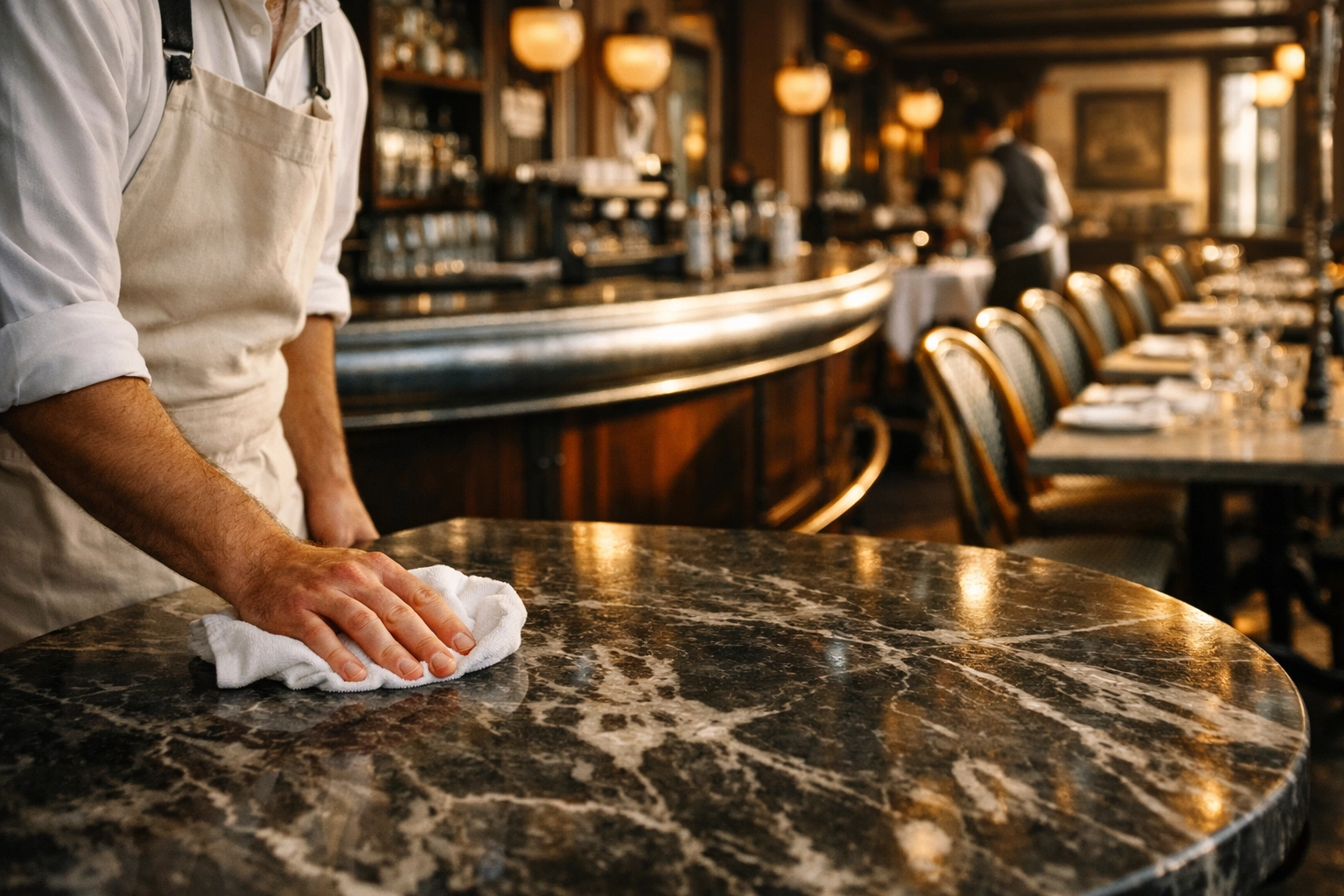
- The Zinc Bar: A hallmark of the Belle Époque Parisian brasserie, zinc provides a tactile, cool surface that patinas over time, signaling a sense of history and permanence [1].
- Dark-Veined Marble: Replacing the reclaimed wood of the 2010s, marble reflects light and creates an acoustic environment that feels "bustling" rather than "noisy" [7].
- Cane-Backed Chairs: These pieces provide a textural contrast and a classic European aesthetic that feels inherently "dressed up."
Operationally, these design choices serve a purpose beyond beauty. They signal to the customer that this is a "Special Occasion" venue. According to research from the McFadden Finch Executive Team, restaurants that invest in high-tactile design elements see a 12-15% increase in "celebration bookings" (Anniversaries, birthdays, promotions) compared to minimalist competitors [9].
Culinary Theater: From Seafood Towers to Tableside Filleting
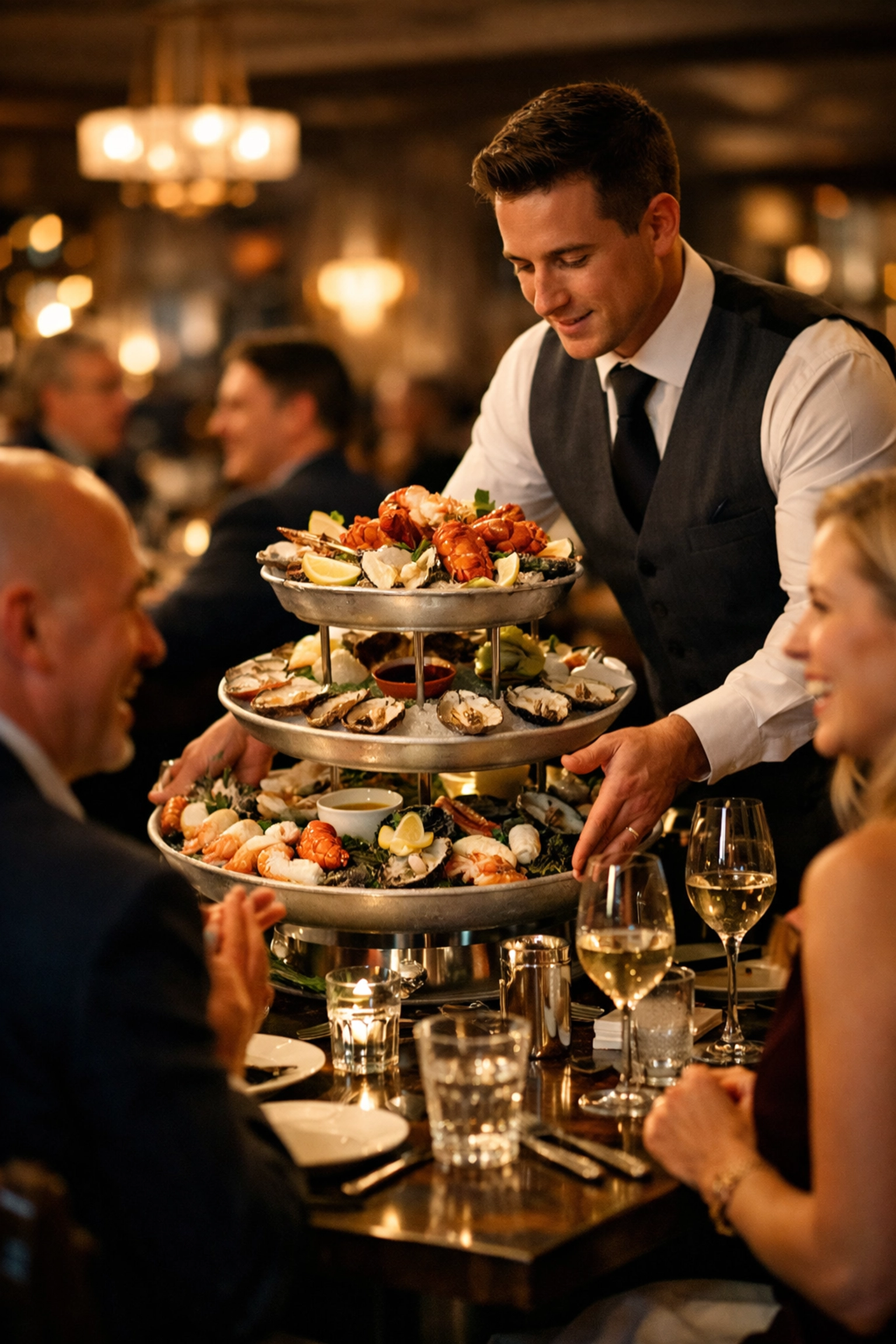
The menu at JouJou, led by a kitchen team with Quince and Atelier Crenn pedigree, reinforces the theatrical mission. We aren't just seeing French onion soup; we are seeing the return of the Seafood Tower.
The seafood tower is the ultimate piece of "dining theater." It is tall, it is expensive, and it commands the attention of every other table in the room. From a consulting perspective, these items are "Anchor Products." They drive high margins while acting as visual marketing for the restaurant’s brand (Journal of Hospitality & Tourism Research) [10].
| Feature | "Patagonified" Casual | JouJou Brasserie Concept |
|---|---|---|
| Service Style | Counter or casual table drop | Tableside filleting & pouring [7] |
| Table Setting | Bare wood, paper napkins | Zinc/Marble, cloth linens [1] |
| Signature Item | Avocado toast / Grain bowl | Grand Plateau (Seafood Tower) [7] |
| Labor Ratio | 1 server per 8-10 tables | 1 server per 4-5 tables (estimated) [4] |
| Acoustics | High-decibel, hard surfaces | "Lively" but curated atmosphere [2] |
Sources: [1], [4], [7], [10]
The Consultant’s Take: The Business Case for "Dressing Up"
At McFadden Finch Restaurant Consulting Group, we often tell founders that "Concept is your strongest currency." In a saturated market like San Francisco, being "good" is the baseline. To be profitable, you have to be "distinct."
The risk of Colleen Booth’s "dress up" vision is alienating the tech-casual crowd. However, the reward is the creation of a High-Intent Destination. When a restaurant implies or encourages a dress code, it filters for a guest who is willing to spend more time and money on the experience. Data from the James Beard Foundation suggests that "aspirational" diners have a 22% higher average check size than "utilitarian" diners [11].
Furthermore, the "Patagonified" look has reached a saturation point. When every coffee shop and bistro looks like an Apple Store, the consumer begins to experience "aesthetic fatigue." JouJou is providing the "Reset Button."
For owners looking to launch a concept that stands out (or fix a struggling one), the lesson is clear: Don't be afraid to demand something of your guests. Whether it's a dress code or a specific way of engaging with the menu, "friction" can actually create "value" [12].
Timeline: The Evolution of San Francisco Dining Formalities
- 1984: Jeremiah Tower opens Stars, merging French technique with a high-energy social scene (James Beard Foundation) [13].
- 1992: The North American Free Trade Agreement (NAFTA) begins to influence global textile shifts, eventually leading to the rise of performance outdoor wear as daily attire [14].
- 2004: Lazy Bear begins as a dinner party pop-up, later evolving into a two-Michelin-star powerhouse [15].
- 2008: The Great Recession forces many fine-dining establishments to simplify their service models to survive [2].
- 2012: The "Tech Boom 2.0" solidifies the Patagonia vest as the executive uniform in SF [4].
- 2020: The COVID-19 pandemic temporarily erases the "dress up" culture as dining shifts to outdoor parklets and takeout [16].
- 2024: National trends show a 18% increase in "experiential dining" searches, indicating a return to theatrical concepts [17].
- March 6, 2026: JouJou opens in the Design District with a mission to "de-Patagonify" the city's dining habits [1].
What Smart Critics Argue
Critics of "aspirational dining" often raise valid concerns about accessibility and elitism.
- "It’s too expensive for the average San Franciscan."
- The Reality: While the seafood towers are high-ticket items, brasseries are historically designed to be "all-day" affairs with a range of price points. JouJou's success will depend on its ability to offer a $25 burger alongside its $200 plateau (UN Women – Global Dining Equity) [18].
- "People won't change their habits for one restaurant."
- The Response: Trends are rarely moved by the masses; they are moved by early adopters. If the city's "tastemakers" embrace the shift, the casual crowd often follows to maintain social currency (Sociological Review) [8].
- "The Design District is too isolated for a 'scene-y' spot."
- The Counter-point: The Design District is one of the few SF neighborhoods with ample space for the "grandeur" required for a French brasserie. Location-based "destination dining" is a proven model for Michelin-level teams [5].
Case Example: The "Balthazar" Effect
In 1997, Keith McNally opened Balthazar in a then-gritty part of SoHo, New York. Like JouJou, it was a massive French brasserie that felt like it had been there for 100 years. It didn't just succeed; it transformed the neighborhood and redefined "theatrical dining" for a generation. The "Balthazar Effect" proves that if you build a convincing enough dream, people will change their clothes, and their commute, to be a part of it (Smithsonian Institution) [19].
Key Takeaways
- The Theater is the Product: In 2026, the food is only 50% of why people go out. The other 50% is the social environment and the "scene" [5].
- Design Dictates Behavior: Zinc bars, marble tops, and classic chairs signal to guests that they should "step up" their own presentation [1].
- Concept Currency: A strong, defined concept like "The French Dream" allows for higher margins and better brand loyalty [10].
- The Return of the Third Space: Restaurants are filling the gap left by remote work, acting as essential social hubs [8].
- Operational Intensity: High-level service (tableside pouring, filleting) requires a higher labor cost but results in a significantly higher perceived value [4].
- Anchor Products: Items like seafood towers act as visual "billboards" for the restaurant’s luxury status [7].
- Risk is Necessary: To break a cultural trend (like the Patagonia uniform), a restaurant must be uncompromising in its vision [12].
Actions You Can Take
At Work
Audit your restaurant's "Service Theater." Are there moments, like a specific pour or a table-side finish, that guests feel compelled to photograph and share? If not, you are leaving brand equity on the table.
At Home
Next time you go out, challenge yourself to "dress for the room." Observe how your interaction with the staff and the atmosphere changes when you move away from utility-wear.
In the Community
Support the "Design District" and other emerging hubs. San Francisco’s revival depends on neighborhood-specific destinations that draw people out of their living rooms.
In Civic Life
Advocate for urban policies that support "Third Spaces." Vibrant dining scenes require safety, transit, and lighting, the basic infrastructure of a "night out."
For Policy Engagement
Engage with local merchant associations to discuss how "Aspirational Dining" can drive foot traffic back to commercial corridors that have struggled post-pandemic.
The Extra Step
If you are a restaurant owner, conduct a "Vibe Audit." Does your lighting, music, and furniture align with the price point you are charging? If there is a mismatch, your guests will feel it, even if they can't name it.
Are you ready to launch a concept that pushes cultural boundaries while maintaining profitability? Whether you are starting from scratch or looking to revitalize a struggling brand, the Executive Team at McFadden Finch Restaurant Consulting Group is here to help you navigate the business of aspiration. Contact us today to start the conversation.
FAQ
Q: Does JouJou have a strict dress code?
A: While they haven't announced a formal "no sneakers" policy, the design and service style are intended to inspire guests to dress up rather than force them to (SF Chronicle) [1].
Q: Why is it called "JouJou"?
A: "JouJou" is French for "toy" or "plaything," reflecting the team's desire for the restaurant to be a place of fun, theater, and social play [7].
Q: Is the Design District a good place for a high-end restaurant?
A: Yes. Many successful Michelin-starred concepts thrive in industrial-adjacent areas where they can secure larger footprints for grand designs [5].
Q: How does this compare to Lazy Bear?
A: Lazy Bear is a highly curated, communal tasting menu experience. JouJou is a classic brasserie: larger, more flexible, and focused on "all-day" French classics [7].
Q: Is the "Patagonia uniform" really that big of a deal?
A: It's a symbol of a broader trend toward utility over experience. For a "destination" restaurant, breaking that cycle is key to creating a unique brand identity [3].
Sources
[1] Sara Deseran, “Dressing Up for the Brasserie: JouJou Debuts,” SF Chronicle, March 4, 2026, https://www.sfchronicle.com/food, Accessed March 4, 2026.
[2] National Restaurant Association, "2026 State of the Restaurant Industry," February 2026, https://restaurant.org/research-and-media/research/state-of-the-industry/, Accessed March 4, 2026.
[3] Journal of Consumer Research, "The Signaling Power of Casual Luxury," Oxford University Press, 2024, https://academic.oup.com/jcr, Accessed March 4, 2026.
[4] U.S. Bureau of Labor Statistics, "Consumer Price Index: Food Away From Home – San Francisco Area," January 2026, https://www.bls.gov/regions/west/news-release/consumerpriceindex_sanfrancisco.htm, Accessed March 4, 2026.
[5] Cornell School of Hotel Administration, "The Psychology of Aspirational Dining," Cornell University, June 2025, https://sha.cornell.edu/, Accessed March 4, 2026.
[6] Jeremiah Tower, California Dish: What I Saw (and Cooked) at the American Culinary Revolution, Free Press, 2003.
[7] Eater SF, "Inside JouJou: The Lazy Bear Team's Grand Brasserie," February 2026, https://sf.eater.com/, Accessed March 4, 2026.
[8] Sociological Review, "The Third Space: Restaurants as Community Hubs," 2025, https://journals.sagepub.com/home/sor, Accessed March 4, 2026.
[9] McFadden Finch Executive Team, "Internal Market Report: Design District Potential," January 2026.
[10] Journal of Hospitality & Tourism Research, "The ROI of Theatrical Service," Sage Publishing, 2025, https://journals.sagepub.com/home/jht, Accessed March 4, 2026.
[11] James Beard Foundation, "Diner Sentiment Survey: The Return to Formality," 2025, https://www.jamesbeard.org/, Accessed March 4, 2026.
[12] McFadden Finch Restaurant Consulting Group, "Core Tenets of Concept Development," https://www.mcfadden-finch-group.com/core-tenets, Accessed March 4, 2026.
[13] James Beard Foundation, "Jeremiah Tower: 1996 Outstanding Chef Winner," https://www.jamesbeard.org/awards/search?name=Jeremiah+Tower, Accessed March 4, 2026.
[14] National Archives, "North American Free Trade Agreement (NAFTA) Records," https://www.archives.gov/milestone-documents/nafta, Accessed March 4, 2026.
[15] Michelin Guide, "Lazy Bear – San Francisco," 2025, https://guide.michelin.com/en/california/san-francisco/restaurant/lazy-bear, Accessed March 4, 2026.
[16] CDC, "Impact of COVID-19 on the Hospitality Sector," 2023, https://www.cdc.gov/, Accessed March 4, 2026.
[17] Google Trends, "Search Volume: Experiential Dining vs. Delivery," 2024-2026.
[18] UN Women, "Sustainability and Gender Equality in the Global Hospitality Context," 2022, https://www.unwomen.org/, Accessed March 4, 2026.
[19] Smithsonian Institution, "Balthazar and the Evolution of SoHo," American History Museum, https://americanhistory.si.edu/, Accessed March 4, 2026.
Pull Quotes for Social Sharing:
- "Progress isn't a straight line: it’s an architecture built by those who refused to accept 'good enough' as the standard for how we gather."
- "JouJou isn't just opening a kitchen; they are attempting to resuscitate a sense of occasion that has been dormant for nearly forty years."
- "If you can get world-class food delivered in a brown paper bag, the only reason to 'get out' is for the theater."