Credit: Leslie Collins, Kansas City Business Journal
Hawaiian Bros went from 25 restaurants in March 2022 to 74 locations across 14 states by January 2026. The company now has signed franchise development agreements for more than 250 future restaurants. Their chief development officer, Carey Malloy Bendoraitis, stated plainly: "I think we can be a 2,000-plus chain."
Scaling to 2,000 units is not a pipe dream. It is a process. This article breaks down the operational and strategic decisions driving Hawaiian Bros' expansion and what restaurant founders can apply to their own growth plans.
The Numbers Behind the Growth
Hawaiian Bros reports the following performance metrics:
- Average unit volume (AUV): $2.5 million annually
- Top 20% of locations: More than $3.5 million annually
- Employees per shift during peak hours: 6-8
- Current restaurant count: 74
- Target for 2026: 100+ locations
- Pipeline additions: 250+ units annually over the next three years
These figures represent the output of deliberate decisions around menu engineering, partner selection, and operational infrastructure.
Lesson 1: Operational Simplicity Equals Higher Margins
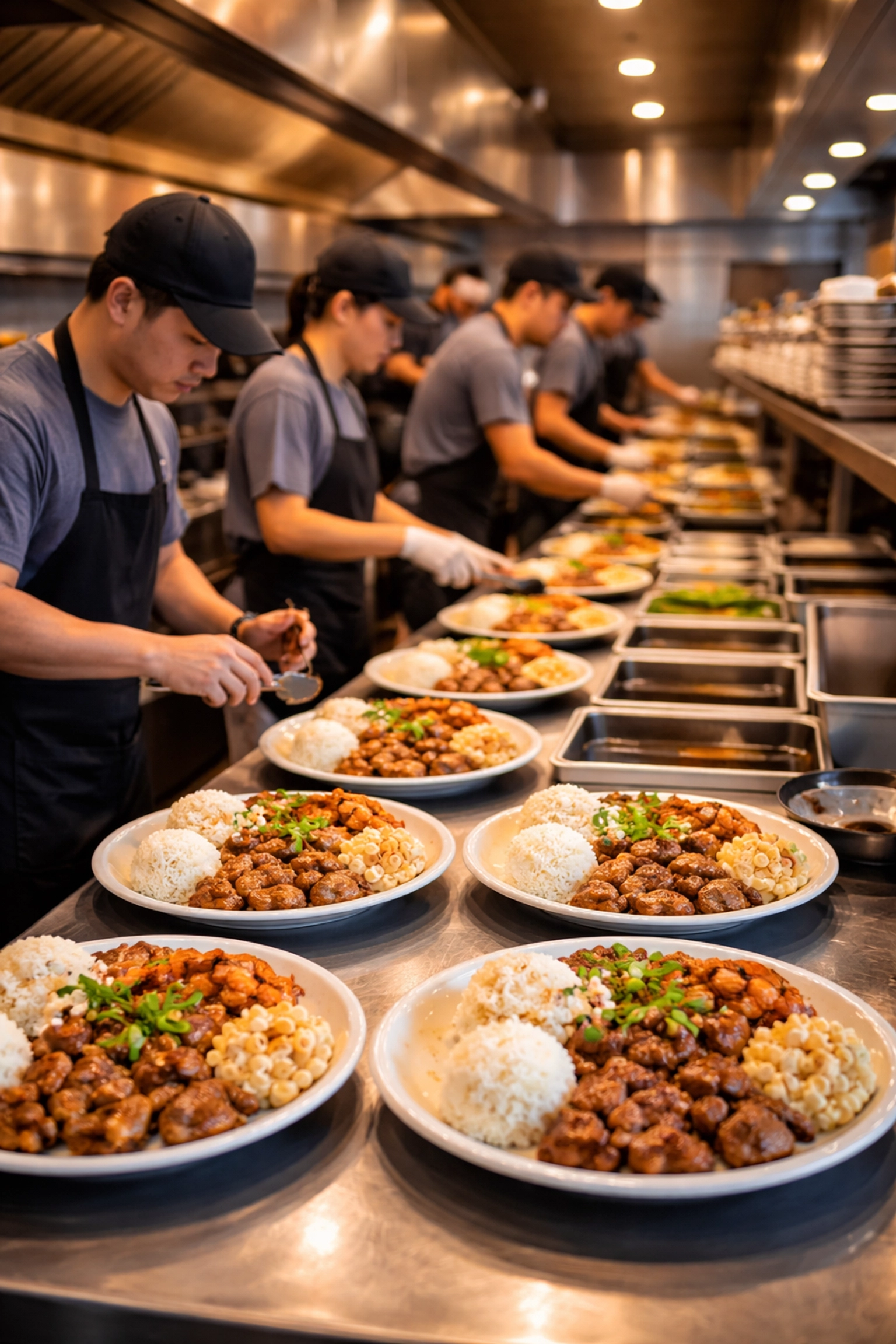
Hawaiian Bros specializes in traditional Hawaiian plate lunches. The menu is simple and straightforward. This design choice directly impacts labor costs and throughput speed.
How Menu Simplicity Reduces Labor Requirements
A limited menu means:
- Fewer ingredients to manage
- Shorter training periods for new staff
- Faster ticket times
- Reduced errors during peak hours
Hawaiian Bros operates with 6-8 employees per shift during busy periods. For comparison, many fast-casual concepts require 12-15 employees for similar volume levels.
"We're not another burger chain. We're different," Bendoraitis stated.
Financial Impact
Lower labor-per-shift translates directly to improved margins. When average unit volume reaches $2.5 million with minimal staffing, the unit economics become attractive to franchisees and investors.
Takeaway for operators: Before scaling, audit your menu for complexity. Every additional SKU adds labor, training time, and potential for operational errors. Menu development consulting can identify items that reduce efficiency without proportional revenue contribution.
Lesson 2: The Two-Way Street of Vetting
Hawaiian Bros does not accept every franchisee applicant. They conduct due diligence on potential partners using methods typically reserved for operator audits.
The Mystery Shopping Approach
Before signing agreements, Hawaiian Bros conducts mystery shopping at a prospective franchisee's existing restaurants. They also review Google ratings and operational standards.
"We've turned people down when we've gone to mystery shop," Bendoraitis said. "If somebody isn't investing in their current brand and maintaining their own brand standards, it's hard to imagine they'll be treating our brand differently."

Selection Criteria
Hawaiian Bros targets franchisees with:
- Multi-unit operational experience
- Strong brand standards at existing locations
- Financial capacity for development agreements
- Alignment with company values
Notable partnerships include MRCO, a Taco Bell franchisee planning 34 Hawaiian Bros locations, and another franchisee with a 100-unit development agreement.
Why This Matters for Smaller Operators
Operators seeking to franchise their concept often focus on signing deals quickly. Hawaiian Bros demonstrates that selectivity protects brand value over time.
"For us, it's not just about signing a deal to build more restaurants. It's about making sure that we're building with the right people," Bendoraitis said.
Takeaway for operators: Develop a franchisee vetting protocol before pursuing franchise expansion. Document minimum requirements for financial capacity, operational history, and brand alignment.
Lesson 3: Building the Support Infrastructure
Rapid scaling requires support systems. Hawaiian Bros provides hands-on assistance to franchisees in three core areas.
Site Selection
Location determines unit performance. Hawaiian Bros assists franchisees with site analysis to identify locations with appropriate traffic patterns, demographics, and visibility.
The company employs flexible prototypes including drive-thru-forward designs, in-line conversions, endcap conversions, and select ghost kitchen models. This flexibility removes real estate as a bottleneck.
Restaurant Design and Buildout
Standardized design reduces construction timelines and ensures brand consistency. Hawaiian Bros manages design support to maintain operational efficiency across all locations.
Training Teams
Hawaiian Bros deploys training teams to new restaurants before and after opening. This investment reduces early-stage operational issues and establishes performance standards from day one.
"We want to make sure we're setting franchisees up for the best level of success," Bendoraitis said.
Takeaway for operators: Scaling requires documented systems for site selection, design, and training. These functions cannot be improvised during rapid growth. Restaurant feasibility studies establish the analytical foundation for site decisions.
Applying These Lessons to Your Concept
Restaurant founders considering scale should evaluate the following:
1. Audit Current Operations
- Document labor hours per revenue dollar
- Identify menu items with low margin or high complexity
- Measure ticket times during peak periods
2. Define Partner Standards
- Establish minimum requirements for franchisees or investors
- Create evaluation criteria beyond financial capacity
- Build assessment processes before receiving inquiries
3. Build Support Systems
- Document site selection criteria
- Standardize design specifications
- Develop training programs that can be deployed remotely
4. Test Before Expanding
Hawaiian Bros refined their model across 25 locations before accelerating growth. Unit economics must be proven before scaling.
Frequently Asked Questions
What is average unit volume (AUV)?
AUV represents the average annual revenue generated by a single restaurant location. Hawaiian Bros reports $2.5 million AUV across their system.
How many employees does a fast-casual restaurant typically need?
Staffing varies by concept complexity. Hawaiian Bros operates with 6-8 employees during peak hours due to menu simplicity. More complex concepts may require 12-15 or more.
What should I look for in a franchise partner?
Evaluate operational track record, financial capacity, brand standards at existing locations, and alignment with your company values.
When is a restaurant concept ready to franchise?
Concepts should demonstrate consistent unit economics across multiple locations, documented operational systems, and support infrastructure for training and site selection.
How does site selection impact restaurant performance?
Location affects traffic, visibility, rent costs, and market demographics. Restaurant consulting firms use feasibility analysis to evaluate potential sites before lease commitments.
Next Steps
Scaling a restaurant concept requires operational efficiency, partner selectivity, and support infrastructure. Hawaiian Bros demonstrates that 2,000-unit growth targets are achievable through disciplined execution.
Book a Concept Scalability Audit: Evaluate your operations for franchise readiness with MFRCG. Schedule a consultation.
Get the Franchise Vetting Checklist: Download our partner evaluation framework. Contact our team to request the resource.
McFadden Finch Restaurant Consulting Group provides restaurant consulting, menu development, and feasibility analysis for operators at all stages of growth.
#RestaurantConsulting #ScalingARestaurant #MenuDevelopment #RestaurantFeasibility #FranchiseDevelopment