Opening a restaurant in San Francisco, Oakland, or anywhere across the Bay Area in 2026 requires more than great food and ambition. The region's competitive dining landscape, complex permitting environment, and elevated operational costs demand a methodical approach. A successful restaurant opening checklist spans 4-8 months of pre-launch planning, covering legal compliance, location selection, kitchen design, operational systems, and team building.
The Bay Area's 2026 restaurant scene is thriving with diversity: from chef-driven concepts like JouJou to experiential venues like Dante's Inferno in Hayes Valley, and international flavors from Tai Er's Sichuan concept to Zareen's Pakistani-Indian expansion. This competitive environment rewards operators who plan thoroughly and execute with precision. Whether you're launching your first concept or expanding an established brand, this restaurant opening checklist breaks down exactly what you need to do, when you need to do it, and how to navigate Bay Area-specific challenges.
Phase 1: Concept Development and Feasibility (8+ Months Before Opening)
Before you sign a lease or order equipment, you need a solid foundation. Start with your business structure and registration decisions. Choose between an LLC, Corporation, or Partnership based on your liability protection needs and tax strategy. Register your business name, secure your domain, obtain your EIN, and set up business banking accounts. Purchase comprehensive business insurance covering general liability, property, workers' compensation, and liquor liability if applicable.
During this phase, develop your core operational strategies: menu concept and pricing, service style (fast-casual, full-service, counter-service), staffing requirements, and initial marketing approach. The Bay Area market shows strong demand for differentiated concepts: generic approaches struggle against established players and well-funded chains.
A restaurant feasibility study is non-negotiable in the Bay Area's expensive market. Analyze your target demographic, competitive density, location viability, and financial projections before committing capital. Map out realistic revenue scenarios, startup costs (typically $275,000-$425,000 for a small to mid-size restaurant), and time-to-profitability. Bay Area operators face higher costs across rent, labor, permits, and equipment compared to most U.S. markets.

Phase 2: Location Selection and Legal Compliance (4-8 Months Before Opening)
Location determines 50% of your success. In the Bay Area, evaluate foot traffic patterns, parking availability, proximity to your target customers, and competition density. Negotiate lease terms covering base rent, tenant improvement allowances (critical in older San Francisco or Oakland buildings), lease length, and assignment rights.
For how to open a restaurant in San Francisco or Oakland specifically, permit complexity exceeds most other markets. Secure these required licenses and permits:
- General business license from your local municipality
- Food service license from the county health department
- Liquor license (ABC Type 41, 47, or 48 depending on service model: expect 90-180 days processing time)
- Sales tax permit from California Department of Tax and Fee Administration
- Certificate of occupancy from the building department
Additional permits may include live entertainment licenses, outdoor seating permits (particularly valuable but regulated in San Francisco), and sign permits. Immersive concepts like Dante's Inferno required specific approvals for their rooftop bar component and entertainment elements.
Verify zoning and ADA compliance early. Bay Area municipalities have specific occupancy limits, building codes, parking restrictions, and noise limitations. Many historic San Francisco and Oakland buildings require substantial upgrades to meet current accessibility and safety standards.
Phase 3: Kitchen & Bar Design for Workflow Efficiency (6-8 Months Before Opening)
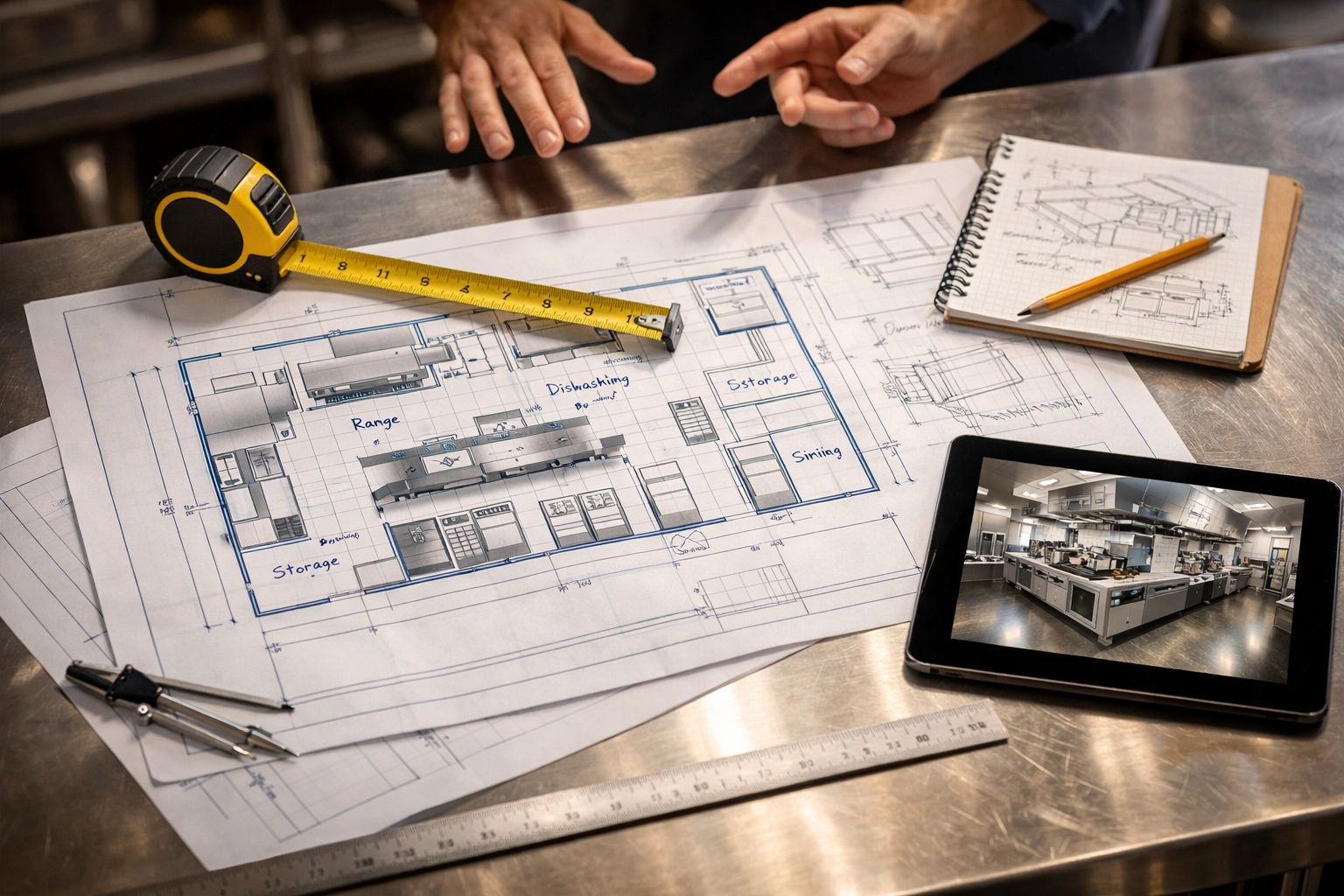
Commercial kitchen layout directly impacts your operational efficiency, labor costs, and menu execution speed. Work with a qualified designer to optimize workflow from receiving to plating. The (National Restaurant Association)[1] emphasizes that kitchen efficiency reduces labor costs by 15-25% compared to poorly designed spaces.
Essential kitchen equipment includes:
- Commercial refrigeration and freezer units sized for your menu and volume projections
- Cooking equipment: ovens, grills, fryers, ranges, salamanders
- Food prep stations with appropriate cutting surfaces and tools
- Three-compartment sinks plus hand-washing stations
- Food storage shelving and containers meeting health code requirements
For bar operations, plan for draft beer systems, wine storage (temperature-controlled for premium programs), appropriate glassware storage, ice machines (capacity matters), and secure liquor inventory systems.
Technology infrastructure integrates into your design phase. Install sufficient electrical capacity for POS terminals, kitchen display systems, WiFi networks covering dining and kitchen areas, security cameras, and payment processing equipment. The Bay Area's tech-savvy customers expect seamless digital experiences from ordering to payment.
Dining room design balances atmosphere with operational efficiency. Consider table spacing for service flow, lighting that adapts from lunch to dinner service, acoustics (particularly important in converted warehouse spaces common in Oakland), and safety equipment placement meeting fire code.
Our Kitchen & Bar Design Consulting service helps operators optimize layouts for maximum efficiency before construction begins.
Phase 4: Financial Projections and Pro Forma Development (6-8 Months Before Opening)
A detailed pro forma financial statement projects your revenue, costs, and profitability over your first 12-36 months. Bay Area lenders and investors expect sophisticated financial modeling before committing capital.
Your pro forma should include:
| Financial Component | Bay Area Considerations |
|---|---|
| Startup Capital | $275K-$425K for small to mid-size; higher in SF proper |
| Occupancy Costs | 8-12% of revenue (vs. 6-10% national average) |
| Labor Costs | 32-38% of revenue (minimum wage $18.67 in SF; $16.52 in Oakland) |
| Food Costs | 28-32% for full-service; 25-28% for fast-casual |
| Operating Expenses | Utilities, insurance, supplies, marketing, maintenance |
| Debt Service | If financing; typical terms 5-7 years at 7-11% interest |
Project conservative revenue ramps: Month 1 at 40-50% capacity, Month 2 at 55-65%, Month 3 at 70-80%, stabilizing at Month 4-6. Bay Area operators face longer ramp periods than national averages due to market saturation and consumer caution.
Build in contingency reserves of 15-20% beyond your startup budget. Bay Area construction costs, permit delays, and equipment lead times frequently exceed initial estimates.
Our Business Plan service develops investor-ready financial projections grounded in market realities.
Phase 5: Operational Systems and SOPs (3-4 Months Before Opening)
Standard Operating Procedures separate successful restaurants from those struggling with consistency and quality control. Document procedures for:
- Opening and closing protocols for FOH and BOH
- Food preparation with recipe specifications, portion sizes, and plating standards
- Food safety and sanitation (HACCP protocols, temperature logs, cleaning schedules)
- Inventory management (par levels, ordering procedures, receiving protocols, waste tracking)
- Customer service standards and service recovery procedures
- Cash handling and payment processing
- Equipment maintenance schedules
Technology stack decisions matter in the Bay Area's competitive market. Select integrated systems covering:
- POS system: Toast, Square, or Lightspeed with tableside ordering capability
- Kitchen display system: Replacing paper tickets, reducing errors
- Reservation management: Resy or OpenTable for full-service concepts
- Inventory management: MarketMan or BlueCart integrating with your POS
- Scheduling and labor management: 7shifts or HotSchedules
- Accounting software: QuickBooks or Xero with restaurant-specific chart of accounts
Establish supplier relationships 2-3 months before opening. Bay Area has excellent distributor networks (Sysco, US Foods, local specialty purveyors) but building accounts and credit terms takes time. Negotiate payment terms, delivery schedules, minimum order quantities, and backup suppliers for critical items.
Phase 6: Staff Recruitment and Training (3-4 Months Before Opening)
The Bay Area's tight labor market requires early and aggressive recruitment. Start posting positions 10-12 weeks before opening. Competitive compensation is non-negotiable: experienced line cooks command $22-$28/hour, servers earn $18.67-$25/hour base (plus tips), and sous chefs start at $60K-$75K annually.
Comprehensive training programs should cover:
- Food safety certification (ServSafe required for management)
- Menu knowledge including ingredients, preparation methods, allergen information
- POS system operation and troubleshooting
- Customer service standards and conflict resolution
- Kitchen operations, equipment use, and safety protocols
- Opening and closing procedures
- Emergency procedures (fire, injury, evacuation)
Plan 2-3 weeks of intensive training before soft opening. Include family and friends service to test systems under realistic conditions. The (National Restaurant Association)[1] reports that well-trained staff reduce turnover by 40% and improve customer satisfaction scores by 25%.
Management hiring deserves extra attention. Your general manager, chef, and bar manager set operational tone and culture. Look for Bay Area experience: they understand local regulations, supplier networks, and customer expectations.
Phase 7: Pre-Opening Testing and Inspections (4-6 Weeks Before Opening)
Schedule your health department inspection 4-6 weeks before planned opening. Inspectors verify equipment installation, hand-washing stations, food storage systems, ventilation, and sanitation procedures. Bay Area health departments are thorough: expect a 2-3 hour inspection and potential re-inspection if issues are found.
Complete fire department and building inspections for your certificate of occupancy. Verify exit signage, fire suppression systems, emergency lighting, and occupancy load calculations.
Conduct operational dry runs testing all systems:
- Run kitchen at full capacity with complete menu preparation
- Test POS system including payment processing, voids, comps, and end-of-day reporting
- Practice service flow with mock customers (staff family, friends, industry colleagues)
- Verify all equipment operates correctly under load conditions
- Test reservation system and table management flow
Soft opening serves two purposes: final systems testing and building word-of-mouth buzz. Invite industry friends, media contacts, and local influencers. Offer limited menu, discounted pricing, and solicit honest feedback. Plan 3-5 soft opening services before grand opening.
What Smart Critics Argue
"This timeline is unrealistic: you can open faster." While some operators compress timelines, Bay Area permitting complexity makes shortcuts risky. Health department inspections can't be rushed, liquor licenses take 90-180 days, and construction delays are common. Starting 8 months before opening builds contingency for inevitable delays.
"Technology investment is overkill for small restaurants." Integrated technology seems expensive upfront but pays for itself through labor efficiency and inventory control. Bay Area labor costs make manual systems financially unsustainable. A $15,000 technology investment saves $2,000-$3,500 monthly in reduced labor and waste.
"Bay Area rent is too expensive: go to suburbs." Suburban locations reduce rent but often sacrifice volume. Successful suburban concepts require different marketing approaches and typically need larger footprints with parking. Urban locations provide walk-by traffic and public transit access. Choose location based on your concept, not just rent.
What to Do Next
Ready to launch your Bay Area restaurant? Follow these prioritized steps:
-
Complete your feasibility analysis assessing market opportunity, competitive positioning, and financial viability. Don't skip this: it saves you from expensive mistakes.
-
Secure your business structure and EIN through your state and federal registration. This enables banking relationships and supplier accounts.
-
Develop detailed financial projections including startup budget, 36-month pro forma, and break-even analysis. Be conservative: underestimating costs is the #1 reason restaurants fail.
-
Identify and evaluate potential locations using objective criteria: foot traffic, parking, demographics, competition, and lease terms. Visit locations at different times and days before committing.
-
Start the permitting process immediately after signing your lease. Submit applications for business license, health permit, and liquor license simultaneously: these have the longest lead times.
-
Design your kitchen layout for operational efficiency before ordering equipment. Poor layout creates permanent operational handicaps that no amount of training can overcome.
-
Build your technology stack selecting integrated systems that communicate with each other. Avoid cobbling together incompatible solutions.
-
Recruit key management team members 12-16 weeks before opening. They should participate in final design decisions, menu development, and staff hiring.
-
Conduct thorough testing during soft opening services. Don't rush to grand opening: fix issues when stakes are lower.
-
Launch with sufficient working capital reserves to cover 3-6 months of operations. Many restaurants achieve profitability only to fail from cash flow problems.
Frequently Asked Questions
How much does it cost to open a restaurant in the Bay Area?
Startup costs typically range from $275,000 to $425,000 for small to mid-size restaurants, depending on location, size, and concept. This includes lease deposits, tenant improvements, equipment, initial inventory, pre-opening expenses, and working capital. San Francisco proper runs 15-25% higher than Oakland or Peninsula locations.
How long does it take to get a liquor license in California?
California ABC liquor licenses take 90-180 days for new applications. Type 41 (beer and wine for on-sale consumption) processes faster than Type 47 (full bar). Start your application immediately after signing your lease: the license ties to your specific address and can't transfer if you change locations.
What's the most common mistake when opening a Bay Area restaurant?
Underestimating timeline and costs. Operators assume 3-4 months from lease signing to opening but Bay Area permitting, construction, and inspection processes typically require 6-8 months. Budget overruns of 20-30% are common when operators don't account for Bay Area's higher costs and regulatory requirements.
Do I need a restaurant consultant for my opening?
Experienced operators with Bay Area background may successfully navigate opening independently. First-time operators or those new to the region benefit significantly from consulting expertise in feasibility analysis, financial projections, kitchen design, and operational systems. Consultants reduce risk and often pay for themselves through avoided mistakes and negotiated savings.
What technology is essential for a 2026 restaurant opening?
Essential systems include integrated POS with kitchen display, online ordering capability, inventory management, reservation system (for full-service), labor scheduling, and accounting software. Bay Area customers expect seamless digital experiences: websites with online ordering, social media presence, and email marketing capability are baseline requirements.
How do I compete with established restaurants in the Bay Area?
Differentiation is critical in the crowded Bay Area market. Successful new concepts offer either unique cuisine, exceptional execution of familiar foods, experiential dining elements, or distinctive atmosphere. Generic approaches struggle against established operators with loyal customer bases. Focus on doing something specific exceptionally well rather than trying to please everyone.
Ready to Launch Your Bay Area Restaurant?
Opening a restaurant in San Francisco, Oakland, or anywhere across the Bay Area requires methodical planning, realistic financial projections, and operational expertise. This restaurant opening checklist provides the framework, but successful execution requires adapting to your specific concept, location, and market positioning.
McFadden Finch Restaurant Consulting Group helps operators navigate every phase of restaurant openings: from initial feasibility studies through grand opening and beyond. Our team brings decades of Bay Area restaurant experience covering concept development, financial modeling, kitchen design, operational systems, and launch support.
Schedule a feasibility consultation to assess your concept's viability and develop your launch roadmap. We help you make informed decisions, avoid expensive mistakes, and position your restaurant for long-term success in the competitive Bay Area market.
Contact the Executive Team at McFadden Finch Restaurant Consulting Group at (510) 973-2410 or visit our website to discuss your restaurant opening plans.
Sources
[1] National Restaurant Association, "Restaurant Industry Operations Report," National Restaurant Association, 2025, https://restaurant.org/research-and-media/research/operations-report/, Accessed February 13, 2026.
[2] Eater SF, "The Most Anticipated Restaurant Openings in San Francisco," Eater San Francisco, January 2026, https://sf.eater.com/maps/best-new-restaurants-sf-bay-area, Accessed February 13, 2026.
[3] San Francisco Chronicle, "New Restaurants Coming to the Bay Area in 2026," San Francisco Chronicle, January 2026, https://www.sfchronicle.com/food/restaurants/article/new-bay-area-restaurants-2026, Accessed February 13, 2026.
About McFadden Finch Restaurant Consulting Group
McFadden Finch Restaurant Consulting Group partners with restaurant operators, hospitality groups, and food service businesses across the Bay Area and beyond. Our mission is simple: help restaurants succeed through expert guidance in concept development, operational efficiency, financial management, and strategic growth.
Our core services include Business Plan Development, Restaurant Turnaround Consulting, Kitchen & Bar Design, Operations Consulting, and Technology Implementation.
Whether you're launching your first concept or optimizing an established operation, we bring practical expertise and proven frameworks to help your restaurant thrive. Contact us at (510) 973-2410 or visit our website to discuss your needs.