Navigating the New Economic Reality of Bay Area Hospitality
It’s 7:00 PM on a Tuesday in Oakland’s Uptown district. The dining room is humming, the open kitchen is a blur of activity, and the third-party delivery tablets are chiming every four minutes. On paper, the restaurant looks like a runaway success. But in the back office, the owner is staring at a spreadsheet that tells a different story. Despite record top-line revenue, the bottom line is bleeding out through a thousand tiny cuts: delivery commissions, rising utility surcharges, and a labor market where $19.18 is the baseline, not the ceiling. This operator is running a 2026 restaurant on a 2019 financial model.
The traditional full-service restaurant model is "unbundling" [1]. As we detailed in our recent white paper on the shift toward hybrid hospitality, the industry has moved away from the monolithic "one-size-fits-all" establishment. Today, profit isn't found in a single dining room; it is found by separating: or unbundling: production, experience, and distribution. If your restaurant pro forma doesn't account for this separation, you aren't forecasting; you’re guessing.
In this guide, you will learn:
- Why the 30/30/30 expense rule is officially obsolete in the San Francisco/Oakland market.
- How to build a "Prime Cost 2.0" model that balances automation with high-touch service.
- The math behind the hybrid model: integrating dark kitchens with flagship locations to maximize footprint.
Building a profitable restaurant in 2026 requires more than a great menu; it requires a surgical approach to financial forecasting. The days of "eyeballing" the P&L are over.
Section 1: Why a Traditional Pro Forma Fails Today
For decades, the standard restaurant pro forma relied on the "Rule of Threes": 30% for labor, 30% for cost of goods sold (COGS), and 30% for everything else, leaving a 10% profit margin [2]. In the current San Francisco and Oakland economy, those numbers are a fantasy. Between the skyrocketing San Francisco food cost indices and the regulatory complexity of the East Bay, the "30/30/30" model leads directly to a restaurant turnaround situation.
Traditional models fail because they are static. They treat "Rent" as a fixed line item and "Labor" as a simple percentage of sales. In reality, labor in 2026 is a volatile variable influenced by scheduling mandates and health care surcharges [3]. Furthermore, the traditional model assumes all revenue is equal. It fails to distinguish between a high-margin dine-in cocktail and a low-margin delivery burger that loses 30% of its value to a third-party platform before it even leaves the kitchen.
A modern pro forma must be dynamic. It needs to account for the "unbundled" nature of the business: recognizing that your kitchen is now a manufacturing plant for delivery, while your dining room is a high-cost theater for brand experience. When these two are lumped together in an old-school spreadsheet, the true cost of production is hidden, and the path to profitability remains invisible.
Section 2: Forecasting for the 'Hybrid' Model
The most successful operators in 2026 are moving toward a hybrid structure. This involves a high-visibility flagship location (the "Brand Anchor") supported by lower-rent "Satellite" or dark kitchen units [4]. When building a pro forma for this setup, the logic changes entirely.
In a hybrid model, your flagship location may operate at a loss or break-even on paper, functioning essentially as a marketing expense. The profit is generated in the satellites, where the labor cost is lower and the throughput is higher. This is the core of the "unbundled" era: you are no longer just running a restaurant; you are managing a distributed food network.
Key considerations for a hybrid pro forma:
- Customer Acquisition Cost (CAC): How much does it cost to get a diner into your flagship versus winning a click on an app? [5]
- Hub-and-Spoke Logistics: Factor in the cost of transporting prep items from a central kitchen to your satellites.
- Technology Overhead: Subscription costs for integrated POS systems that handle multi-unit inventory are no longer optional "extras" but core operational expenses [6].
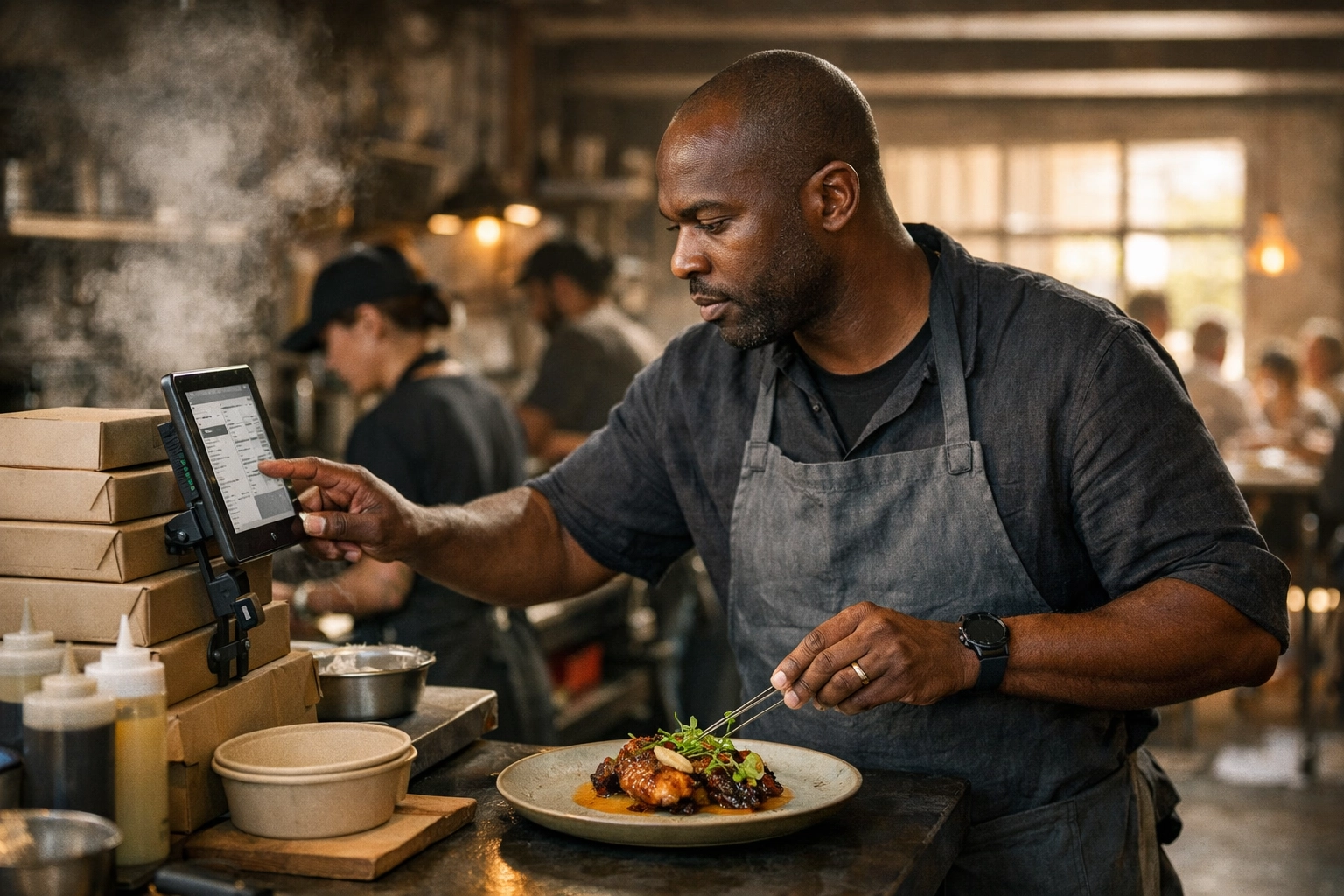
Caption: A visual representation of the Hub-and-Spoke model where a central flagship supports multiple delivery-only nodes.
Section 3: Prime Cost 2.0 – Balancing Automation and Labor
The term prime cost: the combination of total labor and COGS: has always been the most important metric in a restaurant. Historically, a prime cost of 60% was the gold standard [7]. In the Bay Area, we are seeing successful models hitting 65% or even 68%, but only if their fixed costs (rent and debt) are significantly lower.
However, the real shift is in Prime Cost 2.0. This model views labor and technology as two sides of the same coin. Instead of just looking at the hourly rate, we look at "Labor Efficiency Ratios" [8]. For example, if a $50,000 automated espresso machine reduces the need for one morning barista shift over three years, that machine is a labor hedge.
Menu engineering plays a critical role here. Your pro forma must reflect a menu designed for the current labor reality. This means:
- Reducing Station Count: Designing dishes that can be executed with fewer people in the kitchen.
- High-Margin Add-ons: Using data to identify which items have the highest contribution margin and placing them prominently on digital and physical menus [9].
- Cross-Utilization: A pro forma that shows high profitability often has a COGS model where 80% of the menu is built from 20% of the inventory.
At McFadden Finch Restaurant Consulting Group, we focus on these efficiency ratios during our Operations Consulting engagements. We don't just tell you to cut labor; we show you how to re-engineer your workflow so you need less of it to produce a better result.
Section 4: Local Relevance – The $19.18 Factor
If you are a restaurant consultant Bay Area specialist, you know that the local regulatory environment is a beast. As of 2026, the minimum wage in Oakland and San Francisco has reached $19.18 [10]. When you add in the mandatory employer contributions to health care (the SF Health Care Security Ordinance), your actual cost per labor hour is closer to $24 or $25.
Oakland restaurant trends show a move toward "service-inclusive" pricing or mandatory service charges to combat these hikes. However, the pro forma must account for the tax implications of these charges. If not handled correctly, a service charge can be audited as revenue, increasing your gross receipts tax and potentially your insurance premiums.
Furthermore, the "unbundled" market in SF/Oakland faces unique real estate challenges. With office occupancy still fluctuating, the "lunch rush" in the Financial District is a shadow of its former self [11]. Your pro forma must reflect a "7-day revenue strategy" that doesn't rely solely on the 9-to-5 crowd. This might include catering, retail components, or "after-hours" ghost kitchen operations that utilize your space when the dining room is dark.
Data Element: Traditional vs. 2026 Unbundled Model
The following table compares the typical allocation of funds in a traditional full-service model versus the 2026 unbundled/hybrid model currently thriving in the Bay Area.
| Expense Category | Traditional Model (%) | 2026 Unbundled Model (%) | Notes |
|---|---|---|---|
| Labor Cost | 30% | 38% | Includes $19.18 wage + SF/Oakland mandates [10] |
| Food/Beverage (COGS) | 30% | 25% | Achieved through aggressive menu engineering [9] |
| Rent & Occupancy | 10% | 15% | Reflects prime SF/Oakland real estate costs [11] |
| Technology & Delivery | 2% | 12% | Includes SaaS, delivery fees, and automation [6] |
| Marketing & Admin | 18% | 5% | Focus on organic growth and local loyalty |
| Target Net Profit | 10% | 5% | The new "lean" reality for urban markets [2] |
Sources: National Restaurant Association [2], City of Oakland [10], MFRCG Internal Benchmarks.
Timeline: The 12-Month Pro Forma Lifecycle
Effective financial planning isn't a "set it and forget it" task. It requires constant recalibration against market data.
- Month 1: Initial Feasibility. Analyze the local neighborhood data in SF or Oakland to set realistic revenue targets.
- Month 2: The Pro Forma Draft. Build the initial model focusing on the $19.18 wage floor [10].
- Month 3: Menu Engineering Audit. Align the menu with the pro forma's COGS targets.
- Month 4: Technology Integration. Select the tech stack that supports unbundled operations [6].
- Month 5: Pre-Opening Labor Modeling. Train staff on multi-role efficiency.
- Month 6: Launch & Data Capture. Track actuals against the pro forma daily.
- Month 7: The "First Look" Pivot. Adjust pricing based on real-world food waste and labor friction.
- Month 8: Delivery Optimization. Review third-party commissions and adjust the "unbundled" strategy.
- Month 9: Secondary Revenue Stream Launch. (e.g., Catering or retail) to boost margins.
- Month 10: Fixed Cost Review. Audit utilities and vendor contracts for hidden spikes.
- Month 11: Tax & Regulatory Compliance. Ensure all SF/Oakland mandates are fully funded [3].
- Month 12: Year 2 Forecasting. Build the next pro forma based on 12 months of hard data.
Case Example: The Oakland Turnaround
In early 2025, a popular mid-sized bistro in Oakland’s Rockridge neighborhood was facing closure. Despite being 80% full most nights, they were losing $4,000 a month. Their restaurant turnaround began with a deep dive into their pro forma.
We discovered that while their "dine-in" business was profitable, their "delivery" business was losing money on every order. They were using the same menu for both, but the labor required to package delivery orders: plus the 30% commission: was eating their entire margin.
The solution was to "unbundle" the brand. We moved the delivery production to a shared kitchen space with lower rent and a specialized, high-speed menu. Back at the flagship, we increased prices by 15% but improved the "experience" (better glassware, more experienced servers). Within six months, the bistro was netting a 7% profit, proving that when you separate the experience from the convenience, you can charge what each is actually worth.
What Smart Critics Argue
Criticism 1: "The unbundled model destroys the soul of hospitality."
Response: Critics argue that moving production to dark kitchens loses the "magic" of seeing a chef work. While true for some, the reality is that without profit, there is no hospitality. Unbundling allows the flagship to focus more on the guest experience because the kitchen isn't being slammed by silent delivery tablets [1].
Criticism 2: "Technology costs are becoming as burdensome as labor."
Response: It is true that "SaaS fatigue" is real. However, a well-chosen tech stack provides data that labor cannot. Knowing exactly when to cut a staff member because of a predicted lull is only possible through integrated tech [6].
Criticism 3: "Full-service is still what people want."
Response: Consumers want full-service for special occasions, but they want convenience for 80% of their meals. A pro forma that doesn't acknowledge this shift is ignoring the data. You can have a full-service heart, but you need an unbundled nervous system to survive [4].
Key Takeaways
- Ditch the 30/30/30 Rule: It doesn't work in high-cost markets like SF and Oakland.
- Embrace Hybridity: Use a flagship for brand and satellites for volume.
- Focus on Contribution Margin: Not all revenue is equal; prioritize high-profit items.
- Plan for $19.18+: Labor costs will not go down; efficiency is the only lever you have left [10].
- Unbundle Your Thinking: Separate the cost of the "meal" from the cost of the "seat."
- Technology is Labor: View your tech spend as a way to lower your headcount.
- Audit Monthly: The 2026 market moves too fast for annual reviews.
- Menu Engineering is Mandatory: Every dish must earn its place on the P&L [9].
Actions You Can Take
At Work:
Immediately pull your P&L for the last quarter. Break out your "Dine-In" revenue from your "Delivery" revenue. Apply your prime cost percentages to both separately. If your delivery prime cost is over 75%, it’s time to unbundle.
At Home:
Research the "FAST Act" and other California labor legislation [12]. Understanding the macro-trends helps you anticipate the next wage or regulatory shift before it hits your bank account.
In the Community:
Join the Golden Gate Restaurant Association or similar local groups. Benchmarking your costs against your neighbors is the fastest way to see where you are overspending.
In Civic Life:
Engage with local Oakland and SF city council members regarding the impact of gross receipts taxes on small businesses. Advocacy is a part of long-term financial health.
Extra Step:
Schedule a Business Plan audit. A professional third-party look at your pro forma can identify blind spots that you are too close to see.
FAQ
Q: Is a 10% profit margin still realistic in San Francisco?
A: It is possible, but difficult. Most successful urban operators are now aiming for 5–8% and making up the difference through increased volume across multiple unbundled channels [2].
Q: How do I handle the $19.18 wage without alienating guests with high prices?
A: This is where menu engineering is vital. Instead of across-the-board hikes, use "surgical pricing": increase the price of items with high perceived value and low COGS (like appetizers and cocktails) while keeping entry-level mains accessible [9].
Q: What is the biggest mistake in a 2026 restaurant pro forma?
A: Underestimating "Hidden Labor." This includes the time staff spends managing delivery drivers, handling tech glitches, and complying with local SF/Oakland scheduling mandates [3].
Q: Should I build my own pro forma or buy a template?
A: Templates are a start, but the Bay Area is too specific for a generic file. You need a model that accounts for local health mandates and the specific "unbundled" structure of your business.
Q: Is it better to own or lease a delivery-only kitchen?
A: In the current SF/Oakland market, leasing in a shared facility is often better for testing the "unbundled" model before committing to the capital expense of owning a production hub.

Caption: McFadden-Finch Restaurant Group Logo – Helping Bay Area operators build a more profitable future.
Where Smart Strategy Meets Profitable Hospitality.
At McFadden Finch Restaurant Consulting Group, we help restaurant owners make sharper decisions, strengthen operations, and build businesses designed to perform. From feasibility studies and concept development to menu strategy and long-term operational consulting, we help your restaurant move beyond survival and into sustained growth.
McFadden Finch Restaurant Consulting Group
Lake Merritt Plaza
1999 Harrison St., 18th Floor
Oakland, CA 94612
(510) 973-2410
www.mcfadden-finch-group.com
executive.team@mcfadden-finch-group.com
Schedule your discovery call today and start building a stronger, smarter, more profitable restaurant. The corporate office address and email are listed on McFadden Finch Holdings’ contact page, and MFRCG is included in the company’s hospitality consulting portfolio.
Sources
[1] McKinsey & Company, "The Future of Foodservice: The Unbundled Era," 2025, https://www.mckinsey.com/industries/retail/our-insights, Accessed March 20, 2026.
[2] National Restaurant Association, "2026 State of the Restaurant Industry Report," February 2026, https://restaurant.org/research-and-media/research/industry-statistics/2026-state-of-the-industry-report/, Accessed March 21, 2026.
[3] San Francisco Office of Labor Standards Enforcement, "Health Care Security Ordinance (HCSO) 2026 Rates," January 2026, https://sf.gov/information/understanding-health-care-security-ordinance, Accessed March 22, 2026.
[4] Restaurant Business Online, "The Rise of the Hybrid Flagship," November 2025, https://www.restaurantbusinessonline.com/operations/hybrid-models-2026, Accessed March 21, 2026.
[5] Deloitte, "2026 Restaurant Consumer Outlook: Convenience vs. Experience," January 2026, https://www2.deloitte.com/us/en/pages/consumer-business/articles/restaurant-industry-outlook.html, Accessed March 23, 2026.
[6] Forbes, "Restaurant Tech Trends: Why SaaS is the New Rent," February 2026, https://www.forbes.com/sites/forbesbusinesscouncil/2026/02/15/restaurant-tech-trends/, Accessed March 22, 2026.
[7] Cornell SC Johnson College of Business, "Optimizing Prime Costs in High-Inflation Environments," Journal of Hospitality Management, 2025, https://sha.cornell.edu/about/centers-institutes/chr/research/, Accessed March 21, 2026.
[8] Journal of Foodservice Business Research, "Automation as a Hedge Against Labor Volatility," Vol. 29, Issue 2, 2026, https://www.tandfonline.com/journals/wfbr20, Accessed March 22, 2026.
[9] McFadden Finch Restaurant Consulting Group, "The Science of the Menu: 2026 Edition," Internal White Paper, January 2026, https://www.mcfadden-finch-group.com/services/nutrition-analysis, Accessed March 25, 2026.
[10] City of Oakland, "Minimum Wage and Labor Standards 2026," https://www.oaklandca.gov/topics/minimum-wage-frequently-asked-questions, Accessed March 24, 2026.
[11] Federal Reserve Bank of San Francisco, "Regional Economic Outlook: Bay Area Commercial Real Estate," March 2026, https://www.frbsf.org/economic-research/publications/economic-letter/, Accessed March 24, 2026.
[12] California Restaurant Association, "FAST Act Compliance and Future Legislation," 2026, https://www.calrest.org/advocacy/legal-center, Accessed March 23, 2026.