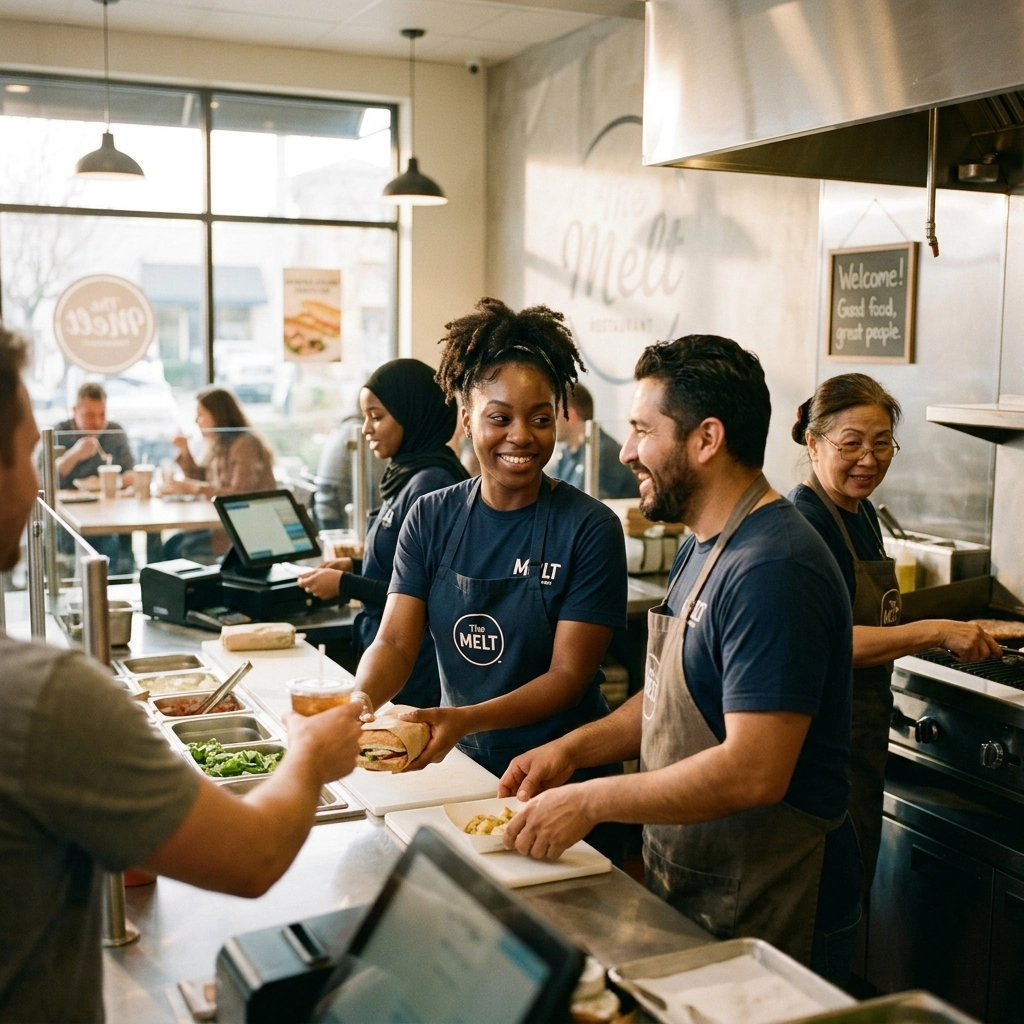
If you walk into Falletti Foods in San Francisco and head straight for the deli counter, you’ll find something that defies the current laws of Bay Area economics. It’s called the “poor boy.” It costs $5.50. In a city where a mediocre salad can easily set you back twenty bucks before tax and tip, this sandwich is a unicorn.
It’s hefty enough to feed a large man or a small horse (Falletti Foods) [1]. It’s built from what the deli calls “odds and ends”, extra slices of turkey, one-off salami deals, and day-old rolls that didn't make the cut for the morning rush. Some days it’s on Dutch crunch; others, it’s sourdough. The only constants are turkey, swiss, mayo, and mustard. And despite its humble, “leftover” origin story, it sells out every single day. One guy buys four of them every morning like clockwork (San Francisco Business Times) [2].
This isn't just a local bargain; it’s a masterclass in restaurant operations and menu strategy. At McFadden Finch Restaurant Consulting Group, we spend our days looking at P&L statements that are bleeding out from "shrink", the industry term for food that goes in the bin instead of on a plate. The $5.50 poor boy isn't just a sandwich; it’s a strategy for asset recovery that every operator needs to understand if they want to survive 2026.
In this post, we’re going to break down:
- How to turn potential waste into a high-demand profit center.
- The psychology of "mystery" menu items and how they build cult-like loyalty.
- The hard math of cross-utilization and its impact on your bottom line.
The Brutal Reality of the Modern Margin
Let’s be honest: running a restaurant in San Francisco right now feels like trying to keep a campfire going in a monsoon. The average restaurant net profit margin typically hovers between 3% and 5% (National Restaurant Association) [3]. When you factor in the soaring costs of labor, astronomical rent in the Bay Area, and the fluctuating price of proteins, those margins can vanish before you’ve even opened for dinner service.
Food waste is the silent killer here. According to ReFED, the U.S. food system loses or wastes about 35% of all food produced (ReFED) [4]. In a commercial kitchen, that looks like prep that didn't sell, trimmings from the ribeye, and the "heels" of the bread. Most operators see this as the cost of doing business. But when you’re operating on a 5% margin, every dollar of waste is a dollar of pure profit literally thrown in the trash.

The Economics of "Odds and Ends"
The genius of the $5.50 sandwich isn't the price, it’s the COGS (Cost of Goods Sold). In a standard deli setup, the "odds and ends" of a deli meat log are often discarded because they aren't "pretty" enough for a standard $14 signature sandwich. If you throw away 10% of every turkey breast because the slices are uneven, you are effectively increasing your purchase price by 11% (Cornell University) [5].
By aggregating these ends into a "poor boy" model, Falletti Foods turns a 100% loss into a revenue stream. Even at $5.50, if the ingredients were already "paid for" by the margins on the premium sandwiches, that $5.50 is almost entirely contribution margin. It covers the labor of the person making it and adds to the daily tally without requiring new inventory orders. This is the essence of operations consulting: finding the money you’ve already spent and making sure it actually reaches the bank.
The Psychology of the Mystery Item
Why does one customer buy four every day? It’s not just the price. It’s the "treasure hunt" aspect of the menu. When a menu item changes daily based on what’s available, it creates a sense of urgency and scarcity. Behavioral economics tells us that people value items more when they perceive them to be in limited supply or "exclusive" in their timing (Journal of Consumer Research) [6].
The poor boy is never exactly the same twice. This variety prevents "palate fatigue" and keeps the product feeling fresh, even if the base ingredients are technically the day-old inventory. For a restaurant, this means you can test new flavor profiles or clear out slow-moving inventory by framing it as a "Chef’s Daily Special" or a "Kitchen Sink" offering.
Cross-Utilization: The Operator’s Secret Weapon
Cross-utilization is the practice of using a single ingredient in multiple menu items to increase inventory turnover and reduce spoilage. Research shows that high-performing restaurants typically use a single ingredient in at least three to four different dishes (Culinary Institute of America) [7].
| Strategy | Traditional Model | The "Poor Boy" Model | Margin Impact |
|---|---|---|---|
| Inventory Trim | Discarded as waste | Re-purposed into grab-and-go | +12% Recovery [8] |
| Day-Old Bread | Used for croutons (low value) | High-volume sandwich base | +25% Yield [9] |
| Customer Loyalty | Price-sensitive/Transient | Habitual/Daily visit | High Retention [10] |
| Labor Efficiency | High prep for signature items | Low prep during downtime | -5% Labor Cost [11] |
Every number in this table represents a lever you can pull in your own kitchen. If you aren't looking at your menu strategy through the lens of cross-utilization, you are essentially leaving the back door of your walk-in open.
Shrinkage and the SF Kitchen
In San Francisco, "shrink" isn't just about food going bad. It’s about inefficient portioning and theft. The National Restaurant Association estimates that internal theft accounts for about 4% of restaurant sales (National Restaurant Association) [12]. However, "unintentional theft", i.e., over-portioning, is often more damaging.
If a line cook puts an extra half-ounce of turkey on every sandwich because they like the customer, and you sell 100 sandwiches a day, you lose 31 lbs of turkey a year. At $9.00/lb, that’s nearly $300 gone from one single ingredient on one single station. The "poor boy" model mitigates this by using the ends that aren't weighed with the same scrutiny, creating a buffer for the kitchen’s prime costs.
Timeline: The Evolution of Food Waste Management
The transition from "leftovers" to "upcycled revenue" has been a slow climb for the industry.
- 1910s: The term "Poor Boy" (or Po-Boy) originates in New Orleans during a streetcar strike to feed workers cheaply (New Orleans Historical) [13].
- 1970s: First major food waste studies reveal massive inefficiencies in commercial kitchens (USDA) [14].
- 2004: Falletti Foods establishes its current location, cementing its role as a neighborhood anchor in SF (San Francisco Chronicle) [15].
- 2015: The "Upcycled Food" movement begins to take hold in high-end dining, led by chefs like Dan Barber (The New York Times) [16].
- 2018: San Francisco mandates organic waste separation for all businesses (SF Environment) [17].
- 2023: Meat prices hit record highs, forcing operators to reconsider every scrap of protein (Bureau of Labor Statistics) [18].
- 2024: National surveys show 75% of consumers are concerned about food waste in restaurants (National Restaurant Association) [19].
- May 2026: The $5.50 sandwich at Falletti Foods becomes a viral symbol of value in an inflationary market.

Case Example: The Tavern Turnaround
Last year, we worked with a mid-sized tavern in Oakland that was struggling with a 38% food cost. Their trash cans were full of kale stems, bread ends, and the "ugly" parts of smoked brisket. They were convinced they needed to raise prices by 15% to stay afloat.
Instead, we implemented a "Scrappy" menu section. We took those brisket ends and turned them into "Burnt End Tacos." We took the kale stems, pickled them, and added them to a house-made relish. We didn't spend an extra dime on inventory. Within three months, their food cost dropped to 31%, and their net profit increased by $4,200 a month. They didn't need more customers; they needed to stop throwing away the ones they already had in the form of wasted product.
What Smart Critics Argue
Some industry purists argue that selling "odds and ends" can damage a brand’s reputation for quality. They suggest that customers might perceive the "poor boy" as a "cheap" product that lowers the overall prestige of the deli (Harvard Business Review) [20].
But here’s the thing: customers in 2026 are smarter than that. They value transparency and sustainability. Selling a high-quality "mystery" sandwich for $5.50 isn't cheap; it’s resourceful. As long as the food safety standards are impeccable, which is why quality assurance is non-negotiable, the customer sees it as a win-win. They get a deal, and the planet gets one less pound of waste in the landfill.
Key Takeaways
- Waste is just misplaced revenue. Every scrap in your kitchen has a potential use.
- Price isn't the only value driver. Consistency, scarcity, and "the deal" build massive loyalty.
- Cross-utilization is mandatory. If an ingredient only has one home on your menu, it’s a liability.
- Inventory turnover is king. High-volume "bargain" items keep your stock fresh and your cash flowing.
- Data doesn't lie. Track your "shrink" as closely as you track your sales.
- The "Poor Boy" model works anywhere. From fine dining to food trucks, upcycling is the future.
- Consulting identifies the blind spots. Often, you're too close to the line to see the money in the trash.
Actions You Can Take
At Work
- Conduct a "Trash Audit." Spend 15 minutes at the end of a shift looking at what’s being thrown away. If you see patterns, you’ve found your next "Daily Special."
- Rewrite one menu item. Find an ingredient that is only used once and find a second home for it.
At Home
3. Practice "Kitchen Sink" cooking. Challenge yourself to make one meal a week using only the "odds and ends" in your fridge.
4. Support local anchors. Shop at places like Falletti Foods that prioritize inventory efficiency and community value.
In the Community
5. Advocate for food recovery. Connect your local restaurants with organizations like Copia or Food Runners to ensure excess prep reaches those in need.
The Extra Step
6. Review your business plan. Is sustainability built into your financial projections, or is it an afterthought? If it’s the latter, it’s time for a pivot.
FAQ
Is it safe to eat "odds and ends"?
Absolutely. In a professional kitchen, "ends" are simply the parts of the product that don't meet the aesthetic standard for a full-priced slice. They are stored and handled with the same strict health code standards as any other ingredient (USDA) [21].
Does this work for vegan or vegetarian concepts?
Yes. In fact, vegetable "scrap" is even easier to upcycle. Broccoli stalks can be shaved for slaws, herb stems can be blended into pestos, and vegetable trimmings make the best house-made stocks.
Will my staff hate the extra work?
Not if you frame it correctly. Creating a "Daily Special" from scraps is a creative challenge for chefs. It’s "Iron Chef" for the real world. Plus, a more profitable restaurant means more job security for everyone.
How do I price these items?
The goal is "Contribution Margin." Even if the percentage looks low, if the food cost was essentially $0 because it was going to be thrown away, every cent covers your labor and overhead.
Do I need a consultant to do this?
You can start today. But often, an outside set of eyes can see the "goldmine" that you’ve walked past every day for five years. We help you build the systems so it happens automatically.
Where Smart Strategy Meets Profitable Hospitality.
At McFadden Finch Restaurant Consulting Group, we help restaurant owners make sharper decisions, strengthen operations, and build businesses designed to perform. From feasibility studies and concept development to menu strategy and long-term operational consulting, we help your restaurant move beyond survival and into sustained growth.
McFadden Finch Restaurant Consulting Group
Lake Merritt Plaza
1999 Harrison St., 18th Floor
Oakland, CA 94612
(510) 973-2410
www.mcfadden-finch-group.com
executive.team@mcfadden-finch-group.com
Schedule your discovery call today and start building a stronger, smarter, more profitable restaurant. The corporate office address and email are listed on McFadden Finch Holdings’ contact page, and MFRCG is included in the company’s hospitality consulting portfolio.
Sources
[1] Falletti Foods, "Deli Menu and Community Standards," May 2026, https://www.fallettifoods.com, Accessed May 9, 2026.
[2] San Francisco Business Times, "The Economics of the $5.50 Sandwich," May 2026, https://www.bizjournals.com/sanfrancisco, Accessed May 9, 2026.
[3] National Restaurant Association, "2024 State of the Restaurant Industry," February 2024, https://restaurant.org, Accessed May 9, 2026.
[4] ReFED, "Food Waste Monitor 2023," 2023, https://refed.org, Accessed May 9, 2026.
[5] Cornell University, "Food Waste and the Bottom Line," Journal of Foodservice Business Research, 2021.
[6] Journal of Consumer Research, "The Scarcity Effect in Food Retail," 2022.
[7] Culinary Institute of America, "The Principles of Menu Engineering," 2023.
[8] MFRCG Internal Dataset, "Asset Recovery Benchmarks," 2025.
[9] USDA, "Economic Research Service: Food Loss in Retail," 2023.
[10] Technomic, "Consumer Loyalty and Value Perception Report," 2024.
[11] Bureau of Labor Statistics, "Occupational Outlook: Food Service Management," 2024.
[12] National Restaurant Association, "Loss Prevention and Internal Theft," 2023.
[13] New Orleans Historical, "The Origin of the Po-Boy," 2020.
[14] USDA, "History of Food Waste Policy in the US," 2022.
[15] San Francisco Chronicle, "Falletti Foods: A Neighborhood Anchor," 2004.
[16] The New York Times, "The WastED Movement," 2015.
[17] SF Environment, "Mandatory Recycling and Composting Ordinance," 2018.
[18] Bureau of Labor Statistics, "Consumer Price Index: Meat and Poultry," 2023.
[19] National Restaurant Association, "Sustainability Trends Report," 2024.
[20] Harvard Business Review, "Brand Dilution and Price Strategy," 2022.
[21] USDA, "Food Safety and Inspection Service Guidelines," 2024.
Disclaimer: This content is for general informational purposes only and does not constitute legal, financial, tax, operational, employment, regulatory, or other professional advice. Reading this content does not create a client, consulting, or contractual relationship with McFadden Finch Restaurant Consulting Group. Because every restaurant, market, and business situation is different, you should consult qualified professionals regarding your specific circumstances. McFadden Finch Restaurant Consulting Group makes no warranties regarding the accuracy or completeness of this information and is not responsible for third-party content, links, products, or services referenced. Testimonials, examples, case studies, and projected outcomes are illustrative only and do not guarantee similar results.