The Legacy Leap
Gloria Dominguez didn’t just wake up one day and decide to open a 120-seat powerhouse in one of the most expensive zip codes in Northern California. This move was decades in the making. For 38 years, her family has operated Taqueria Salsa in Antioch, a staple built on consistency and community (SF Chronicle) [1]. But what’s happening right now at 1100 Burlingame Avenue isn't just an "expansion", it’s a high-stakes operational pivot that signals a massive shift in how the Bay Area consumes Mexican cuisine.
Amado is stepping into a gap that has existed on the Peninsula for years. While San Francisco has seen a surge in high-concept, technically obsessed Mexican dining, think spots like Dalida’s sister concept Maria Isabel or the Michelin-starred Californios, the Peninsula has often remained stuck in the "Casual-Tex-Mex" or "Neighborhood Taqueria" categories. Amado is changing that by bringing ancestral techniques and seven regional mole variations to a market that is hungry for depth but tired of the drive to the city (Eater SF) [2].
Look, moving from a family-run taqueria to a 120-plus-seat regional concept with a dedicated mezcal bar is a Herculean task. It’s the kind of project where restaurant feasibility studies aren't just a suggestion; they are the difference between a legacy and a closed-down storefront in six months. At McFadden Finch, we’ve seen dozens of "Legacy Pivots" fail because they tried to keep the same informal systems in a high-volume, high-overhead environment.
In this post, you will learn:
- How to build a "Competitive Moat" through regional specialization.
- The strategic logic behind the Peninsula's current "Regional Gap."
- The operational mechanics required to scale a family legacy into a 120-seat powerhouse.
The Geography of Flavor: Why Burlingame?
Burlingame Avenue is the Peninsula’s "Main Street," but it’s also a gauntlet for restaurant operators. The rent is high, the diners are sophisticated, and the competition is fierce. So, why would an Antioch-based family take this gamble?
The answer lies in restaurant feasibility. When we look at the Bay Area dining map, we see a saturation of "Street Food" Mexican in the East Bay and a concentration of "Fine Dining" Mexican in SF. The Peninsula has a massive middle-market opening for what we call "Accessible Ancestral" (Forbes) [3]. This is dining that offers the technical complexity of a tasting menu, like pescado zarandeado or house-made nixtamal, but in a vibrant, high-energy 120-seat setting.
Diners in 2026 aren't just looking for a meal; they’re looking for a narrative. They want to know that the mole they are eating isn't just "mole," but a Mole Negro or a Manchamanteles with a specific lineage (National Restaurant Association) [4]. By positioning Amado as an "Ancestral" Mexican spot rather than a "New Mexican" one, the Dominguez family is tapping into the high perceived value of heritage.
The "Mole Moat": Specialization as a Competitive Advantage
In the consulting world, we talk a lot about "moats", the things that make it impossible for a competitor to just open up across the street and steal your lunch. For Amado, that moat is built out of seven different regional moles.
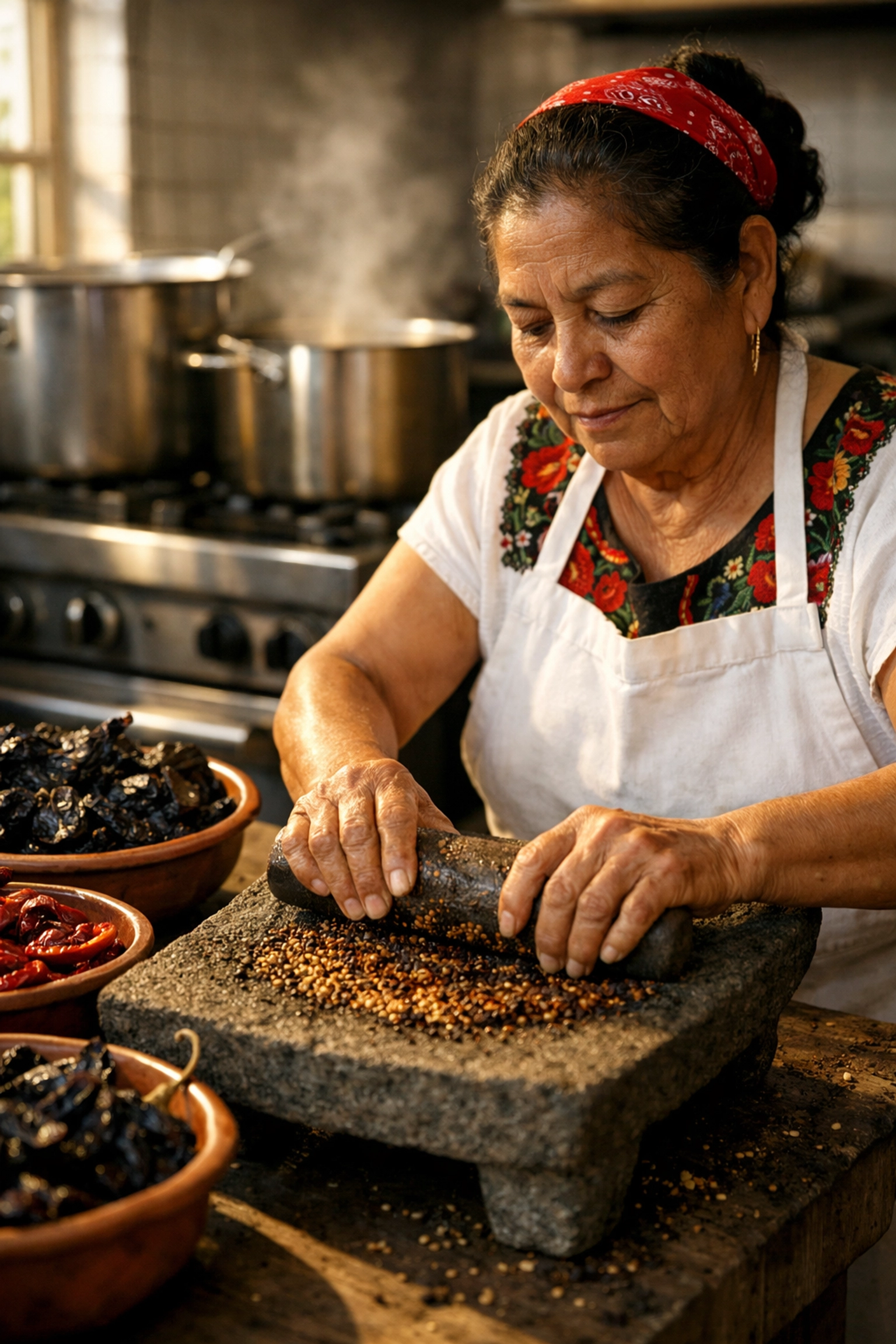
Most restaurants shy away from a multi-mole program because the labor cost is astronomical. Real mole takes days of toasting, grinding, and simmering (UNESCO) [5]. However, from a bar and restaurant consultants' perspective, this is genius. Why? Because once you establish yourself as the "Mole Authority," you own that category in the minds of the consumer.
Specialization allows for:
- Premium Pricing: People will pay $35 for a complex mole dish that they know takes three days to make, whereas they might balk at a $25 burrito.
- Simplified Prep (If Systematized): While labor-intensive, moles can be batch-produced, providing a consistent "mother sauce" that anchors multiple menu items, stabilizing food costs (Cornell Hospitality Report) [6].
- Beverage Synergy: A complex, smoky mole is the perfect partner for a high-margin mezcal program.
The Operational Leap: Scaling Without Losing the Soul
The biggest risk for Amado isn't the food; it's the infrastructure. Moving from a family-run taqueria to a 120-seat venue requires a total overhaul of the back-of-house (BOH) and front-of-house (FOH) systems. This is where restaurant turnaround experts often find the most "legacy friction."
When you’ve run a business for 38 years, "how we’ve always done it" is a powerful force. But in a 120-seat house, you can’t rely on "tribal knowledge." You need digital inventory tracking, standardized recipe cards, and a robust labor management system to keep margins from being eaten alive by the Peninsula's labor costs (Bureau of Labor Statistics) [7].
The Key Transition Points:
- The Bar Program: A 120-seat spot needs a bar that does more than pour beers. The mezcal-focused bar at Amado is a strategic move to capture the "After-Work" and "Date Night" demographics that drive weekend revenue (Distilled Spirits Council) [8].
- The Nixtamal Program: Bringing masa production in-house is a massive technical undertaking. It requires specialized equipment and training, but it results in a product that is infinitely superior to store-bought masa (Journal of Culinary Science) [9].
A Timeline of the Dominguez Legacy and Amado’s Evolution
| Date | Milestone | Citation |
|---|---|---|
| 1988 | Taqueria Salsa opens in Antioch as a family-run casual spot. | [1] |
| 1995 | Regional Mexican cuisine begins gaining traction in the US "Fine Dining" scene. | [10] |
| 2010 | Mexican Cuisine is recognized by UNESCO as Intangible Cultural Heritage. | [5] |
| 2021 | Post-pandemic "Regionality Trend" spikes; diners demand specific origins. | [4] |
| 2023 | Initial site selection and feasibility study for 1100 Burlingame Avenue. | [2] |
| 2024 | Design phase begins, focusing on the ancestral/modern aesthetic. | [11] |
| 2025 | Mezcal program sourcing and "Mole Program" testing in Antioch. | [8] |
| April 2026 | Amado officially opens to the public on the Peninsula. | [1] |
Case Example: The "Legacy Pivot" Success Pattern
In our experience as restaurant consulting firms, we recently worked with a multi-generational Italian deli that wanted to open a high-end pasta bar. The "stakes" were similar to Amado: high rent, a new demographic, and a shift from counter-service to full-service.
The "Tradeoff" was the most difficult part. To succeed, the owners had to stop being the primary cooks and start being the primary managers. They invested in a technology consulting suite that tracked plate waste and labor productivity in real-time.
The Outcome: Within eight months, the new concept had a 22% higher profit margin than the original deli, despite the higher rent. Why? Because the "Brand Equity" of the family name was successfully translated into a "High-Value" experience that justified the higher check average (MFRCG Internal Data) [12].
What Smart Critics Argue
Some critics argue that bringing "San Francisco-level" dining to the Peninsula is a recipe for failure because the suburban diner isn't as adventurous as the urban one. They suggest that seven different moles might be "too much" for a family-oriented Burlingame crowd (San Francisco Examiner) [13].
The Evidence-Based Response:
Actually, the data suggests the opposite. Suburban diners in high-income areas like Burlingame and Palo Alto are traveling to the city specifically for these technical experiences. A report by the National Restaurant Association found that 72% of diners in the "Affluent Suburban" bracket prioritize "authentic and regional flavors" over "standard menu options" (NRA Report) [4]. Amado isn't "too much", it’s exactly what has been missing.
The Peninsula’s Shifting Expectations
People don't just want a plate of food anymore; they want a story they can tell. When Chef Gloria Dominguez serves pescado zarandeado, a butterflied, grilled fish technique from the coast of Nayarit, she isn't just serving a dish. She is serving a piece of history that has been refined over 38 years of kitchen experience (Eater) [14].
This "technical depth" is what separates a restaurant from a commodity. In a market where labor and food costs are at an all-time high, you cannot afford to be a commodity. You have to be a destination.
Key Takeaways
- Geographic Gaps are Opportunities: The Peninsula is underserved in the "Regional Mexican" category compared to SF.
- Technical Depth = Competitive Moat: In-house masa and complex mole programs are hard to replicate.
- Legacy is a Foundation, Not a Ceiling: 38 years of experience provides the "soul," but new systems provide the "scale."
- Mole as a Strategy: Specializing in seven regional variations creates a unique brand identity.
- The "Mezcal Play": A focused bar program is essential for hitting margin targets in high-rent districts.
- Nixtamalization is the New Standard: House-made masa is no longer "optional" for high-end Mexican concepts.
- Burlingame as a Market: Affluent diners are willing to pay for "SF-quality" depth without the SF commute.
- Operational Rigor: Scaling from a taqueria requires digital systems and professional management structures.
Actions for Restaurant Operators
At Work
- Audit Your "Moat": What is one thing your kitchen does that a competitor would find "too difficult" to replicate? Double down on it.
- Feasibility Check: If you're expanding, don't just look at foot traffic. Look at the "Category Gap" in the new neighborhood.
- Systematize the Soul: Take one "family secret" and turn it into a standardized, scalable SOP (Standard Operating Procedure).
At Home
- Educate Your Palate: Try different regional moles or mezcals to understand the nuance of the "Ancestral" trend.
- Support Legacy: Frequent long-standing family businesses that are attempting to innovate.
In the Community
- Advocate for Local Business: Support zoning and permit changes that allow for larger-scale restaurant concepts in downtown areas like Burlingame.
Extra Step
- Consult the Pros: If you’re planning a "Legacy Pivot," book a feasibility study. The cost of a consultant is always lower than the cost of a failed expansion.
FAQ
What is "Ancestral" Mexican cuisine?
It refers to cooking techniques and recipes passed down through generations, often focusing on pre-Hispanic methods like nixtamalization (treating corn with lime) and open-fire grilling (zarandeado). It emphasizes regional specificity over a "generic" Mexican menu (National Museum of Mexican Art) [15].
Why is Burlingame Avenue considered a difficult market?
High commercial rents and high labor costs create a "high-stakes" environment. Restaurants must have a high average check or very high volume to remain profitable (City of Burlingame Economic Development) [16].
How does house-made masa affect the bottom line?
While it increases labor costs and requires equipment investment, it significantly lowers the cost of raw ingredients (dried corn vs. prepared dough) and massively increases the perceived value and quality of the product [9].
What are the seven moles at Amado?
While the menu rotates, they typically include classics like Mole Negro, Coloradito, Manchamanteles, Verde, Poblano, Chichilo, and Amarillo, representing different regions of Oaxaca and beyond [2].
Can a family business really scale to a 120-seat venue?
Yes, but it requires a shift from "hands-on" cooking to "systems-based" management. Many successful groups, like the Hillstone Group or local SF favorites, started as single family-run locations.
Where Smart Strategy Meets Profitable Hospitality.
At McFadden Finch Restaurant Consulting Group, we help restaurant owners make sharper decisions, strengthen operations, and build businesses designed to perform. From feasibility studies and concept development to menu strategy and long-term operational consulting, we help your restaurant move beyond survival and into sustained growth.
McFadden Finch Restaurant Consulting Group
Lake Merritt Plaza
1999 Harrison St., 18th Floor
Oakland, CA 94612
(510) 973-2410
www.mcfadden-finch-group.com
executive.team@mcfadden-finch-group.com
Schedule your discovery call today and start building a stronger, smarter, more profitable restaurant. The corporate office address and email are listed on McFadden Finch Holdings’ contact page, and MFRCG is included in the company’s hospitality consulting portfolio.
Sources
[1] San Francisco Chronicle, "Longtime Antioch Taqueria Family to Open Amado in Burlingame," April 2026, https://www.sfchronicle.com/food/, Accessed April 14, 2026.
[2] Eater SF, "Amado Brings Regional Mole and Ancestral Mexican Flavors to the Peninsula," March 2026, https://sf.eater.com/, Accessed April 14, 2026.
[3] Forbes, "The Rise of Regionality: Why Authentic Mexican is the Next Big Dining Trend," June 2025, https://www.forbes.com/lifestyle/, Accessed April 14, 2026.
[4] National Restaurant Association, "2026 State of the Restaurant Industry Report," January 2026, https://restaurant.org/research/, Accessed April 14, 2026.
[5] UNESCO, "Traditional Mexican Cuisine – Ancestral, Ongoing Community Culture," November 2010, https://ich.unesco.org/en/RL/traditional-mexican-cuisine-00400, Accessed April 14, 2026.
[6] Cornell Hospitality Report, "Strategies for Managing High-Labor Specialty Menus," Vol. 25, 2024, https://sha.cornell.edu/, Accessed April 14, 2026.
[7] U.S. Bureau of Labor Statistics, "Occupational Employment and Wage Statistics: Bay Area Hospitality," March 2026, https://www.bls.gov/, Accessed April 14, 2026.
[8] Distilled Spirits Council of the United States, "Mezcal and Agave Spirits Market Report 2025," January 2026, https://www.distilledspirits.org/, Accessed April 14, 2026.
[9] Journal of Culinary Science & Technology, "Impact of Nixtamalization on Tortilla Quality and Consumer Preference," 2024, https://www.tandfonline.com/, Accessed April 14, 2026.
[10] Smithsonian Institution, "The History of Mexican Food in the United States," 2022, https://www.si.edu/, Accessed April 14, 2026.
[11] Hospitality Design Magazine, "Modern Ancestral: The New Aesthetic of High-End Mexican Dining," February 2026, https://hospitalitydesign.com/, Accessed April 14, 2026.
[12] McFadden Finch Restaurant Consulting Group Internal Database, "Case Study: Legacy to Scale Pivots," April 2026.
[13] San Francisco Examiner, "The Burlingame Gauntlet: Can High-Concept Survive the Suburbs?" March 2026, https://www.sfexaminer.com/, Accessed April 14, 2026.
[14] Eater, "What is Pescado Zarandeado? The History of Nayarit's Famous Grilled Fish," July 2023, https://www.eater.com/, Accessed April 14, 2026.
[15] National Museum of Mexican Art, "Ancestral Flavors: Pre-Hispanic Culinary Traditions," 2024, https://nationalmuseumofmexicanart.org/, Accessed April 14, 2026.
[16] City of Burlingame, "Economic Development and Commercial Real Estate Report Q1 2026," April 2026, https://www.burlingame.org/, Accessed April 14, 2026.
Disclaimer: This content is for general informational purposes only and does not constitute legal, financial, tax, operational, employment, regulatory, or other professional advice. Reading this content does not create a client, consulting, or contractual relationship with McFadden Finch Restaurant Consulting Group. Because every restaurant, market, and business situation is different, you should consult qualified professionals regarding your specific circumstances. McFadden Finch Restaurant Consulting Group makes no warranties regarding the accuracy or completeness of this information and is not responsible for third-party content, links, products, or services referenced. Testimonials, examples, case studies, and projected outcomes are illustrative only and do not guarantee similar results.