Your menu says "Fresh pasta. Locally sourced. Daily specials." Your competitor down the street says the exact same thing. Both of you close on Mondays, both of you have Edison bulbs, and both of you think your Brussels sprouts are revolutionary. So why does one restaurant have a 90-minute wait while the other is begging OpenTable to send anybody, literally anybody‽
The answer lives in the invisible architecture of language. Not what you say, but how you punctuate it. Most restaurant owners treat punctuation like parsley on a 1987 diner plate, decorative, forgettable, scraped to the side. But in 2026, when guests scroll past 47 brunch options before noon, punctuation is the difference between "we serve breakfast" and "we serve breakfast⸮"
This isn't about grammar pedantry. It's about restaurant branding strategy that acknowledges a basic truth: your brand voice lives in the pauses, the inflections, the tiny marks that tell a reader how to feel. According to research from (Cornell University's Food & Brand Lab)[1], menu language and formatting influence guest perception of quality, value, and even taste. But here's what they didn't study, because almost nobody uses them, the rare punctuation marks designed specifically to add nuance, emotion, and intent.
Welcome to the world of the interrobang, the irony mark, the love point, the certitude point, and the acclamation point. These marks exist. Most people have never seen them. And that's exactly why they matter for restaurant consulting firms and operators who want to stand out in a saturated market.
The Boring State of Restaurant Copy
Walk into any gastropub, farm-to-table bistro, or "elevated comfort food" concept in America, and you'll read some version of this:
"We believe in honest food. Seasonal ingredients. Community-driven hospitality."
Period. Period. Period.
It's not wrong. It's just invisible. The writing equivalent of beige subway tile. You're using the same punctuation toolkit humanity has relied on since the printing press, and so is everyone else. According to Keith Houston's (Shady Characters: The Secret Life of Punctuation, Symbols & Other Typographical Marks)[2], writers have been experimenting with punctuation to convey tone since the 1580s, when Henry Denham proposed the "percontation point" (a reversed question mark) to indicate rhetorical questions.
But somewhere along the way, we got conservative. We settled for the period, the comma, the question mark, the exclamation point, and the occasional em dash if we're feeling fancy. That's the equivalent of cooking with salt, pepper, and nothing else. It works, but it doesn't sing.
The restaurant industry suffers from this more than most. Your menu copywriting tips playbook probably says: keep it short, keep it clean, don't confuse people. Fair. But "not confusing" and "actively engaging" are two different things. One gets you a polite nod. The other gets you a reservation at 7:30 PM on a Saturday.
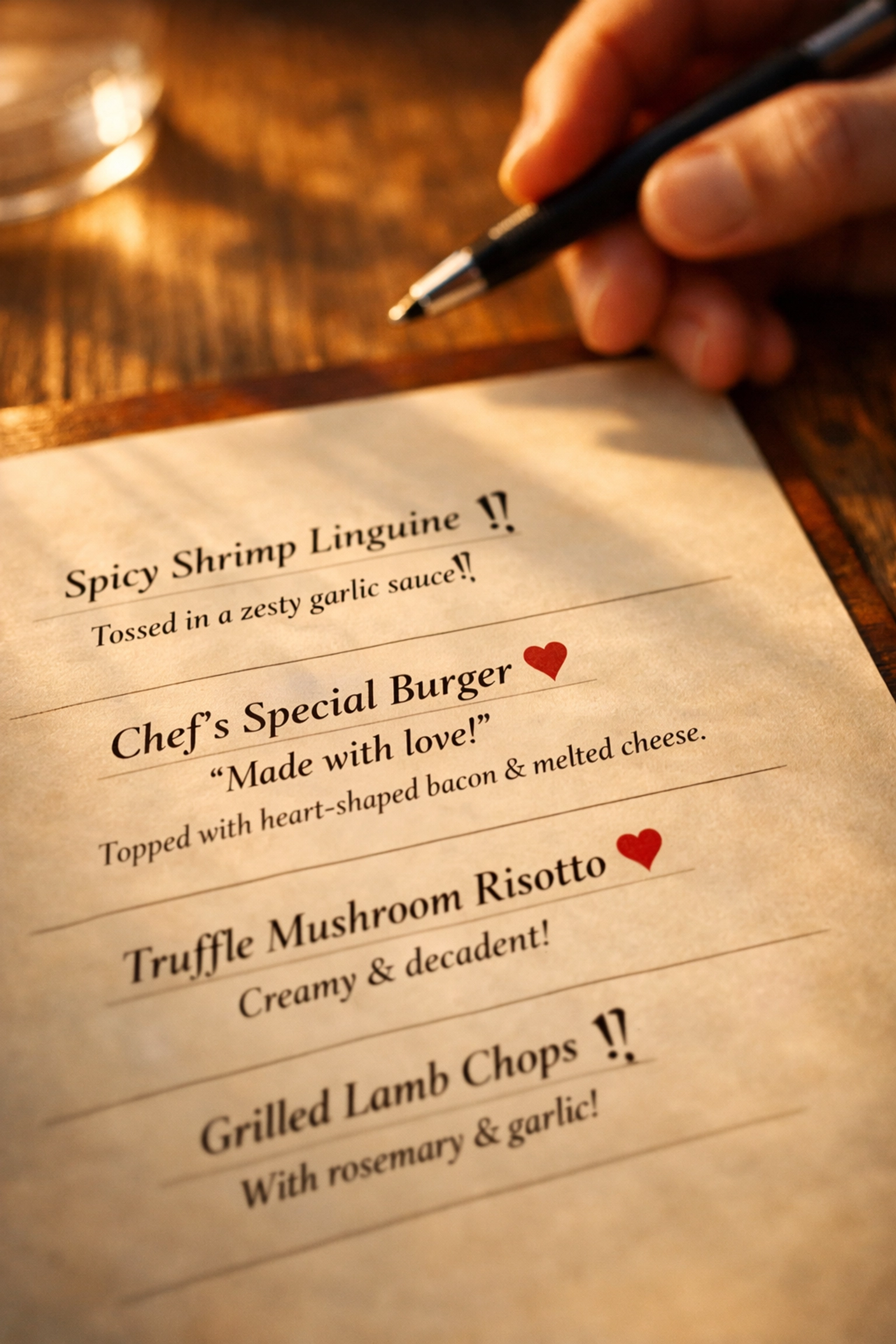
The History of the Marks: A 10-Point Deep Dive
Let's introduce the characters.
1. The Interrobang (‽)
Invented in 1962 by advertising executive Martin K. Speckter, the interrobang combines a question mark and exclamation point into a single glyph. Speckter was tired of writing "What?" or "How‽" in ad copy and wanted a punctuation mark that conveyed simultaneous surprise and inquiry. According to (Mental Floss)[3], the interrobang briefly appeared in typewriter keyboards and advertising campaigns in the 1960s before fading into obscurity.
Use Case for Restaurants: "You've never tried our mole‽" It's playful, confident, and conversational, perfect for social media or menu descriptions that assume the guest is in on the joke.
2. The Irony Mark (⸮)
Also called the "percontation point" or "snark mark," this symbol dates back to the 16th century but was revived by French poet Alcanter de Brahm in 1899. It signals sarcasm, irony, or rhetorical questions. In print, it looks like a reversed question mark.
Use Case for Restaurants: "Oh, you want the well-done steak⸮" (Internal SOP humor, or a cheeky menu footnote for concepts with strong brand personalities.)
3. The Love Point (❣)
Proposed by novelist Hervé Bazin in 1966 as part of a suite of six new punctuation marks, the love point (or "point d'amour") signals affection, warmth, or enthusiasm. It looks like a combination of a heart and an exclamation point.
Use Case for Restaurants: "Thank you for being part of our family❣" (Perfect for hospitality-driven copy, especially in FOH training manuals or guest follow-up emails.)
4. The Certitude Point (⸪)
Another Bazin invention, the certitude point (or "point de certitude") indicates absolute confidence or authority. It's the typographical equivalent of dropping the mic.
Use Case for Restaurants: "Our sourdough ferments for 72 hours⸪" (Use this to punctuate quality claims you can back up, it signals, "We're not guessing.")
5. The Acclamation Point (‽)
Similar to the interrobang but leaning more toward excitement than question, the acclamation point emphasizes surprise or delight mid-sentence.
Use Case for Restaurants: "Then we add the bone marrow‽ because why wouldn't we?" (Great for storytelling menus that walk guests through a dish's construction.)
According to (BBC Culture)[4], these marks failed to gain mainstream adoption because typewriters and later digital keyboards didn't include them. But in 2026, with Unicode support and custom fonts, they're accessible to anyone willing to break from convention.
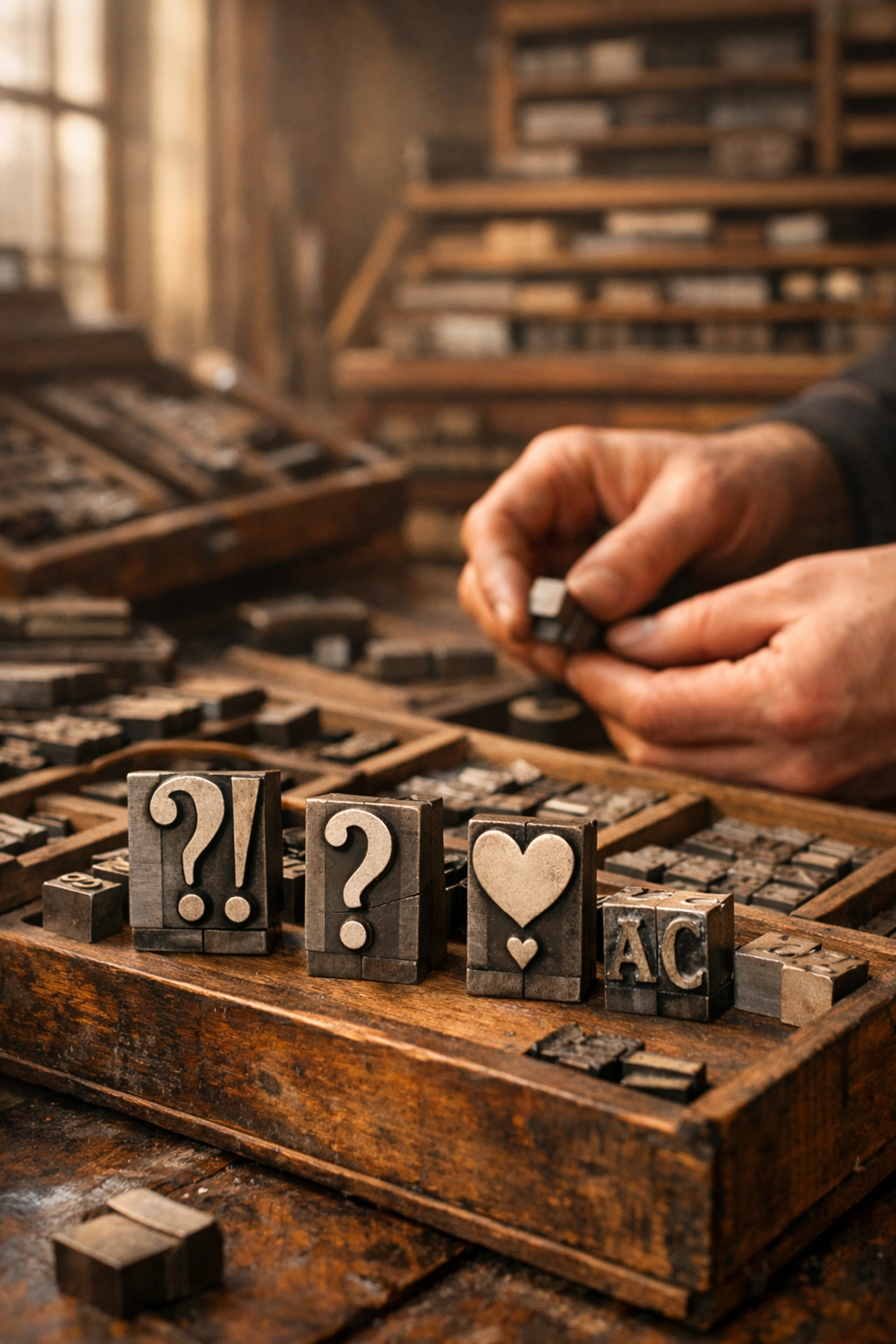
The Psychology of the Guest: How Punctuation Triggers Emotion
Here's the thing about punctuation: it's not decoration. It's a cognitive cue. When you read a period, your brain says, "Statement complete. Move on." When you read a question mark, your brain says, "Wait, what's the answer?" When you read an exclamation point, your brain says, "This person is excited or shouting."
Research from (Maria Popova's The Marginalian)[5] explores how typographical choices influence reading comprehension and emotional response. The takeaway: readers don't just process words, they process the entire visual and rhythmic package. A sentence ending in a period feels final. A sentence ending in an interrobang feels like an invitation.
For restaurant operators, this matters because restaurant brand voice isn't just about vocabulary. It's about pacing. Inflection. The difference between "We make great pasta." and "We make great pasta‽" One is an assertion. The other is a challenge, a wink, a dare.
Cornell's menu psychology research (Cornell University)[1] found that descriptive menu language increases perceived value and purchase intent. But they used conventional punctuation in their studies. Imagine the results if they'd tested unconventional marks that trigger curiosity or affection. A "Grandma's Lasagna❣" isn't just nostalgia; it's warmth encoded at the character level.
Here's a practical grid comparing conventional vs. rare punctuation in common restaurant contexts:
| Context | Conventional | Rare Punctuation | Psychological Effect |
|---|---|---|---|
| Menu descriptor | "Hand-rolled gnocchi." | "Hand-rolled gnocchi⸪" | Confidence, authority |
| Social media caption | "New fall menu!" | "New fall menu‽" | Surprise, invitation |
| FOH training manual | "Greet guests warmly." | "Greet guests warmly❣" | Affection, emphasis |
| Private dining pitch | "Can we host your event?" | "Can we host your event‽" | Excitement, urgency |
| Menu footnote | "We take our sourdough seriously." | "We take our sourdough seriously⸪" | Unshakable conviction |
Practical Application: Menus, Social Media, and Internal SOPs
Let's get tactical. Where do these marks actually live in a restaurant operation?
Menus
Your menu is not a legal document. It's a sales tool, a brand artifact, and often the first physical touchpoint a guest has with your concept. Most menus read like grocery lists. "Roasted chicken. Seasonal vegetables. $28." Functional, yes. Memorable, no.
Now consider: "Wait, did we really dry-age this chicken for three weeks‽" or "Our vegetables come from a farm seven miles away⸪"
The first invites intrigue. The second signals mastery. Neither is deceptive. Both are more engaging than a period.
Pro Tip from McFadden Finch Restaurant Consulting Group: If you're working on a restaurant feasibility study or brand development, test menu copy with and without rare punctuation in your concept validation phase. Track which version generates more questions from focus groups.
Social Media
Instagram captions are where rare punctuation thrives. You're not writing for print, you're writing for a thumb-scrolling, dopamine-seeking audience with a six-second attention span. An interrobang stops the scroll. A love point feels human. A certitude point says, "We know what we're doing."
Example:
- Conventional: "Our new cocktail menu is here! Come try it."
- With rare marks: "Our new cocktail menu is here‽ (Yes, we included the Mendeleev riff you've been asking about⸪)"
Internal SOPs
This is the sleeper application. Your standard operating procedures don't have to read like DMV paperwork. If you want restaurant turnaround results, your team has to want to read the training manual.
Compare:
- "Always greet guests within 30 seconds of seating."
- "Always greet guests within 30 seconds of seating❣ (They chose us, make them feel it.)"
The second version doesn't just inform. It activates.
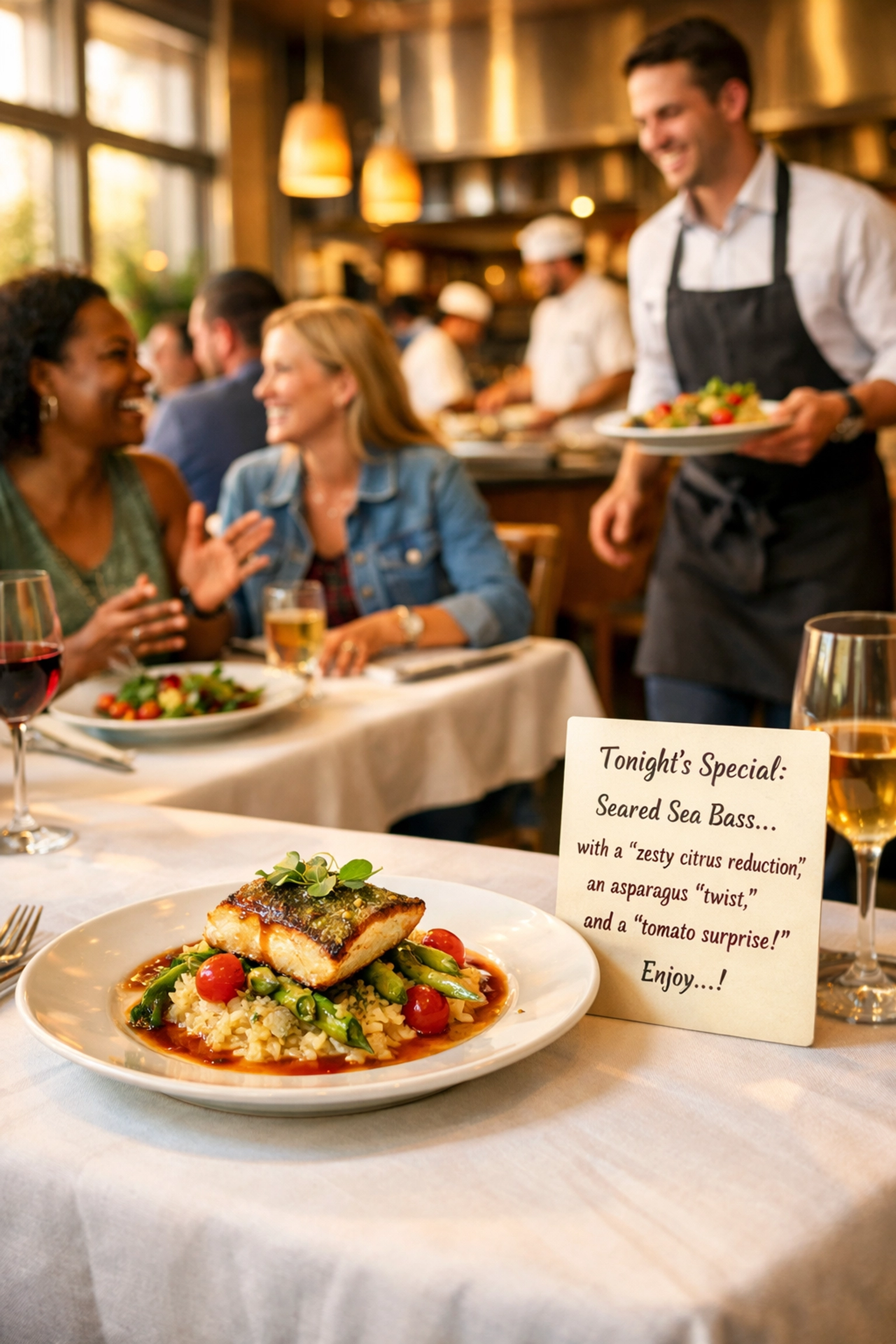
The Consultant's Role: Why McFadden Finch Cares About These Details
At McFadden Finch Restaurant Consulting Group, we talk about prime cost optimization, labor scheduling, and feasibility studies. But we also talk about the invisible stuff, the tone, the voice, the 3-pixel difference between "professional" and "actually engaging."
Because here's the truth: you can fix your food cost. You can streamline your menu engineering. You can install the perfect POS system. But if your brand voice sounds like everyone else's, none of that matters. The market is too crowded. Guests are too distracted. You need every advantage.
Rare punctuation is a low-cost, high-impact tool that signals, "We think differently here." It's not for every concept, if you're running a white-tablecloth fine dining room, an interrobang might feel out of place. But if you're building a brand that values personality, wit, or warmth, these marks are free real estate.
Case Study: The West Portal Adjacency Play
Let's look at a real-world example from this week. Chef Wipada Rattanapun and Arkaranit Dusitnitsakul, the team behind San Francisco's Khao Tiew, are opening a new brunch concept called Tur in West Portal. The tagline, according to (San Francisco Business Times)[6]: "Brunch on the beach / Feel like you're at an Asian friend's home."
That's strong copy. But imagine if the signage read: "Feel like you're at an Asian friend's home❣" or "Brunch on the beach‽ (We're an hour's walk from Ocean Beach, but you get the vibe.)"
The love point adds warmth. The interrobang adds humor and self-awareness. Both reinforce the brand's casual, inviting personality. And in a neighborhood undergoing a "dining renaissance" alongside Elena's and Khao Tiew, that tonal differentiation matters.
This is the kind of detail we'd surface in a branding workshop. Not because rare punctuation is a magic bullet, but because it's a signal of intentionality. If you're thinking about how to end a sentence, you're thinking about how a guest receives that sentence. And that's the mindset that wins.
What Smart Critics Argue
Let's address the obvious counterarguments.
"This is gimmicky."
Fair. If you slap an interrobang on every menu item, it loses meaning. But used sparingly, once per menu, once per social post, it's not a gimmick. It's a flourish. The same way a Michelin chef uses a single microgreen as a focal point.
"Guests won't understand these marks."
Maybe. But they'll feel them. That's the point. An interrobang looks different enough to create a pause, a moment of curiosity. Even if a guest doesn't know its technical name, they'll register the tone shift.
"Our brand is too serious for this."
Then don't use them. But "serious" and "stuffy" aren't synonyms. Even fine dining brands use humor and warmth in their copy. A certitude point on a wine pairing note ("This Burgundy will haunt you⸪") isn't silly. It's confident.
"I can't type these on my phone."
You can. Unicode shortcuts exist for iOS and Android. Or use custom fonts in design software. If you can find an emoji, you can find an interrobang.
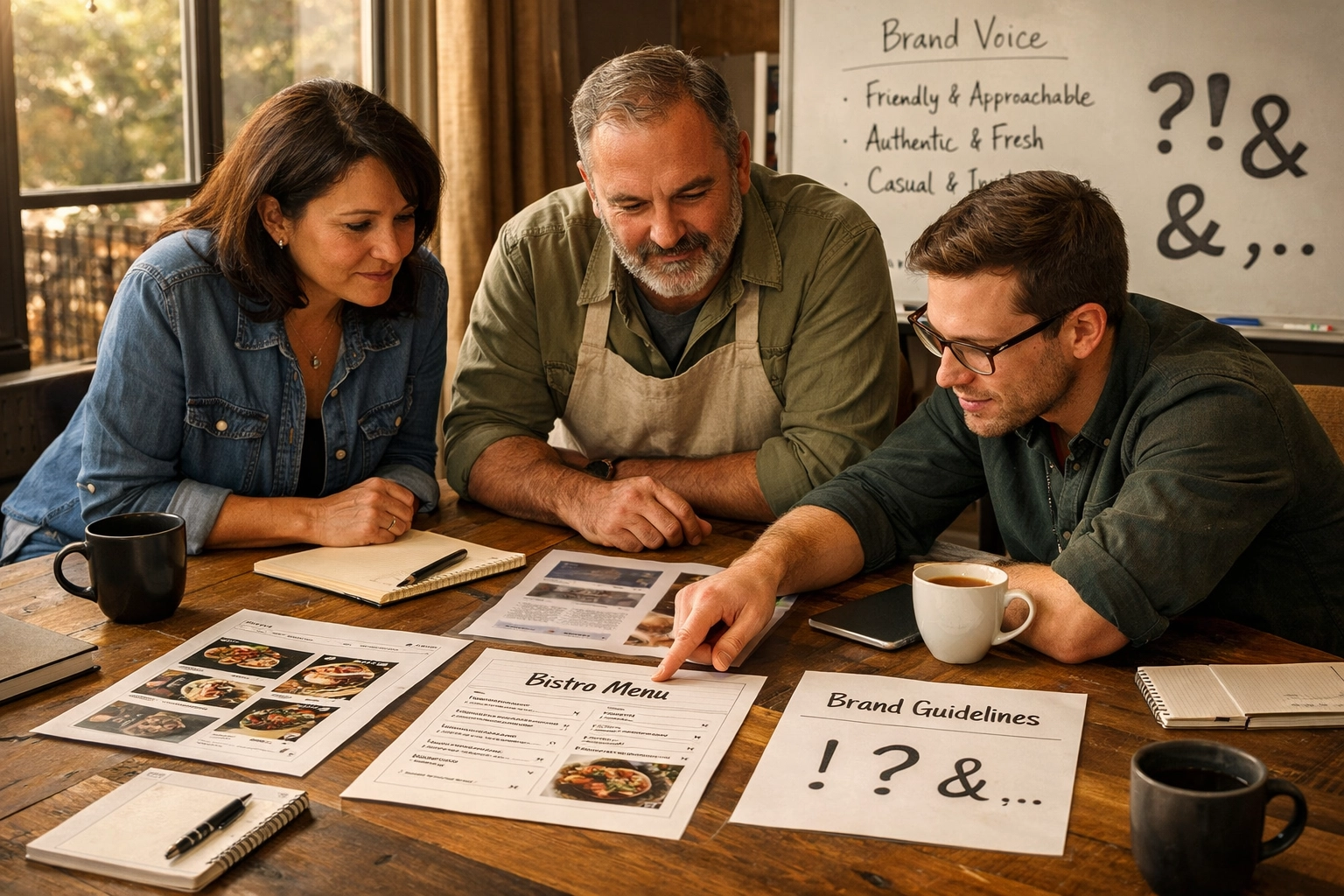
What to Do Next
Here's how to implement rare punctuation without looking like you're trying too hard:
-
Audit your current copy. Pull up your menu, website, and last 10 social posts. Identify moments where a rare mark could add nuance, surprise, warmth, authority.
-
Start with one mark. Don't go full Bazin on day one. Pick the interrobang or the love point and test it in low-stakes contexts (Instagram stories, internal memos).
-
Train your team. If you're using these marks in SOPs or FOH scripts, explain why. "This love point signals warmth" is more useful than "just copy this."
-
Test in focus groups. If you're working with a consultant (or want to, call us at 510-973-2410), include punctuation variations in your concept testing. Track which version resonates.
-
Update your brand guidelines. Once you've found your mark, codify it. "We use the interrobang for playful surprise" gives future designers and copywriters a blueprint.
-
Don't overdo it. One interrobang per menu. One love point per email. Restraint is power.
-
Learn the history. Read Keith Houston's Shady Characters[2]. Understanding why these marks were invented helps you use them intentionally.
-
Pair with strong copy. Rare punctuation amplifies good writing; it doesn't fix bad writing. If your copy is weak, fix that first.
-
Track engagement. If you add an interrobang to your Instagram bio, watch your DM rate. If you add a certitude point to your menu, ask servers if guests comment on it.
-
Revisit quarterly. Brand voice evolves. What felt fresh in Q1 might feel stale by Q4. Audit your punctuation usage and adjust.
FAQ
Q: Where can I actually type an interrobang on my computer?
A: On Mac: Option + Shift + / (if you've installed the proper font). On Windows: Alt + 8253. Or copy-paste from Unicode sites. Many design tools (Canva, Adobe) include it in glyph libraries.
Q: Will this confuse older guests?
A: Possibly. But "confuse" might be too strong. They'll see an unfamiliar mark, pause, and keep reading. That pause is engagement. If you're worried, test it first in digital channels where the audience skews younger.
Q: Can I trademark a punctuation mark as part of my logo?
A: Yes. Punctuation marks are fair game for logo design. If you build your brand around the interrobang, own it visually.
Q: Is this just a trend?
A: Maybe. But trends are how culture evolves. The emoji was a "trend" in 2012. Now it's infrastructure. The question isn't whether rare punctuation is trendy, it's whether your brand benefits from standing out.
Q: What's the ROI on changing my punctuation?
A: Impossible to isolate. But if 2% more guests comment on your Instagram, if 5% more people ask about a menu item, if your team actually reads the SOP, that's ROI. Engagement compounds.
Q: Should I use these in legal or allergy disclaimers?
A: No. Keep compliance copy clean. Rare punctuation is for brand voice, not liability mitigation.
Don't Be a Period. Be an Interrobang.
The restaurant industry is loud. Every operator is shouting about fresh ingredients, craft cocktails, and "elevated" whatever. Your food might be incredible. Your service might be flawless. But if your brand voice sounds like everyone else's, you're wallpaper.
Rare punctuation won't save a bad concept. It won't fix your labor issues or your lease terms. But it will signal to guests, investors, and your own team that you think differently. That you care about nuance. That you're willing to deploy a 0.0002-second pause in a menu description because you know how you say something matters as much as what you say.
At McFadden Finch Restaurant Consulting Group, we help operators build brands that last: not just operationally, but emotionally. From feasibility studies to turnaround strategies to the tiny typographical details that differentiate you from the competition. Because in 2026, "good enough" isn't.
So go ahead. Add the interrobang. Plant the love point. Own the certitude point. Your guests are waiting for a reason to care. Give them one, 0.5 picas at a time.
Ready to sharpen your brand voice and build a concept that stands out‽
Contact the Executive Team at McFadden Finch Restaurant Consulting Group at (510) 973-2410 or visit mcfadden-finch-group.com to schedule a discovery call. We'll help you find the punctuation: and the strategy: that fits your vision.
Sources
[1] Cornell University, Food & Brand Lab, "Menu Psychology and Consumer Behavior Research," Dyson School of Applied Economics and Management, 2024, https://dyson.cornell.edu/, Accessed February 23, 2026.
[2] Houston, Keith, Shady Characters: The Secret Life of Punctuation, Symbols & Other Typographical Marks, W. W. Norton & Company, 2013, https://shadycharacters.co.uk/, Accessed February 23, 2026.
[3] Mental Floss, "The Interrobang: The Greatest Punctuation Mark You've Never Heard Of," Mental Floss LLC, 2023, https://www.mentalfloss.com/, Accessed February 23, 2026.
[4] BBC Culture, "The Forgotten Punctuation Marks That Tried to Change Writing," British Broadcasting Corporation, 2022, https://www.bbc.com/culture, Accessed February 23, 2026.
[5] Popova, Maria, "The Art of Punctuation and the Rhythm of Thought," The Marginalian, 2023, https://www.themarginalian.org/, Accessed February 23, 2026.
[6] Barreira, Alex, "Chef behind uberpopular Thai restaurant Khao Tiew plots new brunch spot in West Portal," San Francisco Business Times, February 23, 2026, https://www.bizjournals.com/sanfrancisco/, Accessed February 23, 2026.
About McFadden Finch Restaurant Consulting Group
We partner with restaurant owners, operators, and investors to build concepts that work: from feasibility and branding to operations and turnaround. Whether you're launching your first concept or fixing your fifth, we bring the strategy, structure, and nuance that separate surviving from thriving. Learn more at mcfadden-finch-group.com or call (510) 973-2410.