Grease rules are not uniform across the Bay Area. In the East Bay, EBMUD treats wastewater, while local communities own their sewer collection systems. In San Francisco, the SFPUC runs its own FOG Control Ordinance and assigns food service establishments a discharger category. That means the right device, inspection contact, and records depend on your restaurant’s address, not its brand. Build one FOG compliance file for each location, and confirm which agency handles that address.
Start with the sewer agency for your address
EBMUD treats wastewater for nine communities in its service area, but says the local communities own their sewer systems. The local agency directory lists contacts for Oakland, Berkeley, Alameda, Emeryville, Albany, Piedmont, and Stege Sanitary District. Stege serves El Cerrito, Kensington, and Richmond Annex. The directory lists these phone numbers:
- Oakland: (510) 615-5566
- Berkeley: (510) 981-6300
- Alameda: (510) 749-5840
- Emeryville: (510) 596-4300
- Albany: (510) 524-9543
- Piedmont: (510) 420-3050
- Stege Sanitary District: (510) 524-4667
For grease-control information, EBMUD directs commercial restaurants to its FOG program at cleanbay@ebmud.com or (510) 287-1651. It also tells operators to contact their local sewer system agency about grease-removal device installation requirements. Confirm the requirements for your specific address rather than assuming that EBMUD’s wastewater role makes it the local sewer authority. [3]
San Francisco has a separate system. SFPUC inspectors inspect food service establishments, assign a FOG discharger category, and notify the establishment of its requirements. Start with the SFPUC FOG Control page and keep any category notice or permit for your location in the file. [5]
Know what a device check can involve
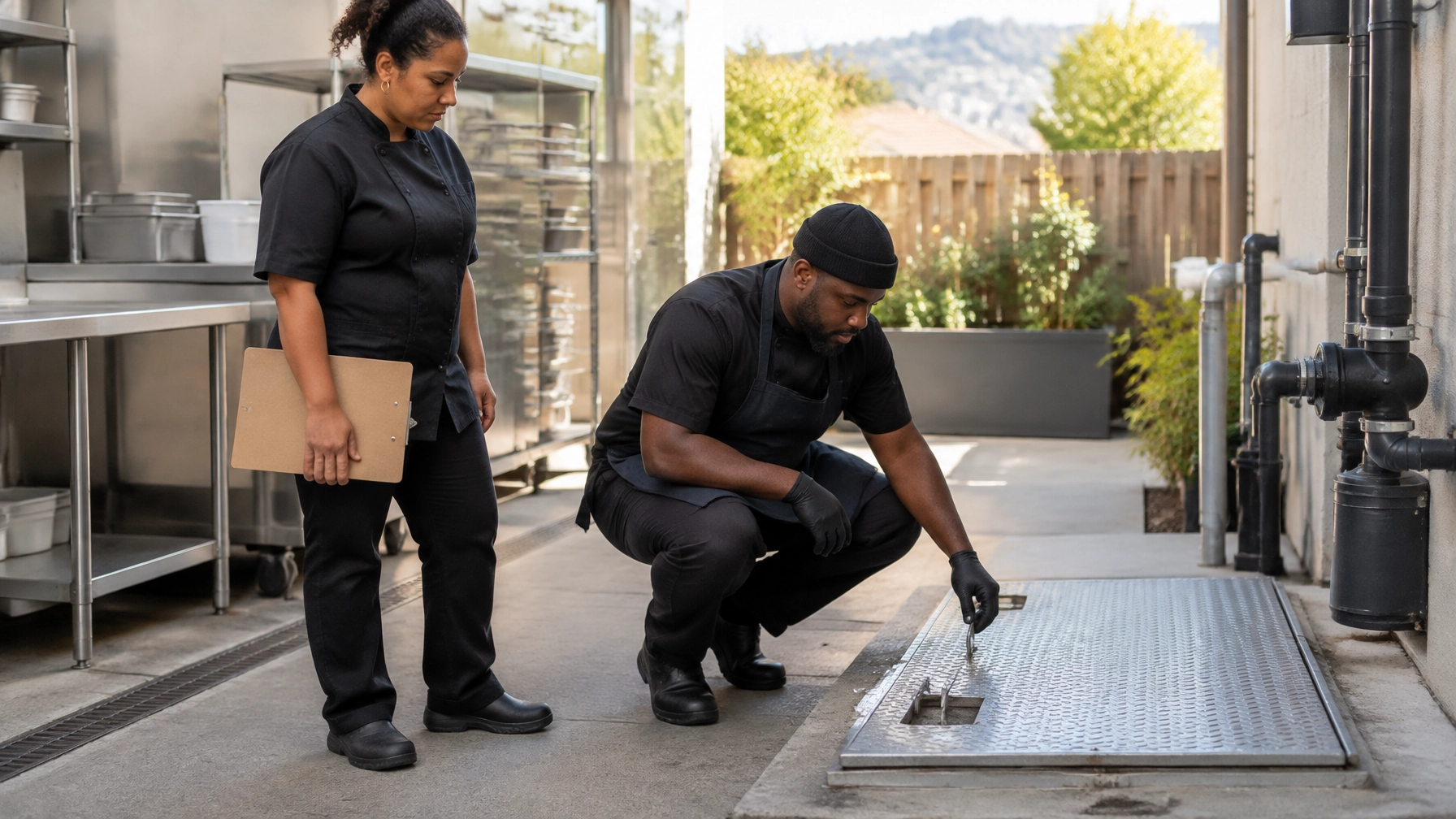
For grease interceptors, EBMUD’s best management practices chart says the combined thickness of floating grease and settled bottom solids should not exceed 25 percent of the interceptor’s total depth. EBMUD says the device will not meet performance standards once those levels exceed 25 percent. Treat this as EBMUD guidance, not a universal rule for every city or every type of device. [1]
The inspection question is not simply, “When was it last pumped?” EBMUD’s interceptor maintenance flyer says an inspector will check whether the interceptor is pumped frequently enough to meet local collection-system requirements. The inspector may ask for records showing pump-out dates and the hauler used. The flyer recommends that the hauler completely pump out the unit, check for needed repairs at each service, and leave a receipt. It does not set one pumping interval for every restaurant. Follow the requirements for your sewer agency and the needs of your device. [2]
The flyer also warns that if a sewer overflow occurs, an operator may be responsible for cleanup costs and property damage. A complete, current service file helps you show what maintenance took place. [2]
Put the working records in one file
EBMUD’s sample grease trap maintenance log records the date cleaned, who cleaned it, the amount of grease removed in inches, and where the grease was disposed of. Use the log that matches your equipment and keep supporting records with it. [3]
For each location, organize:
- Device location and size, plus the type of device.
- Hauler name and any license or authorization details required by the local agency.
- Pump-out dates and the volume or amount removed, when recorded.
- Where the waste was taken or disposed of.
- Service receipts and signed manifests.
- The name of the person who checked the device and the date of the check.
- The location’s category notice, permit, or program requirements, if applicable.
- A log of sewer-overflow reports, including the agency reference number.
Keep the records with the site rather than relying on someone at another location to find them. For Oakland locations, the city says used-oil recycling containers and grease-control devices should be emptied regularly by a liquid-waste hauler. Oakland directs operators to report sewer overflows to OAK311 at 311 or (510) 615-5566, 24 hours a day, seven days a week. After hours, press 0 for the standby crew. Record the call and any OAK311 reference in the location’s file. [4]

San Francisco: keep the category and equipment requirements together
SFPUC’s materials describe four categories, even though its inspectors assign Categories 1, 2, or 3 for FOG discharge potential. Category 4 covers limited food preparation. Keep the category notice and any later correspondence with the equipment and maintenance records. [5]
- Category 1: The establishment generates significant FOG and has no grease-capturing equipment. SFPUC requires an approved Grease Removal Device or gravity grease interceptor, not a passive hydro-mechanical trap. A Category 1 notice gives the establishment 60 days to install the required equipment and obtain approval from the Department of Building Inspection, or the Port if the location is on Port property. The equipment must capture all grease-bearing discharge lines. [5][6]
- Category 2: The establishment generates significant FOG and already has equipment. It must capture all grease-bearing lines, be properly sized and installed, and remain operational, maintained, and serviced. SFPUC may require additional or replacement equipment if existing equipment is not working properly or does not capture the relevant discharge lines. [5]
- Category 3: The establishment is a less-significant FOG discharger, but its grease-bearing wastewater lines must still connect to grease-capturing equipment. SFPUC allows this category to install any type of equipment. [5]
- Category 4: The establishment reheats, hot-holds, or assembles ready-to-eat food and does not need grease-capturing equipment under the fact sheet’s description of limited food preparation. [5]
New San Francisco restaurants must install a Grease Removal Device before opening unless an SFPUC inspector determines the establishment is a less-significant discharger. SFPUC also says that renovations that increase the potential for grease discharge can trigger a category reassessment. A change of ownership requires the new owner to contact SFPUC. The agency says no new garbage grinders have been allowed since May 1, 2011, and existing grinders must be removed or made permanently inoperative. [5]
For a Category 1 device, SFPUC requires third-party certification to ASME 112.14.3 and 112.14.4. A passive hydro-mechanical trap cannot be installed as the required Category 1 equipment. If installation is not feasible because of a lack of physical space, the establishment may request a variance. SFPUC’s published program also describes lease and loan options and a 14.2 percent reduction on the sewer-service-charge portion of the bill for eligible accounts after an approved device is installed and verified. The reduction is subject to the agency’s requirements, including maintenance. Do not assume that every restaurant or account qualifies. [5][6]
Berkeley locations still need a site-specific check
The City of Berkeley says restaurants and food facilities must be evaluated to ensure FOG is properly removed from wastewater before it reaches the sewer. It identifies a grease interceptor or another city-approved grease-removal device as possible approaches, and says large quantities of FOG should be recycled through a licensed grease recycler, citing EBMUD. For a Berkeley address, keep the relevant city or sewer-agency requirements with the equipment records and confirm device approval with the agency responsible for that location. [7]
Make clean practices part of the shift
A file is easier to maintain when the work is built into regular kitchen routines. EBMUD recommends training all staff on best practices, posting no-grease reminders by sinks and dishwashers, collecting and recycling waste cooking oil, and dry-wiping pots, pans, and equipment before washing. It also recommends absorbent paper under fryer baskets and picking up grease spills with absorbent material before mopping. EBMUD warns against emulsifiers and solvents other than ordinary dishwashing detergents because they can break down grease and carry the problem downstream. [1]
San Francisco has an additional waste-separation instruction for Category 1 devices: trap waste skimmed from a Grease Removal Device belongs in a separate drum for a certified grease hauler. It must not go down a drain or into the used vegetable oil drum, where it can contaminate cleaner oil and cause rejection by the recycler. [6]

Use the address-based file as your inspection checklist
Before the next inspection, or before opening a new location, have four things ready: the device record, the hauler’s service manifests, the site’s category notice or program requirements, and the correct sewer-agency contact number. Keep the file with that restaurant, update it after each service, and confirm requirements with the agency responsible for the address. For help strengthening restaurant operating systems, explore McFadden Finch’s operations consulting services.
Sources
- East Bay Municipal Utility District, “Best Management Practices (BMPs) for Food Related Fats, Oils and Grease”, accessed November 17, 2026.
- East Bay Municipal Utility District, “Grease Interceptor Maintenance”, accessed November 17, 2026.
- East Bay Municipal Utility District, “Fats, oils and grease” and “Sewer lines (managed by cities)”, accessed November 17, 2026.
- City of Oakland, “Fats, Oils and Grease (FOG) Restaurant Guidelines”, accessed November 17, 2026.
- San Francisco Public Utilities Commission, “Fats, Oils & Grease (FOG) Control” and “Basic Facts for Restaurants and Other Food Service Establishments”, accessed November 17, 2026.
- San Francisco Public Utilities Commission, “Category 1 Fats, Oils and Grease (FOG) Dischargers”, accessed November 17, 2026.
- City of Berkeley, “Environmental Regulations & Resources for Berkeley Food Businesses”, accessed November 17, 2026.
Where Smart Strategy Meets Profitable Hospitality.
McFadden Finch Restaurant Consulting Group helps Bay Area restaurant owners and operators evaluate concepts, strengthen operating systems, and make informed business decisions. Our services include feasibility studies, menu development, and operations consulting.
McFadden Finch Restaurant Consulting Group
Lake Merritt Plaza
1999 Harrison St., 18th Floor
Oakland, CA 94612
(510) 973-2410
www.mcfadden-finch-group.com
executive.team@mcfadden-finch-group.com
Call (510) 973-2410 to discuss your restaurant’s next steps.
Disclaimer: This content is for general informational purposes only and does not constitute legal, financial, tax, operational, employment, regulatory, or other professional advice. Reading this content does not create a client, consulting, or contractual relationship with McFadden Finch Restaurant Consulting Group. Because every restaurant, market, and business situation is different, you should consult qualified professionals regarding your specific circumstances. McFadden Finch Restaurant Consulting Group makes no warranties regarding the accuracy or completeness of this information and is not responsible for third-party content, links, products, or services referenced. Testimonials, examples, case studies, and projected outcomes are illustrative only and do not guarantee similar results.