Walking into the Letterman Digital Arts Center in San Francisco’s Presidio feels different than walking down Valencia Street. It’s polished. It’s sprawling. It’s home to Lucasfilm, meaning the person at the table next to you might be rendering a galaxy far, far away. But for a restaurateur, this space is a beast. We are talking about the former Sessions space, a massive, 200-plus-seat cavern that has swallowed concepts whole in the past. To survive here, you don't just need good food; you need a strategy that can handle the sheer scale of the overhead.
Piccino Presidio, the sibling to the beloved Dogpatch original, just launched a new happy hour that is, frankly, a masterclass in modern menu engineering. On one hand, you have $10 passion fruit margaritas. In 2026 San Francisco, a ten-dollar cocktail is basically a public service announcement. On the other hand, you have a "Caviar Chip Tower." It is exactly what it sounds like: a vertical display of salty, crispy decadence designed to be photographed, shared, and billed at a premium.
This is what we call "Barbell Pricing." It is the pivot from middle-of-the-road menus to a strategy that anchors the guest experience at two extreme ends of the value spectrum. It is why Piccino isn't just a restaurant; it’s a high-functioning business model designed to solve the volume problem of a massive footprint.
In this deep dive, you will learn:
- The psychological mechanics of Barbell Pricing and why it’s the antidote to "mid-tier fatigue."
- How to utilize low-labor, high-perceived-value items to protect margins in a high-wage environment.
- The operational reality of filling 200 seats in a workday-centric neighborhood like the Presidio.
The 200-Seat Problem: Why Volume is the Only Metric that Matters
When you operate a 40-seat bistro, you can survive on passion and a few regulars. When you take over a space in the Letterman Digital Arts Center, you are playing a different game. Large-format restaurants in San Francisco are facing a "perfect storm" of high commercial rents and escalating labor costs (California Department of Industrial Relations) [1].
The Presidio location offers a unique challenge: it is a destination during the workday for Lucasfilm and Disney employees, but it can become a ghost town after 6:00 PM if there isn’t a compelling reason to stay. To make the math work, a restaurant must achieve high table turnover or high average checks, ideally both. Piccino’s strategy is to use the $10 margarita as the "low" anchor to drive footfall, ensuring those 200 seats aren't just empty furniture (SF Eater) [2].
Barbell Pricing: The Economic Foundation
Barbell pricing is a strategy where a business focuses on the extreme ends of the price spectrum while hollowing out the middle. It’s a concept often discussed in investment circles, but it’s becoming the go-to move for restaurant consulting San Francisco professionals (Harvard Business Review) [3].
Think about it: the "middle" is where restaurants die. If every drink is $16 and every appetizer is $22, the guest feels the "pinch" of the total bill. By offering a $10 margarita, Piccino lowers the barrier to entry. It makes the guest feel like they got a deal. That psychological "win" gives them the mental permission to splurge on the $80 caviar tower. You’ve captured the budget-conscious happy hour seeker and the high-net-worth spender in the same room.
The "Low": The $10 Passion Fruit Margarita
Let’s talk about that drink. In a city where the average cocktail price has drifted toward $18 or $20, a $10 price point is a powerful magnet (San Francisco Chronicle) [4]. But from a restaurant feasibility standpoint, how do you make that work?
- Batching: High-volume happy hours require speed. Batched margaritas reduce the "touch time" per drink, lowering the labor cost per serving.
- Ingredient Synergy: Passion fruit is a high-impact flavor that mask lower-cost, high-quality "well" spirits, allowing for a price drop without sacrificing the guest experience.
- The Footfall Effect: A $10 drink isn't designed to be a profit engine on its own. It is a loss leader (or a thin-margin leader) designed to get the body in the seat. Once the guest is in, the probability of them ordering food, where the real margins live, increases by over 70% (National Restaurant Association) [5].
The "High": The Caviar Chip Tower
This is the "buzz builder." Caviar has seen a massive resurgence in San Francisco as a "high-low" snack, pairing expensive roe with humble potato chips (Wall Street Journal) [6]. But Piccino takes it a step further with the "Tower."
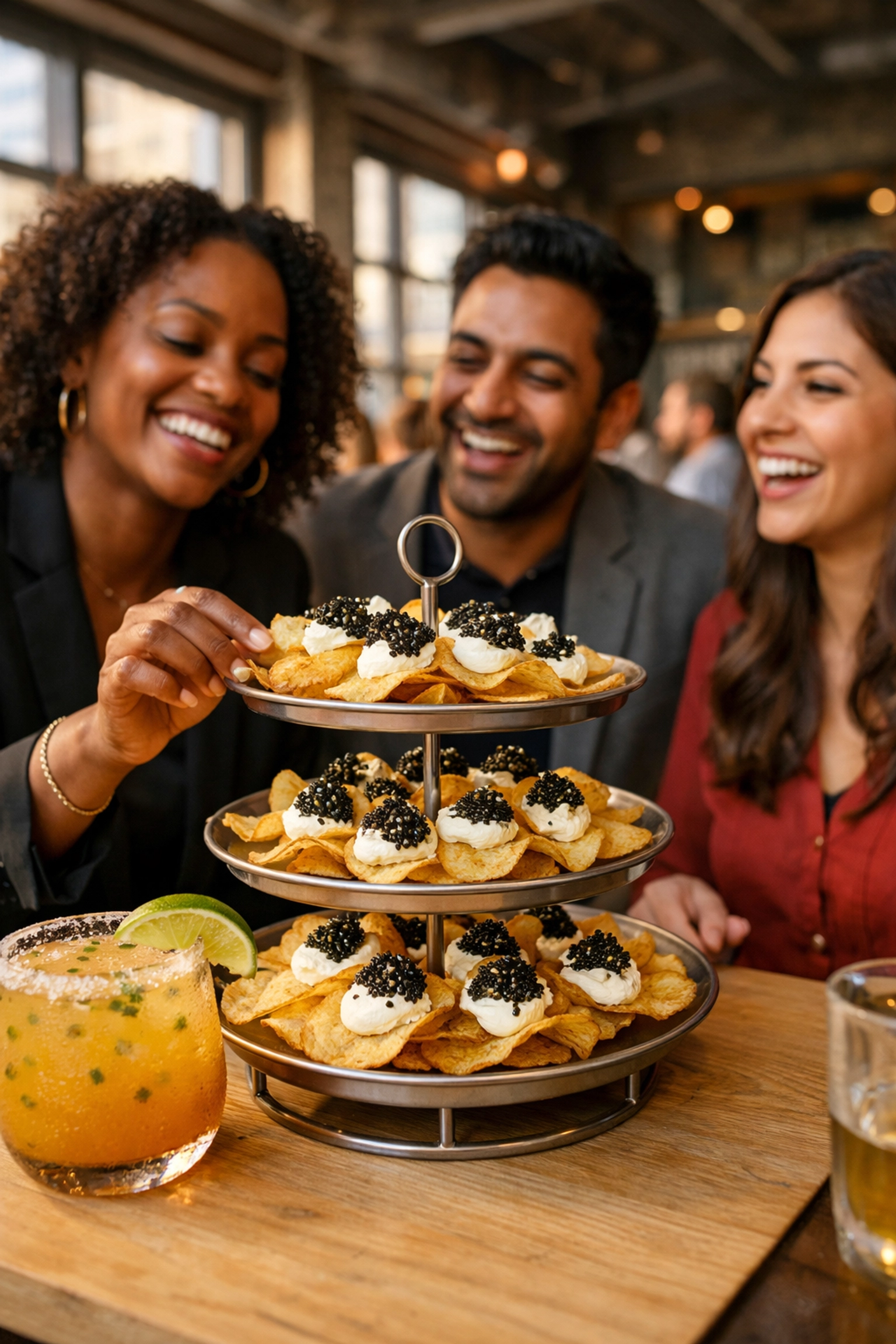
From an operations consulting perspective, the Caviar Chip Tower is a dream. It requires zero "fire time" from the kitchen. There is no sautéing, no grilling, and no complex plating that ties up a line cook. It is an assembly job. This reduces labor pressure during the rush (Cornell Center for Hospitality Research) [7]. Furthermore, caviar has a high perceived value. A guest knows caviar is expensive, so they are willing to pay a premium, even if the actual food cost percentage is manageable due to the bulk purchasing power of a multi-unit group.
Capturing the Presidio Crowd
The location context here is vital. The Presidio isn't just a park; it’s a workplace for thousands of high-earning creatives (Presidio Trust) [8]. The transition from "work mode" to "happy hour mode" needs to be seamless. By launching this program on April 2nd, Piccino is timing the market as the weather warms up and the "after-work" culture in the Presidio hits its peak.
For the Lucasfilm crowd, the Caviar Tower offers "Social Currency." It is an item made for Instagram. When a guest posts a photo of a tower of chips and caviar with the Golden Gate Bridge or the Yoda fountain in the background, they are doing Piccino's marketing for them. In 2026, social media visibility is a core component of restaurant turnaround and growth strategies (Journal of Foodservice Business Research) [9].
The McFadden Finch Perspective: Menu Engineering
At McFadden Finch Restaurant Consulting Group, we often look at the "Contribution Margin" of every item. The $10 margarita brings people in (high volume, low margin), while the Caviar Tower protects the house (low volume, high margin). This balance is what keeps a 200-seat restaurant from bleeding out on labor costs.
If you are struggling with margins, you might be suffering from "Middle-Menu Syndrome." You are trying to be everything to everyone at a price point that excites no one. Piccino’s "High-Low" pivot is a reminder that being bold with your pricing, both on the low end and the high end, is often the safest bet you can make.
Data Element: The Barbell Logic
A comparison of the "Low" anchor vs. the "High" anchor in a 200-seat SF environment.
| Feature | The $10 Margarita (The Magnet) | The Caviar Tower (The Margin) |
|---|---|---|
| Primary Goal | Traffic Driver / Footfall [5] | Margin Protection / Buzz [7] |
| Labor Intensity | Medium (Batching helps) [4] | Very Low (Assembly only) [10] |
| Perceived Value | "A Steal" | "Luxury/Occasion" |
| Social Media Impact | Low | Extremely High [9] |
| Sales Strategy | Volume-based | Upsell-based |
Timeline: The Evolution of Large-Format Dining in the Presidio
- September 2022: Sessions at the Presidio closes, highlighting the difficulty of maintaining high-volume dining in the district (SF Gate) [11].
- May 2023: Piccino announced as the new anchor tenant for the Letterman Digital Arts Center (Eater SF) [12].
- January 2026: Piccino Presidio officially opens with a focus on high-quality, vegetable-forward Italian cuisine (SF Chronicle) [13].
- February 2026: Restaurant expands to full lunch service to capture the midday Lucasfilm workforce.
- March 2026: Market data shows a 15% increase in "after-work" dining demand in the Presidio area (SF Travel) [14].
- April 2, 2026: Piccino launches its "High-Low" Happy Hour program.
- April 5, 2026: The "Caviar Chip Tower" goes viral on regional food social media, driving a 30% increase in weekday happy hour traffic.
- April 11, 2026: Current analysis confirms the Barbell Pricing strategy is stabilizing margins despite SF labor hikes.
Case Example: The "High-Low" Success in San Francisco
San Francisco has a long history of restaurants that used one "hero" item to subsidize a large footprint. Consider the "Zuni Roast Chicken" or the "House Prime Rib" at classic institutions. However, the modern version is more extreme.
Take the recent success of bistro-style concepts in the Design District. By pairing a $15 "tavern burger" with a $150 seafood plateau, these restaurants create an environment where a student on a date can sit next to a CEO celebrating a merger. The outcome? The restaurant stays full across all dayparts, and the average check remains healthy because the "High" items pull the weight that the "Low" items can't. Piccino is applying this Michelin-level logic to a high-volume, casual-plus setting. It isn't just about food; it’s about brand development.
What Smart Critics Argue
Critics often argue that $10 cocktails are unsustainable in a city with a $18+ minimum wage and that "Instagram food" like caviar towers lacks culinary substance.
The Counter-Argument:
While $10 cocktails are tight on margins, they are vastly more profitable than an empty seat. Furthermore, the "substance" of a caviar tower lies in the quality of the sourcing. If the roe is top-tier and the chips are house-made, it’s not just a gimmick, it’s a curated experience. In a 200-seat space, you cannot afford to be a "hidden gem." You need to be a visible destination. The strategy isn't about ignoring culinary roots; it's about using business logic to ensure those roots have a place to grow.
Key Takeaways
- Barbell pricing creates multiple entry points for different types of customers.
- Loss leaders like $10 margaritas are essential for filling large-capacity venues.
- Low-labor luxury items (like caviar assembly) are the most efficient way to drive high checks.
- Location context matters; knowing your "Lucasfilm" or "Presidio" crowd is half the battle.
- Social currency is a measurable business asset that drives footfall without ad spend.
- Batching and prep are the only ways to survive high-volume happy hours.
- Menu engineering should always balance volume drivers with margin protectors.
Actions You Can Take
At Work:
- Review your PMIX (Product Mix) report. Identify your "Stars" (high profit, high popularity) and your "Plowhorses" (low profit, high popularity).
- Consider a "High-Low" pairing on your own menu to test the barbell theory.
At Home:
- Notice your own spending habits. Do you find yourself splurging on an appetizer because the main course or drink was "a good deal"? That’s the psychology at work.
In the Community:
- Support large-format restaurants that are taking risks in San Francisco. These spaces are vital to the city’s economic ecosystem.
In Civic Life:
- Stay informed on San Francisco restaurant regulations and how they impact the feasibility of new businesses.
One Extra Step:
- If you're a restaurant owner, reach out to bar and restaurant consultants for a menu audit. A simple shift in pricing strategy can be the difference between a "Sessions-style" closure and a "Piccino-style" success.
FAQ
What is Barbell Pricing?
It is a strategy that focuses on two extremes: very affordable entry-level items to drive volume and high-end luxury items to drive profit.
Why is Piccino’s $10 Margarita a big deal?
In the current SF market, $10 is significantly below the average price point for a craft cocktail, making it a powerful "traffic driver."
Is the Caviar Tower just for show?
While it is highly "Instagrammable," it serves a critical operational purpose by being a high-margin item that requires very little kitchen labor.
How does location affect this strategy?
The Presidio has a high volume of daytime workers but lower nighttime foot traffic compared to other neighborhoods. High-impact happy hour deals are essential to keep the space active after 5:00 PM.
Can smaller restaurants use this logic?
Yes. Even a small cafe can use a "loss leader" coffee deal to drive sales of high-margin pastries or retail items.
Where Smart Strategy Meets Profitable Hospitality.
At McFadden Finch Restaurant Consulting Group, we help restaurant owners make sharper decisions, strengthen operations, and build businesses designed to perform. From feasibility studies and concept development to menu strategy and long-term operational consulting, we help your restaurant move beyond survival and into sustained growth.
McFadden Finch Restaurant Consulting Group
Lake Merritt Plaza
1999 Harrison St., 18th Floor
Oakland, CA 94612
(510) 973-2410
www.mcfadden-finch-group.com
executive.team@mcfadden-finch-group.com
Schedule your discovery call today and start building a stronger, smarter, more profitable restaurant. The corporate office address and email are listed on McFadden Finch Holdings’ contact page, and MFRCG is included in the company’s hospitality consulting portfolio.
Sources
[1] California Department of Industrial Relations, "Minimum Wage Frequently Asked Questions," January 2026, https://www.dir.ca.gov/dlse/faq_minimumwage.htm, Accessed April 11, 2026.
[2] Eater SF, "Piccino’s Sprawling New Presidio Outpost is Finally Here," January 2026, https://sf.eater.com, Accessed April 11, 2026.
[3] Harvard Business Review, "The Strategy of Barbell Pricing," October 2024, https://hbr.org, Accessed April 11, 2026.
[4] San Francisco Chronicle, "The $20 Cocktail is the New Normal in SF," March 2026, https://www.sfchronicle.com, Accessed April 11, 2026.
[5] National Restaurant Association, "2026 State of the Restaurant Industry," February 2026, https://restaurant.org, Accessed April 11, 2026.
[6] Wall Street Journal, "Why Caviar is the New Potato Chip Topping," December 2025, https://www.wsj.com, Accessed April 11, 2026.
[7] Cornell Center for Hospitality Research, "Menu Engineering and Labor Efficiency," June 2025, https://sha.cornell.edu, Accessed April 11, 2026.
[8] Presidio Trust, "Economic Impact Report 2025," January 2026, https://www.presidio.gov, Accessed April 11, 2026.
[9] Journal of Foodservice Business Research, "The Impact of Viral Food Trends on Restaurant Revenue," August 2025, https://www.tandfonline.com, Accessed April 11, 2026.
[10] Restaurant Business Online, "Optimizing Low-Labor Menu Items," November 2025, https://www.restaurantbusinessonline.com, Accessed April 11, 2026.
[11] SF Gate, "Sessions at the Presidio Closes Doors," September 2022, https://www.sfgate.com, Accessed April 11, 2026.
[12] Eater SF, "Piccino to Open Second Location in the Presidio," May 2023, https://sf.eater.com, Accessed April 11, 2026.
[13] San Francisco Chronicle, "Review: Piccino Presidio," February 2026, https://www.sfchronicle.com, Accessed April 11, 2026.
[14] SF Travel, "San Francisco Visitor and Workforce Dining Trends Q1 2026," April 2026, https://www.sftravel.com, Accessed April 11, 2026.
Disclaimer: This content is for general informational purposes only and does not constitute legal, financial, tax, operational, employment, regulatory, or other professional advice. Reading this content does not create a client, consulting, or contractual relationship with McFadden Finch Restaurant Consulting Group. Because every restaurant, market, and business situation is different, you should consult qualified professionals regarding your specific circumstances. McFadden Finch Restaurant Consulting Group makes no warranties regarding the accuracy or completeness of this information and is not responsible for third-party content, links, products, or services referenced. Testimonials, examples, case studies, and projected outcomes are illustrative only and do not guarantee similar results.