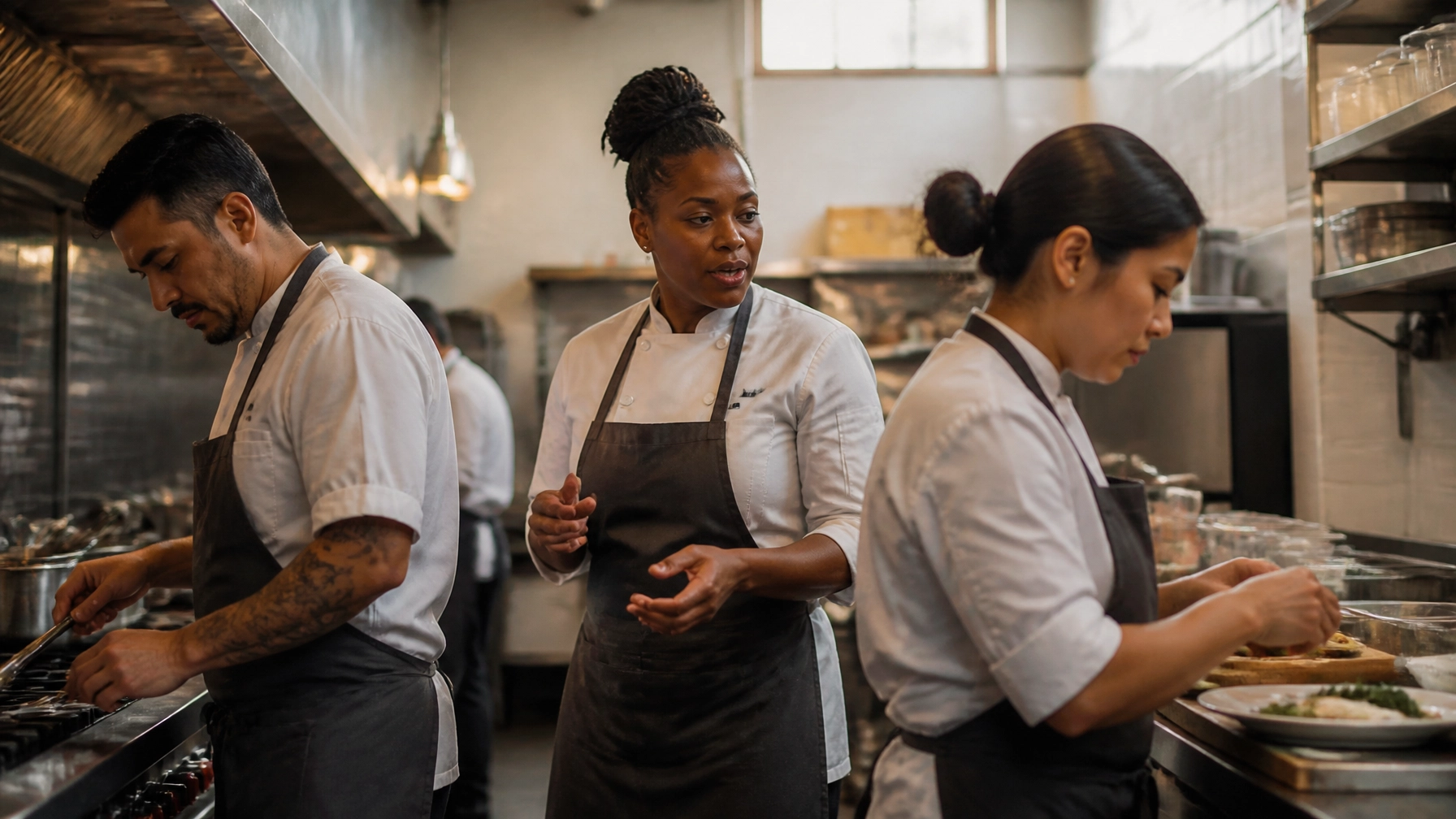
In the spring of 2026, a talented chef in Oakland walked into a lender meeting with a gorgeous mood board, a collection of curated Instagram photos, and a menu that read like a dream. She had "passion" and "vision," but she did not have a Debt Service Coverage Ratio (DSCR) projection. The meeting lasted twelve minutes. Three days later, a first time operator with significantly less culinary experience but a sixty page feasibility study and a detailed financial model secured a $750,000 loan for a similar space (National Restaurant Association) [2]. The difference was not the food. The difference was the math.
The era of funding a restaurant on a handshake and a "good feeling" is over. In today's market, lenders and private investors view restaurants as high-risk assets that require institutional-grade documentation before a single dollar is committed. Whether you are launching a fast-casual concept or a semi-upscale full-service venue, your business plan must transition from a creative "concept deck" into a fundable financial roadmap. This requires a shift in perspective from being an artist to being an operator who understands how to protect capital.
In this guide, you will learn:
- The specific financial benchmarks that 2026 lenders require for approval.
- Why a feasibility study is now the non-negotiable first step in your funding journey.
- How to build a 12-month pre-opening timeline that accounts for the reality of Bay Area permitting and construction.
The Concept Deck vs. The Fundable Business Plan
A concept deck is designed to sell a feeling. It focuses on interior design, brand voice, and the "vibe" of the guest experience. While these elements matter for marketing, they are secondary for funding. A fundable business plan is an operational manual. It proves that you understand the mechanics of profitability (McFadden-Finch Restaurant Consulting Group) [1].
Investors in 2026 look for "proof of concept" before the doors even open. This means showing that your menu has already been engineered for a 28% to 35% food cost and that your labor model is not a guess but a documented schedule based on projected covers. If your plan focuses 80% on the "what" and only 20% on the "how," it will likely be rejected. A professional plan flips that ratio, dedicating the majority of its pages to market analysis, competitive gap identification, and tiered financial projections.

The Underwriting Numbers Lenders Demand
Lenders, particularly those dealing with SBA 7(a) or 504 loans, use specific formulas to determine if your business can survive. If your projections do not align with these industry benchmarks, your plan will be flagged as unrealistic (Small Business Administration) [5].
1. Debt Service Coverage Ratio (DSCR) Above 1.25x
The DSCR is the most critical metric for any bank. It measures your ability to pay your annual debt obligations using your net operating income. Lenders generally require a DSCR of 1.25x or higher. This means for every $1.00 you owe in loan payments, your restaurant must generate at least $1.25 in profit. Proposing a plan with a 1.05x ratio leaves zero margin for error, and in the volatile Bay Area market, lenders will not take that bet.
2. Prime Cost Under 65%
Your prime cost, the sum of your Cost of Goods Sold (COGS) and total labor, is the heartbeat of your P&L. For a full-service restaurant to be considered healthy in 2026, prime cost must stay between 58% and 62% (Toast) [4]. If your plan shows a prime cost of 70%, you are essentially telling an investor that you have no control over your two largest expenses.
3. Occupancy Between 6% and 10%
In high-rent markets like San Francisco or San Jose, it is tempting to overspend on a "trophy" location. However, if your rent, taxes, and insurance exceed 10% of your gross revenue, your path to profitability becomes nearly impossible (McFinch Group) [1]. Lenders look for a sweet spot of 6% to 8% to ensure the business can absorb seasonal dips in traffic.
Realistic Startup Costs in the 2026 Bay Area
One of the fastest ways to lose credibility with an investor is to lowball your startup costs. In 2026, the reality of building a restaurant in Northern California is stark. Between prevailing wage labor, updated ADA requirements, and the rising cost of Type I hoods, a "budget" buildout is rarely possible (California Restaurant Association) [8].
| Expense Category | Low Estimate | High Estimate | Key Driver |
|---|---|---|---|
| Permits & Professional Fees | $40,000 | $120,000 | Architectural & MEP Engineering [3] |
| Construction & Buildout | $300,000 | $800,000 | Square footage & condition of space [7] |
| Kitchen & Bar Equipment | $75,000 | $250,000 | New vs. Second-generation assets [4] |
| Pre-opening Labor & Training | $15,000 | $50,000 | 4 weeks of full-staff training [6] |
| Total Estimated Capital | $430,000 | $1,220,000+ | Location & Concept Complexity |
A plan that claims you can open a 2,000-square-foot full-service restaurant for $200,000 will be dismissed as naive. It is better to ask for more capital upfront and show a clear path to repayment than to run out of cash two weeks before your grand opening.

The 3 to 6 Month Ramp-Up Reality
Many founders make the mistake of projecting "steady state" sales from day one. In reality, the first 90 to 180 days of a restaurant are often a financial drain. This period, known as the ramp-up, involves high labor costs as you train staff and lower-than-average revenue as you build local awareness.
A fundable business plan includes a dedicated working capital reserve to cover these losses. Lenders want to see that you have at least three months of operating expenses in the bank to bridge the gap between "doors open" and "breakeven" (Restaurant Business Online) [9]. Showing this level of foresight demonstrates that you are prepared for the "honeymoon period" to end and the hard work of retention to begin.
Why Feasibility Studies Are Now Table Stakes
A feasibility study is a rigorous, third-party audit of your business idea. It answers the question: "Does this specific concept work in this specific neighborhood at this specific time?" (McFadden-Finch Group) [1].
Lenders prioritize plans backed by a feasibility study because it replaces founder bias with objective data. This study includes a competitive gap analysis, which identifies exactly what the local market is missing. If you are opening a high-end steakhouse in a neighborhood with four existing steakhouses within a three-block radius, a feasibility study will force you to articulate your unique value proposition or find a better location before you sign a lease.
The 12-Month Pre-Opening Timeline
Time is the most expensive commodity in restaurant development. In the Bay Area, the permitting process alone can take six to nine months (SF Department of Public Health) [3]. Your business plan must include a realistic milestones timeline to show investors you understand the regulatory landscape.
- Month 1-2: Feasibility study and site selection.
- Month 3-4: Business plan finalization and funding securement.
- Month 5-6: Architectural drawings and permit submission.
- Month 7-9: Construction and equipment procurement.
- Month 10: Key management hiring and vendor strategy.
- Month 11: Staff recruitment and intensive training.
- Month 12: Soft opening and grand launch.
Menu Engineering During the Planning Phase
Menu engineering is not just for operating restaurants. It should happen before you ever print a physical menu. By analyzing the theoretical profitability of each dish, you can ensure that your projected food costs are achievable (Cornell University Hospitality) [10].
For example, if your signature dish has a high ingredient cost but low labor requirement, it might be a "star" for your bottom line. Conversely, a dish that is cheap to buy but requires three hours of prep might actually be a "dog" that drains your labor budget. Investors want to see that you have analyzed your menu with this level of granularity.

Case Example: The $850,000 Pivot
An aspiring restaurant group in San Jose recently sought funding for a Mediterranean concept. Their initial plan estimated $500,000 in startup costs and focused heavily on the "authentic recipes" of the lead chef. After a consultation, they realized their location required a massive electrical upgrade to support their kitchen equipment, adding $150,000 to the buildout.
By adjusting their business plan to reflect a more realistic $850,000 capital requirement and providing a third-party feasibility study that proved high demand for the concept in that specific ZIP code, they secured a traditional bank loan at a 7.5% interest rate. Had they stuck to their initial "low" number, they would have likely failed their first bank audit.
What Smart Critics Argue
Some industry veterans argue that a business plan is a waste of time because "everything changes once you open." While it is true that you must be agile, a business plan provides the baseline from which you pivot.
Others claim that private investors care more about the founder than the numbers. While personal charisma might get you a first meeting, professional investors with fiduciary duties to their partners cannot legally or ethically invest in a business without a documented financial model. A plan is not a crystal ball, it is a risk mitigation tool.
Key Takeaways
- Math Over Mood: Investors fund spreadsheets, not just stories. Ensure your DSCR is above 1.25x.
- Prime Cost Control: Target a prime cost of 58% to 62% for full-service operations.
- Feasibility First: Use an objective study to validate your location and concept before signing a lease.
- Realistic Capital: Budget between $490,000 and $1,200,000 for a professional Bay Area launch.
- The Ramp-Up: Always include a 3 to 6 month working capital reserve in your funding request.
- Timeline Awareness: Account for a minimum of 12 months from concept to grand opening.
- Menu Design: Engineer your menu for a 28% to 35% food cost before the kitchen is built.
Actions to Take Now
At Work
Audit your current concept deck. If it lacks a detailed cash flow projection for the first three years, hire a consultant to build a professional financial model.
At Home
Review your personal financial statement. Most restaurant lenders require a personal guarantee, so you need to know exactly what your liquidity and net worth look like today.
In the Community
Visit three competitors in your target neighborhood. Note their busiest times, average check size, and service model. This data will be the foundation of your competitive gap analysis.
In Civic Life
Attend a local Planning Commission or Small Business Commission meeting. Understanding the current sentiment toward new restaurant permits in your city can save you months of delays.
One Extra Step
Schedule a "pre-application" meeting with a local SBA lender. Ask them what specific red flags they are currently seeing in restaurant applications to ensure your plan avoids them.
FAQ
How much of my own money do I need to put in?
Most lenders look for an "equity injection" of 10% to 20% of the total project cost. For a $1M project, expect to provide $100,000 to $200,000 of your own capital (Small Business Administration) [5].
What if I don't have a location yet?
You can still build a business plan using "pro-forma" data based on a target neighborhood. In fact, many landlords will not even show you a space until they know you have a fundable plan in hand.
Is a second-generation space always cheaper?
Often, yes. Taking over a space that already has a Type I hood and grease trap can save you $100,000 to $250,000 in buildout costs, but always verify that the existing equipment is up to current codes (McFadden-Finch Group) [1].
How long does it take to write a fundable plan?
A professional, research-backed business plan typically takes 4 to 8 weeks to complete, depending on the complexity of the concept and the depth of the market research required.
Can I use a template for my financial projections?
While templates are a good starting point, generic models often fail to account for Bay Area labor laws and specific California tax requirements. A customized model is always preferred by serious lenders.
Where Smart Strategy Meets Profitable Hospitality.
At McFadden Finch Restaurant Consulting Group, we help restaurant owners make sharper decisions, strengthen operations, and build businesses designed to perform. From feasibility studies and concept development to menu strategy and long-term operational consulting, we help your restaurant move beyond survival and into sustained growth.
McFadden Finch Restaurant Consulting Group
Lake Merritt Plaza
1999 Harrison St., 18th Floor
Oakland, CA 94612
(510) 973-2410
www.mcfadden-finch-group.com
executive.team@mcfadden-finch-group.com
Schedule your discovery call today and start building a stronger, smarter, more profitable restaurant. The corporate office address and email are listed on McFadden Finch Holdings' contact page, and MFRCG is included in the company's hospitality consulting portfolio.
Sources
[1] McFadden-Finch Restaurant Consulting Group, "The Ultimate Guide to Restaurant Feasibility," January 2026, https://www.mcfadden-finch-group.com/the-ultimate-guide-to-restaurant-feasibility-everything-you-need-to-succeed-before-your-2026-launch, Accessed July 20, 2026.
[2] National Restaurant Association, "2026 State of the Restaurant Industry Report," February 2026, https://restaurant.org, Accessed July 20, 2026.
[3] San Francisco Department of Public Health, "Food Safety Program: Permits and Fees," June 2026, https://sfdph.org, Accessed July 20, 2026.
[4] Toast, "Restaurant Success Report: 2025 Industry Benchmarks," October 2025, https://pos.toasttab.com, Accessed July 20, 2026.
[5] U.S. Small Business Administration (SBA), "SBA 7(a) Loan Program Requirements," March 2026, https://sba.gov, Accessed July 20, 2026.
[6] 7shifts, "2026 Restaurant Labor Cost Management Study," May 2026, https://7shifts.com, Accessed July 20, 2026.
[7] Eater SF, "How Much Does It Cost to Open a Restaurant in San Francisco in 2026?", January 2026, https://sf.eater.com, Accessed July 20, 2026.
[8] California Restaurant Association, "Regulatory Compliance Guide for New Operators," April 2026, https://calrest.org, Accessed July 20, 2026.
[9] Restaurant Business Online, "Why Working Capital is the New Prime Cost," February 2026, https://restaurantbusinessonline.com, Accessed July 20, 2026.
[10] Cornell University School of Hotel Administration, "Strategic Menu Engineering and Profitability," 2024, https://sha.cornell.edu, Accessed July 20, 2026.
Disclaimer: This content is for general informational purposes only and does not constitute legal, financial, tax, operational, employment, regulatory, or other professional advice. Reading this content does not create a client, consulting, or contractual relationship with McFadden Finch Restaurant Consulting Group. Because every restaurant, market, and business situation is different, you should consult qualified professionals regarding your specific circumstances. McFadden Finch Restaurant Consulting Group makes no warranties regarding the accuracy or completeness of this information and is not responsible for third-party content, links, products, or services referenced. Testimonials, examples, case studies, and projected outcomes are illustrative only and do not guarantee similar results.