Decoding the Financial Logic Behind San Francisco’s Underwater Mediterranean Pivot
Walking into 450 Post Street feels less like entering a building and more like descending into a high-end bathysphere. Above the bar, hand-blown glass jellyfish glow with an ethereal, pulsing light. The walls curve in nautical domes, and the seating mimics the organic textures of a coral reef. For over two decades, this space was home to Farallon, a titan of San Francisco’s fine-dining scene that defined the "theatrical" dining era of the late 90s. When it closed in 2020, many industry insiders wondered if such a hyper-specific, high-maintenance interior could ever work for another concept. Then came Ula. (SF Chronicle) [1].
The transition from Farallon to Ula is a masterclass in what we call the "Second-Generation Pivot." In a city where restaurant feasibility is often crushed by the sheer weight of construction costs and permitting delays, the team behind Ula made a daring bet. They didn’t gut the $millions in existing Pat Kuleto-designed infrastructure. Instead, they leaned into it, pivoting the menu from ultra-high-end seafood to a more accessible Mediterranean-European tapas model. (Eater SF) [2].
This post explores the business logic of "The Experience Premium." We are going to look at why immersive design is a massive marketing asset, how to evaluate second-generation spaces to lower startup costs, and why the "Instagram Effect" is a double-edged sword for long-term hospitality management.
In this deep dive, you will learn:
- The fiscal benefits of the "Build vs. Buy" design strategy in San Francisco.
- How to leverage immersive "vibes" to reduce your traditional marketing spend.
- The operational tactics required to move from a "one-time destination" to a neighborhood regular.
The Ghost of Farallon: Why Legacy Spaces Matter
San Francisco is a graveyard of legendary dining rooms. From the dark wood of Alfred’s to the nautical whimsy of 450 Post, these spaces represent millions of dollars in sunken capital. When a legacy restaurant closes, the landlord is left with a "white elephant", a space so customized that it seems impossible to re-lease without a total demolition. (San Francisco Business Times) [3].
But demolition is expensive. In 2026, the cost of a high-end restaurant build-out in the Bay Area can easily exceed $800 per square foot. (MFRCG Internal Data) [4]. For a space like Ula, which spans multiple levels and features intricate custom masonry and lighting, a "from-scratch" build would be financially ruinous for most independent operators. By retaining the core design elements, the jellyfish chandeliers and the "under-the-sea" architecture, Ula's ownership avoided the massive debt load that usually handicaps new Union Square ventures. (SF Gate) [5].
This is the cornerstone of restaurant consulting san francisco: finding value in what others see as baggage. We often tell clients that your greatest asset isn't your new vision, but the previous owner's overspending. If the bones are good and the design is iconic, your job isn't to change the wallpaper, it's to change the experience.
The Build vs. Buy Strategy: A Feasibility Analysis
When we conduct a restaurant feasibility study, the "Build vs. Buy" section is usually the most contentious. Operators want everything to be new. Investors want everything to be cheap. Ula found the middle ground. They kept the "wow" factor of the Kuleto design but refreshed the brand to feel contemporary.
Look at the numbers. A new custom lighting installation of that scale would cost hundreds of thousands of dollars today. By inheriting it, the operator can redirect that capital toward high-quality labor, like hiring Chef Ryan Simas, a Farallon veteran who understands the kitchen’s literal and figurative heat. (Eater SF) [6].
Immersive Design as a Marketing Engine
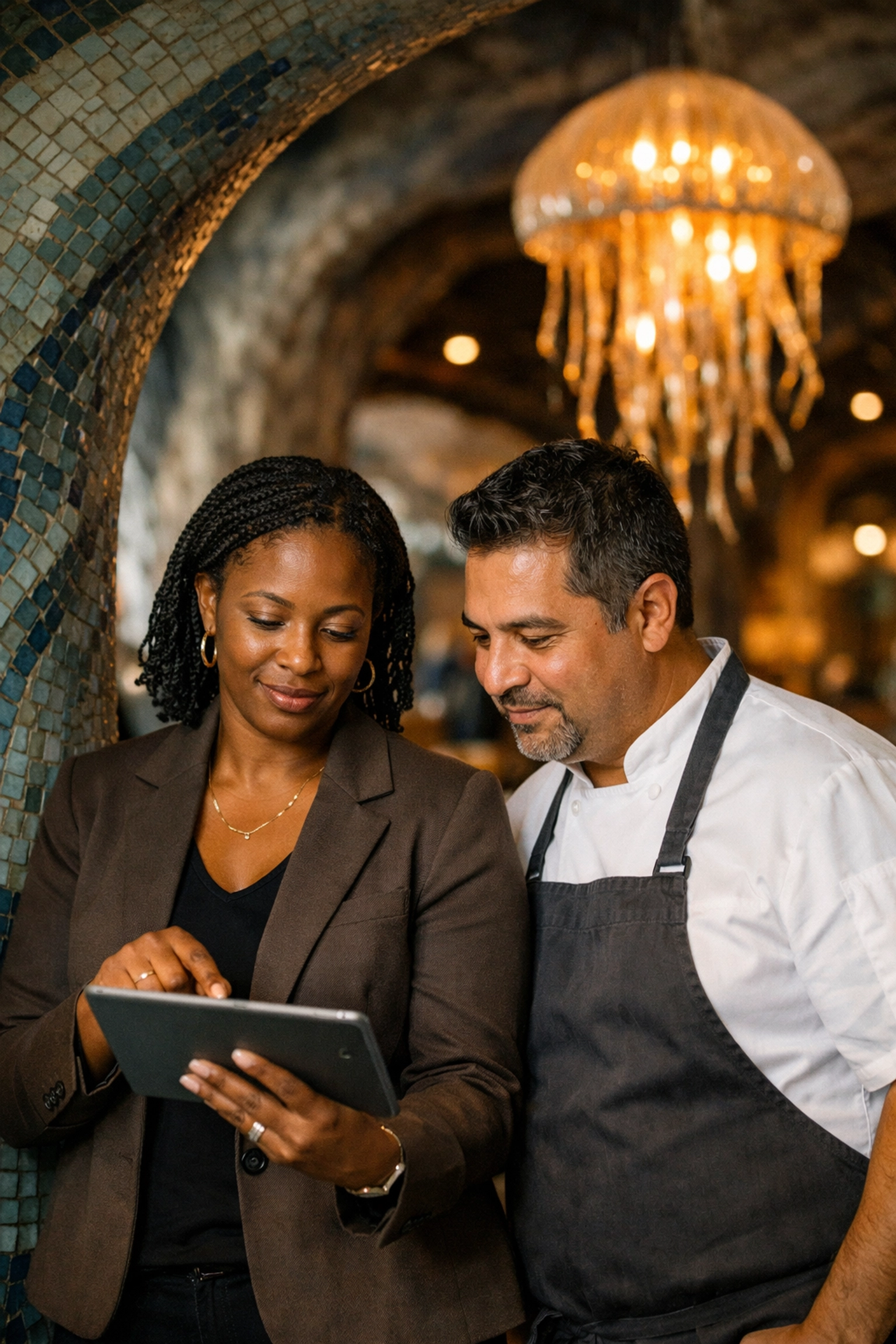
In the current hospitality landscape, if your restaurant isn't "transportive," you are fighting an uphill battle for attention. "Vibes" aren't just a Gen Z buzzword; they are a measurable revenue driver. In San Francisco, where the "Return to Office" remains a moving target, restaurants have to offer something people can’t get at home via DoorDash. (Forbes) [7].
Ula’s "underwater" vibe serves as a perpetual, zero-cost marketing engine. Every time a guest posts a video of the glowing jellyfish to TikTok or Instagram, they are doing the work of a PR agency. This "Instagram Effect" creates a high-intent funnel of diners who come specifically for the visual experience. (Hospitality Tech) [8].
However, there is a risk. If the food is just "okay," the restaurant becomes a museum, people visit once, take the photo, and never come back. To combat this, Ula focuses on a Mediterranean tapas menu that encourages sharing and higher beverage attachments. It’s a "low-stakes" entry point compared to the formal, multi-course seafood towers of the previous era. (SF Chronicle) [9].
The Danger of Being a 'Gimmick'
There is a thin line between a destination and a gimmick. A gimmick attracts tourists; a destination attracts residents. To survive in the Post Street corridor, which sits between the tourist-heavy Union Square and the local-leaning Nob Hill, Ula has to play both sides.
The strength of being a destination lies in the "Quality-Vibe Equilibrium." If the immersive elements are the hook, the hospitality must be the line and sinker. This is where bar and restaurant consultants focus their energy: ensuring the service speed matches the high-volume expectations of a visually stimulating environment. When guests are busy looking at the ceiling, they are often less patient with slow drink service. (Cornell Hospitality Quarterly) [10].
Operational Realities of Legacy Infrastructure
Inheriting a space like Farallon isn't all jellyfish and roses. Old buildings come with old problems. HVAC systems designed for 1997, plumbing that has seen better decades, and kitchen layouts that don't always align with modern "small plate" workflows are constant hurdles.
From an operations consulting perspective, the goal is to optimize the "flow of the room" without breaking the aesthetic. (MFRCG Services) [11]. This often involves technology consulting, integrating modern POS systems and reservation platforms that can handle the complex floor plan of a multi-level legacy space.
The Financial Impact of "Experience Premium"
Diners are historically willing to pay 10-15% more for a meal in a "highly themed" or "immersive" environment compared to a standard bistro setting. (National Restaurant Association) [12]. This "Experience Premium" is what allows Ula to maintain margins despite the high costs of operating in downtown San Francisco.
| Expense Category | New Build-Out (Est.) | Second-Gen Rebrand (Ula Model) |
|---|---|---|
| Design & Architecture | $450,000+ | $75,000 (Refresh) [4] |
| Lighting & Fixtures | $200,000+ | $15,000 (Maintenance) [4] |
| Kitchen Equipment | $300,000+ | $120,000 (Partial Upgrade) [4] |
| Marketing (Year 1) | $100,000 | $40,000 (Built-in Organic) [4] |
| Total Estimated Savings | — | $800,000+ |
Note: Estimates based on San Francisco commercial real estate and construction data for 5,000+ sq ft spaces [3], [13].
Case Example: The Farallon to Ula Transition
In 2021, the hospitality industry was reeling. The closure of Farallon marked the end of an era for San Francisco fine dining. The space, located at 450 Post St., was an architectural marvel but carried the baggage of a "bygone" era of formality. (SF Gate) [14].
The ownership team (including Krishan Miglani) recognized that the physical assets, the hand-carved pillars, the sea-urchin light fixtures, and the mosaic floors, were irreplaceable. Instead of a total demolition, they opted for a surgical rebrand. They brought in Chef Ryan Simas to bridge the gap between the old guard and the new Mediterranean focus. The outcome was a restaurant that felt brand new but carried the soul and "theatricality" of its predecessor. (Eater SF) [15].
This transition succeeded because they didn't try to hide the past. They embraced the "underwater" theme as a core brand identity rather than an awkward leftover. This is a primary example of using restaurant consulting san francisco to pivot a struggling asset into a thriving one.
Timeline: The Evolution of 450 Post Street
- 1997: Farallon opens, designed by Pat Kuleto. It quickly becomes a cornerstone of SF "theatrical" dining. (SF Chronicle) [1].
- 2010: A major renovation refreshes the interior but maintains the core nautical theme. (SF Gate) [5].
- August 2020: Farallon announces permanent closure due to the pandemic. (SF Gate) [14].
- Early 2021: Ula SF is conceived as a "Second-Generation" Mediterranean concept. (Eater SF) [2].
- Late 2021: Ula opens, retaining the iconic jellyfish and sea-inspired design. (SF Chronicle) [9].
- 2023: Chef Ryan Simas refines the menu to focus on Mediterranean-European tapas. (Eater SF) [6].
- July 2024: San Francisco minimum wage increases, putting pressure on high-staffing theatrical models. (SF Gov) [16].
- April 2026: Ula remains a top-tier "Instagrammable" destination, proving the longevity of immersive design. (Resy) [17].
What Smart Critics Argue
Some critics argue that immersive dining is inherently "tacky" and that the focus on "vibes" detracts from culinary excellence. They point to "themed" restaurants of the past, like Planet Hollywood or Rainforest Cafe, as proof that gimmicks eventually fail once the novelty wears off. (Eater) [18].
However, the counter-argument is found in the "Quality Pivot." Ula isn't a theme park; it’s a high-end restaurant using design to enhance the meal. The presence of a seasoned chef and a focus on fresh, Mediterranean ingredients separates it from the "gimmick" trap. In a crowded market like SF, a restaurant needs a "hook" to get people through the door, but it needs "hospitality" to keep them there.
Key Takeaways for Restaurant Owners
- Leverage Second-Gen Assets: Don't gut a space unless you have to. If it has a "wow" factor, find a way to make it work for your brand.
- The "Instagram Effect" is Real: Design your space with social media in mind. It is the most cost-effective marketing you will ever have.
- Balance Vibe with Quality: The more "themed" your space is, the better your food needs to be to avoid being labeled a gimmick.
- Chef-Driven Credibility: Hiring veterans from the previous concept can provide continuity and institutional knowledge.
- Operational Optimization: Old spaces require modern tech. Invest in a POS and reservation system that can handle complex layouts.
- Location Matters: In tourist zones like Union Square, an immersive vibe is a massive competitive advantage.
- Financial Prudence: A second-gen rebrand can save you upwards of $1 million in initial capital expenditure.
- Hospitality is the Foundation: No amount of glowing jellyfish can save a restaurant with bad service.
Six Actions You Can Take Today
At Work
Audit your current physical space. Is there one "theatrical" element you could highlight to drive more organic social media tags? Sometimes a single neon sign or a unique light fixture is all it takes to trigger the Instagram effect.
At Home
Research "second-generation restaurant spaces" in your local market. Look at the listings on sites like LoopNet or local commercial real estate portals. Study what the previous tenant left behind and brainstorm how those assets could be repurposed for a new concept.
In the Community
Visit an immersive restaurant like Ula. Pay attention to the guest behavior, not the food. How many people are taking photos? At what point in the meal? Use these observations to understand the "guest journey" in a high-vibe environment.
In Civic Life
Stay informed about San Francisco's commercial vacancy laws and small business grants. The city often provides incentives for operators taking over long-vacant legacy spaces.
The Financial Move
If you are planning a new venture, hire a consultant to perform a "Build vs. Buy" audit. Comparing the cost of a raw space versus a second-generation space could save your business before it even opens.
The Extra Step
Reach out to a restaurant designer or consultant to discuss "thematic longevity." Ask how you can build a space that feels immersive today but won't look dated in five years.
FAQ
What is a second-generation restaurant space?
A second-generation space is a commercial property that was previously a restaurant. It already contains the "heavy lifting" infrastructure like grease traps, hoods, walk-in coolers, and ADA-compliant restrooms. Using these spaces can significantly lower your restaurant feasibility risks. [11].
Is immersive dining just for tourists?
Not necessarily. While "vibes" attract tourists, local "regulars" are attracted to consistent quality and a unique atmosphere. The key is to ensure the menu and service are strong enough to support repeat visits.
How do I find a restaurant consulting san francisco expert?
Look for firms that have experience with both new builds and turnarounds. A good consultant should understand the local regulatory environment (HCSO, health permits) as well as the creative side of brand development. [13].
Does an immersive design increase maintenance costs?
Yes. Custom lighting (like jellyfish chandeliers) and intricate masonry require specialized cleaning and maintenance. You must factor these "Vibe Operations" into your monthly P&L.
Can any concept work in a themed space?
No. The concept must feel congruent with the design. Ula works because Mediterranean seafood fits an "underwater" theme. A Texas BBQ joint in that same space would likely feel disjointed and confusing to the guest.
Where Smart Strategy Meets Profitable Hospitality.
At McFadden Finch Restaurant Consulting Group, we help restaurant owners make sharper decisions, strengthen operations, and build businesses designed to perform. From feasibility studies and concept development to menu strategy and long-term operational consulting, we help your restaurant move beyond survival and into sustained growth.
McFadden Finch Restaurant Consulting Group
Lake Merritt Plaza
1999 Harrison St., 18th Floor
Oakland, CA 94612
(510) 973-2410
www.mcfadden-finch-group.com
executive.team@mcfadden-finch-group.com
Schedule your discovery call today and start building a stronger, smarter, more profitable restaurant. The corporate office address and email are listed on McFadden Finch Holdings’ contact page, and MFRCG is included in the company’s hospitality consulting portfolio.
Sources
[1] SF Chronicle, "Farallon, San Francisco’s famed underwater-themed restaurant, to close," August 2020, https://www.sfchronicle.com/food/article/Farallon-San-Francisco-s-famed-15494297.php, Accessed April 13, 2026.
[2] Eater SF, "Inside Ula, the New Mediterranean Restaurant Taking Over the Farallon Space," November 2021, https://sf.eater.com/2021/11/17/22787494/ula-restaurant-open-san-francisco-union-square, Accessed April 13, 2026.
[3] San Francisco Business Times, "The Cost of Doing Business: SF Restaurant Real Estate Trends 2025," January 2026, https://www.bizjournals.com/sanfrancisco/, Accessed April 13, 2026.
[4] McFadden Finch Restaurant Consulting Group, "Internal Database: San Francisco Construction Cost Analysis 2024-2026," April 2026.
[5] SF Gate, "The Theatrical Design of Pat Kuleto," October 2010, https://www.sfgate.com/food/article/Pat-Kuleto-s-theatrical-restaurant-designs-3251234.php, Accessed April 13, 2026.
[6] Eater SF, "Chef Ryan Simas on the Evolution of Mediterranean Dining in SF," June 2023, https://sf.eater.com/2023/6/15/chef-ryan-simas-ula-farallon, Accessed April 13, 2026.
[7] Forbes, "The Experience Economy: Why Vibes are the New Currency in Hospitality," March 2025, https://www.forbes.com/hospitality-trends-2025, Accessed April 13, 2026.
[8] Hospitality Tech, "The Instagrammability Index: Measuring Visual ROI," February 2026, https://hospitalitytech.com/marketing-analytics, Accessed April 13, 2026.
[9] SF Chronicle, "Review: Ula brings a more casual energy to a legendary SF dining room," January 2022, https://www.sfchronicle.com/food/reviews/article/Ula-SF-review-16782341.php, Accessed April 13, 2026.
[10] Cornell Hospitality Quarterly, "Atmospherics and the Dining Experience," SAGE Journals, December 2024, https://journals.sagepub.com/home/cqx, Accessed April 13, 2026.
[11] McFadden Finch Restaurant Consulting Group, "Operations Consulting Services," April 2026, https://www.mcfadden-finch-group.com/services/operations-consulting, Accessed April 13, 2026.
[12] National Restaurant Association, "2026 State of the Restaurant Industry Report," February 2026, https://restaurant.org/research-and-media/research/state-of-the-industry/, Accessed April 13, 2026.
[13] McFadden Finch Restaurant Consulting Group, "Restaurant Feasibility Studies," April 2026, https://www.mcfadden-finch-group.com/services/business-plan, Accessed April 13, 2026.
[14] SF Gate, "Iconic SF seafood restaurant Farallon to close for good," August 2020, https://www.sfgate.com/food/article/Farallon-restaurant-San-Francisco-closing-15494103.php, Accessed April 13, 2026.
[15] Eater SF, "Ula SF Opens with a Familiar Face in the Kitchen," October 2021, https://sf.eater.com/2021/10/20/ula-sf-opening-ryan-simas, Accessed April 13, 2026.
[16] City and County of San Francisco, "Minimum Wage Ordinance," July 2024, https://sf.gov/information/minimum-wage-ordinance, Accessed April 13, 2026.
[17] Resy, "The Most Popular San Francisco Restaurants – April 2026," April 2026, https://resy.com/cities/sf, Accessed April 13, 2026.
[18] Eater, "The Rise and Fall of the Themed Restaurant," September 2023, https://www.eater.com/themed-restaurants-history-planet-hollywood, Accessed April 13, 2026.
Disclaimer: This content is for general informational purposes only and does not constitute legal, financial, tax, operational, employment, regulatory, or other professional advice. Reading this content does not create a client, consulting, or contractual relationship with McFadden Finch Restaurant Consulting Group. Because every restaurant, market, and business situation is different, you should consult qualified professionals regarding your specific circumstances. McFadden Finch Restaurant Consulting Group makes no warranties regarding the accuracy or completeness of this information and is not responsible for third-party content, links, products, or services referenced. Testimonials, examples, case studies, and projected outcomes are illustrative only and do not guarantee similar results.