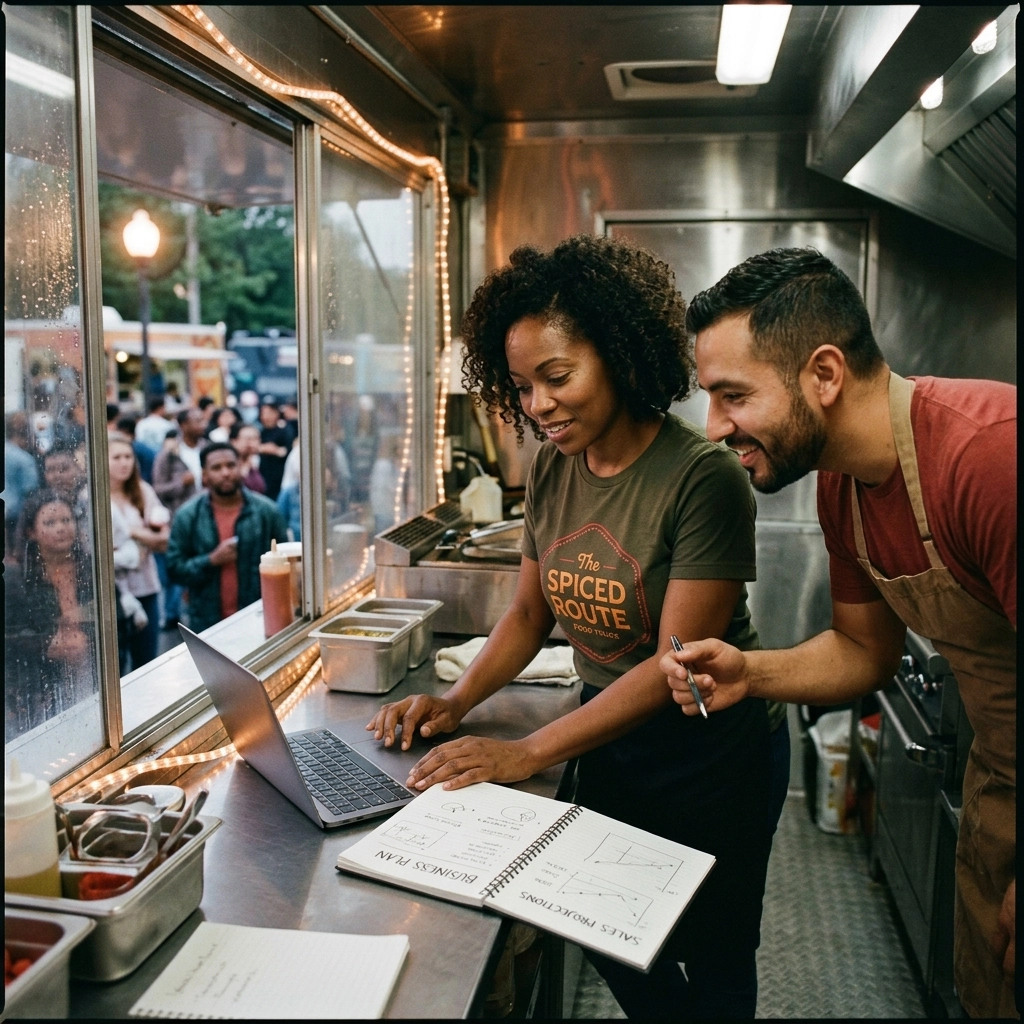
Building a profitable mobile concept requires more than a killer menu, it demands a strategic roadmap for permits, logistics, and survival.
Imagine standing inside a custom-wrapped, $120,000 step van in the middle of a bustling downtown corridor. The smell of your signature Korean-Mexican fusion is drawing a crowd, and the line is stretching around the block. It looks like a win. But then, a city code enforcement officer pulls up. You realize your permit doesn't cover this specific zone. Ten minutes later, your generator chokes because it wasn’t rated for the midday heat, and you’re forced to tell fifty hungry people that you're closed for the day. You’re out $2,000 in potential sales, and you still have to pay your staff.
This isn't a hypothetical nightmare; it’s a Tuesday for operators who thought a great recipe was the same thing as a business. The "mobile" part of a food truck is its greatest asset and its biggest liability. Without a rigorous food truck business plan, you aren't running a business; you’re driving a very expensive hobby that breaks down frequently.
The industry has shifted. In 2024, the mobile food service market in the U.S. reached a valuation of $1.6 billion, growing at an annual rate of 9.9% (IBISWorld) [1]. But that growth hides a brutal reality: many trucks fail within the first two years because they lack the operational infrastructure to handle the "unseen" variables.
In this guide, you will learn:
- How to navigate the "regulatory gauntlet" of permits and health department requirements.
- Why the commissary kitchen is the most critical partner in your supply chain.
- The math behind route strategy and how to forecast financials that actually make sense.
The Regulatory Gauntlet: More Than Just a Sticker
Look, getting a health permit for a brick-and-mortar restaurant is a headache, but for a food truck, it’s a moving target. You aren't just dealing with one set of rules. If you plan to drive from Oakland to San Francisco to San Jose, you are entering three different jurisdictions with three different sets of fire codes, health regulations, and parking ordinances (National Restaurant Association) [2].
A solid food truck business plan identifies these zones before you ever turn the key. Most cities require a Mobile Food Facility (MFF) permit, but the requirements can vary wildly. For instance, some jurisdictions require a specific type of high-temperature dishwashing setup, while others allow for three-compartment sinks with chemical sanitizers (FDA Food Code) [3]. If you build your truck for one city and try to operate in another, you might find yourself barred from the curb. At McFadden Finch Restaurant Consulting Group, we often see owners spend thousands on retrofitting equipment because they didn't do the feasibility work upfront.
The Commissary Kitchen: Your Silent Partner
Here’s the thing: you probably cannot legally prep your food on the truck. Most states require mobile vendors to operate out of a licensed commissary kitchen (Public Health Law Center) [4]. This is where you store your bulk ingredients, do your heavy prep, and dispose of your grey water.
Your business plan needs to account for the commissary as a major line item. It’s not just a monthly fee; it’s a logistical anchor. If your commissary is 45 minutes away from your primary route, you are burning fuel and labor hours just getting to the starting line. A well-vetted plan analyzes the proximity of these kitchens and their amenities, like overnight plug-ins for your refrigeration, which can save you from losing thousands in inventory during a power hiccup (SBA) [5].

Route Strategy: The Chess Game of the Curb
The biggest mistake new operators make is thinking they can just find a "good spot" and park. The reality is that the best spots are often fought over or require long-term contracts with private lots. A "park and pray" strategy is a recipe for bankruptcy.
Professional operators use data-driven route strategies. This means analyzing foot traffic patterns, competitor density, and nearby events. According to research on urban food corridors, trucks that rotate through a "loop" of 3-5 reliable locations see 20% higher customer retention than those that move randomly (Journal of Urban Economics) [#6]. Your food truck business plan should include a "Route Feasibility Study" that maps out where you will be every hour of the week, including the cost of "renting" spots at breweries or corporate parks.
Financial Forecasting: Beyond Food Costs
Everyone calculates their COGS (Cost of Goods Sold), but food trucks have a unique set of "burn" expenses. You have fuel, propane, generator maintenance, and "commission" fees if you use third-party apps or participate in organized food truck markets (Restaurant Business Online) [7].
A realistic financial forecast needs to account for seasonality and weather. If it rains for a week in the Bay Area, your sales might drop by 70%. Does your plan have the cash reserves to survive a wet winter? Most consultants suggest having at least three to six months of operating capital in the bank before you launch (Score.org) [8]. We help our clients build business plans that include "stress tests", showing what happens to the bottom line when gas prices spike or a major event gets canceled.
Technology is Your Engine
Modern trucks don't just take cash. You need a tech stack that handles mobile ordering, inventory management, and, most importantly, real-time location updates for your fans. 73% of diners say they use social media or a truck’s website to find its current location (Toast) [9].
If your tech fails, your business stops. Your plan should specify a POS system that works offline (for those dead zones) and integrates with your accounting software. This isn't just about convenience; it’s about "speed of service." In the food truck world, your "ticket time" is your lifeblood. If you can’t turn a ticket in under four minutes, your line will evaporate (Cornell Hospitality Quarterly) [10].
The Maintenance Trap
Your truck is a kitchen, but it’s also a vehicle. If the engine dies, your kitchen dies. We’ve seen operators lose an entire month of revenue because they didn't have a contingency plan for mechanical failure.
A professional plan includes a preventive maintenance schedule for both the truck and the kitchen equipment. High-vibration environments (like driving a truck over city potholes) wreak havoc on refrigeration compressors and gas lines. You need to budget for specialized "mobile-rated" equipment, which is often 15-20% more expensive than standard commercial gear but lasts three times as long in a mobile environment (Foodservice Equipment & Supplies) [11].
Feasibility: The McFadden Finch Difference
Why do people hire a business consultant for a truck? Because we look at the numbers you’re too excited to see. A feasibility study isn't about crushing your dream; it’s about making sure your dream doesn't crush your bank account. We look at the "market saturation", if there are already six taco trucks in your target five-mile radius, we help you pivot your concept or find a different neighborhood where you can actually compete.
The 10-Step Launch Timeline
Building a mobile empire doesn't happen overnight. Here is the typical roadmap for a successful launch:
- Concept & Feasibility (Month 1): Market research and initial brand development. [2]
- The Business Plan (Month 2): Detailed financial forecasting and route strategy. [5]
- Financing (Month 3): Securing loans or investors using the professional plan. [8]
- Vehicle Sourcing (Month 4-6): Buying or building a truck that meets local codes. [11]
- Permitting & Licensing (Month 5-7): Applying for MFF permits, fire certificates, and business licenses. [3]
- Commissary Selection (Month 7): Vetting and signing a contract with a licensed kitchen. [4]
- Staffing & Training (Month 8): Hiring a team that can handle high-speed, cramped environments. [12]
- Menu Engineering (Month 8): Finalizing dishes that can be prepped fast and travel well. [10]
- Marketing & Soft Launch (Month 9): Building buzz on social media and doing private events. [9]
- Grand Opening (Month 10): Hitting your first public route with a fully optimized system. [1]
Data: The Mobile vs. Brick-and-Mortar Reality
Many entrepreneurs choose food trucks because they think they are "cheaper" than a restaurant. While the entry cost is lower, the operational margins can be tighter.
| Expense Category | Food Truck (Avg) | Brick-and-Mortar (Small Cafe) |
|---|---|---|
| Initial Startup Cost | $75k – $150k [5] | $250k – $500k [13] |
| Monthly Rent/Permits | $800 – $2,500 (Commissary/Parking) [4] | $3,500 – $8,000 [13] |
| Maintenance Reserve | 5-7% of revenue (Vehicle + Kitchen) [11] | 2-3% of revenue [10] |
| Marketing Need | High (Must communicate location) [9] | Moderate (Fixed location awareness) [7] |
| Prime Cost Goal | 55 – 60% [2] | 60 – 65% [10] |
Sources: SBA [5], National Restaurant Association [2], Foodservice Equipment & Supplies [11].
Case Example: The Pivot from "Vibes" to Data
An Oakland-based entrepreneur (let's call them "Truck X") launched a high-end bao bun truck in 2024. They had incredible branding and a chef from a Michelin-starred background. However, within four months, they were bleeding cash. They were parking at high-profile events but paying 30% of their gross to organizers, and their prep time was so complex they could only serve 40 people an hour.
They came to McFadden Finch for a turnaround strategy. We overhauled their food truck business plan. We moved them from expensive events to a consistent corporate route three days a week and simplified the menu to increase throughput. By focusing on "speed of service" and a "fixed-mobile" route (the same spots every week), they increased their net profit by 22% in ninety days. The lesson? The food was great from day one, but the plan was what finally made it a business.
What Smart Critics Argue
Some industry veterans argue that business plans are "dead" because the mobile industry moves too fast for a static document. They suggest that "agility" is more important than a 40-page PDF.
While it’s true that you need to be agile, agility without a foundation is just chaos. A business plan isn't a static document; it’s a living framework. You don't write it to put it on a shelf; you write it to understand the math of your survival. If you don't know your break-even point for a Tuesday afternoon, you can't make an "agile" decision about whether to stay open or pack it in.
Key Takeaways
- Permits are regional: Never assume a permit in one city works in the next. [3]
- Commissaries are mandatory: Your kitchen isn't just on the truck; it’s at your base of operations. [4]
- Route over "Vibes": Data-driven location selection beats "gut feeling" every time. [6]
- Maintenance is a fixed cost: Budget for the inevitable breakdown of the truck or the generator. [11]
- Speed is profit: If your ticket times are over 5 minutes, you are losing money. [10]
- Tech is the bridge: Use social media and GPS tracking to keep your customers connected to your location. [9]
- Feasibility saves lives: A professional feasibility study prevents you from entering a saturated market. [1]
Actions You Can Take Today
At Work
Audit your current throughput. Time your staff from the moment a customer pays to the moment they receive their food. If it’s over 4 minutes, identify the bottleneck in your kitchen layout.
At Home
Review your last three months of fuel and propane costs. Most operators underestimate these by 15%. Adjust your menu pricing if your "energy surcharge" is eating your margins.
In the Community
Visit three local commissary kitchens. Don't just look at the price; look at the cleanliness, the security of the parking, and the ease of the grey water disposal station.
In Civic Life
Attend a city council meeting or a small business commission hearing. Mobile food laws are changing rapidly in the Bay Area, and being the first to know about a new "permitted zone" can give you a massive competitive edge.
The Extra Step
Hire an expert to "stress test" your current financial projections. A fresh set of eyes can often see the $500-a-month leak in your operations that you've become blind to.
FAQ
Do I really need a commissary if I have a full kitchen on my truck?
Yes. In almost every major U.S. jurisdiction, health departments require a permanent, licensed facility for bulk storage, heavy prep, and wastewater disposal [4].
How much should I spend on a used food truck?
A reliable used truck usually costs between $50,000 and $90,000. Anything cheaper often requires so much mechanical work that you’ll lose more in "down-time" than you saved on the purchase price [11].
What is the most profitable item to sell on a food truck?
Items with high perceived value but low ingredient costs, such as gourmet fries, specialized tacos, or signature beverages. The key is "assembly speed" over "complex cooking" [10].
How do I find out where I’m allowed to park?
Check your city's "Mobile Food Vendor" handbook. Many cities provide interactive maps showing permitted zones and prohibited "no-stop" areas [3].
Can McFadden Finch help with my truck's menu?
Absolutely. We specialize in menu strategy that balances culinary excellence with the physical constraints of a 10-foot kitchen.
Where Smart Strategy Meets Profitable Hospitality.
At McFadden Finch Restaurant Consulting Group, we help restaurant owners make sharper decisions, strengthen operations, and build businesses designed to perform. From feasibility studies and concept development to menu strategy and long-term operational consulting, we help your restaurant move beyond survival and into sustained growth.
McFadden Finch Restaurant Consulting Group
Lake Merritt Plaza
1999 Harrison St., 18th Floor
Oakland, CA 94612
(510) 973-2410
www.mcfadden-finch-group.com
executive.team@mcfadden-finch-group.com
Schedule your discovery call today and start building a stronger, smarter, more profitable restaurant. The corporate office address and email are listed on McFadden Finch Holdings’ contact page, and MFRCG is included in the company’s hospitality consulting portfolio.
Sources
[1] IBISWorld, "Food Trucks in the US – Market Size, Industry Analysis, and Forecast," January 2024, https://www.ibisworld.com/united-states/market-research-reports/food-trucks-industry/, Accessed May 14, 2026.
[2] National Restaurant Association, "Food Truck Operational Standards and Best Practices," 2025, https://restaurant.org, Accessed May 14, 2026.
[3] U.S. Food and Drug Administration (FDA), "Food Code 2022," https://www.fda.gov/food/fda-food-code/food-code-2022, Accessed May 14, 2026.
[4] Public Health Law Center, "Regulatory Framework for Mobile Food Vendors," 2023, https://www.publichealthlawcenter.org, Accessed May 14, 2026.
[5] U.S. Small Business Administration (SBA), "Starting a Food Truck Business Guide," https://www.sba.gov/business-guide/, Accessed May 14, 2026.
[6] Journal of Urban Economics, "Agglomeration and the Spatial Distribution of Mobile Vendors," University of California Press, 2024.
[7] Restaurant Business Online, "The Rising Costs of the Mobile Food Segment," 2025, https://www.restaurantbusinessonline.com, Accessed May 14, 2026.
[8] Score.org, "Financial Planning for Mobile Entrepreneurs," https://www.score.org, Accessed May 14, 2026.
[9] Toast, "2024 Food Truck Industry Report," https://pos.toasttab.com/blog/on-the-line/food-truck-industry-stats, Accessed May 14, 2026.
[10] Cornell Hospitality Quarterly, "Optimizing Throughput in Limited-Space Kitchens," Cornell University, 2023.
[11] Foodservice Equipment & Supplies, "Specifying Equipment for the Vibration and Heat of Food Trucks," 2024, https://fesmag.com, Accessed May 14, 2026.
[12] California Department of Industrial Relations, "Labor Laws for Mobile Businesses," https://www.dir.ca.gov, Accessed May 14, 2026.
[13] San Francisco Business Times, "The Real Estate Reality: Brick and Mortar vs. Mobile," 2025, https://www.bizjournals.com/sanfrancisco/, Accessed May 14, 2026.
Disclaimer: This content is for general informational purposes only and does not constitute legal, financial, tax, operational, employment, regulatory, or other professional advice. Reading this content does not create a client, consulting, or contractual relationship with McFadden Finch Restaurant Consulting Group. Because every restaurant, market, and business situation is different, you should consult qualified professionals regarding your specific circumstances. McFadden Finch Restaurant Consulting Group makes no warranties regarding the accuracy or completeness of this information and is not responsible for third-party content, links, products, or services referenced. Testimonials, examples, case studies, and projected outcomes are illustrative only and do not guarantee similar results.