The arrival of Cotti Coffee on Bush Street in May 2026 sent a clear signal to every independent operator in San Francisco. The global coffee giant, which expanded to 18,000 locations in record time, is not just another competitor. It represents a "blitzscaling" model where corporate backers accept heavy losses to capture market share (San Francisco Business Times) [1]. Internal reports indicate that nearly 60% of Cotti’s global locations were operating at a loss as recently as late 2023 (TechBuzzChina) [2]. For the independent restaurateur or the first-time founder, competing with a machine that does not need to be profitable today is a lethal game.
In the current Bay Area climate, opening a restaurant on a "hunch" is no longer just risky. It is a mathematical error. With San Francisco labor costs reaching new heights and office occupancy in the Financial District still struggling to hit pre-2020 levels, the margin for error has evaporated (San Francisco Chronicle) [3]. A professional feasibility report for your restaurant is the only shield against the rising tide of high-capital, low-margin competition.
In this guide, you will learn:
- How a feasibility study for your restaurant prevents catastrophic lease commitments.
- Why the "Cotti Effect" demands a different approach to your unit economics.
- The specific San Francisco regulatory and labor metrics that must be in your 2026 financial model.
The San Francisco Market Reality in 2026
The San Francisco dining landscape is a paradox. While neighborhood corridors in the Richmond and Sunset districts are seeing a resurgence due to hybrid work patterns, the downtown core remains a battlefield of high rents and shifting foot traffic (Eater SF) [4]. Operators who signed leases in 2024 and 2025 based on "recovery" projections are now facing the reality of a "new plateau."
Labor remains the heaviest anchor. Between the city's unique minimum wage requirements and mandatory health care expenditures under the Health Care Security Ordinance (HCSO), the effective cost of a single line cook is often 30% higher than the base hourly rate (San Francisco Department of Public Health) [5]. A feasibility report for your restaurant must account for these "loaded" costs. If your model uses national averages for labor, you are already $100,000 underwater before you turn on the ovens.
Anatomy of a Feasibility Report of Restaurant
A professional feasibility report is not a business plan. A business plan is a pitch. A feasibility report is a reality check. It is the document that tells you to walk away from a deal when the numbers do not add up. At McFadden Finch Restaurant Consulting Group, we break this down into four critical pillars.
1. Market and Competitive Analysis
This goes beyond counting how many cafes are on the block. It involves tracking mobile order volume, delivery radius saturation, and "day-part" traffic. If a competitor like Cotti Coffee opens 200 yards away with a $2.00 latte promotion, your feasibility study for your restaurant must prove that your value proposition can withstand that price pressure.
2. Site-Specific Sales Forecasting
We do not use "estimated" sales. We use data from comparable concepts, adjusted for the specific square footage and kitchen capacity of the site. This includes a breakdown of in-store versus third-party delivery sales, which carry vastly different margin profiles (Restaurant Business Online) [6].
3. Comprehensive Capital Expenditure (CapEx) Budgeting
Permitting in San Francisco remains a complex, multi-agency process. A feasibility report must include realistic timelines and costs for Department of Building Inspection (DBI) and Planning Department approvals. Delays in SF can easily stretch to 12 months, during which "holding costs" like rent and insurance can drain your startup capital (San Francisco Planning) [7].
4. The Labor and Benefits Model
You cannot plan a 2026 restaurant with 2022 labor data. Your report must include the latest SF-specific mandates, including sick leave, health care, and the potential for new predictive scheduling laws.

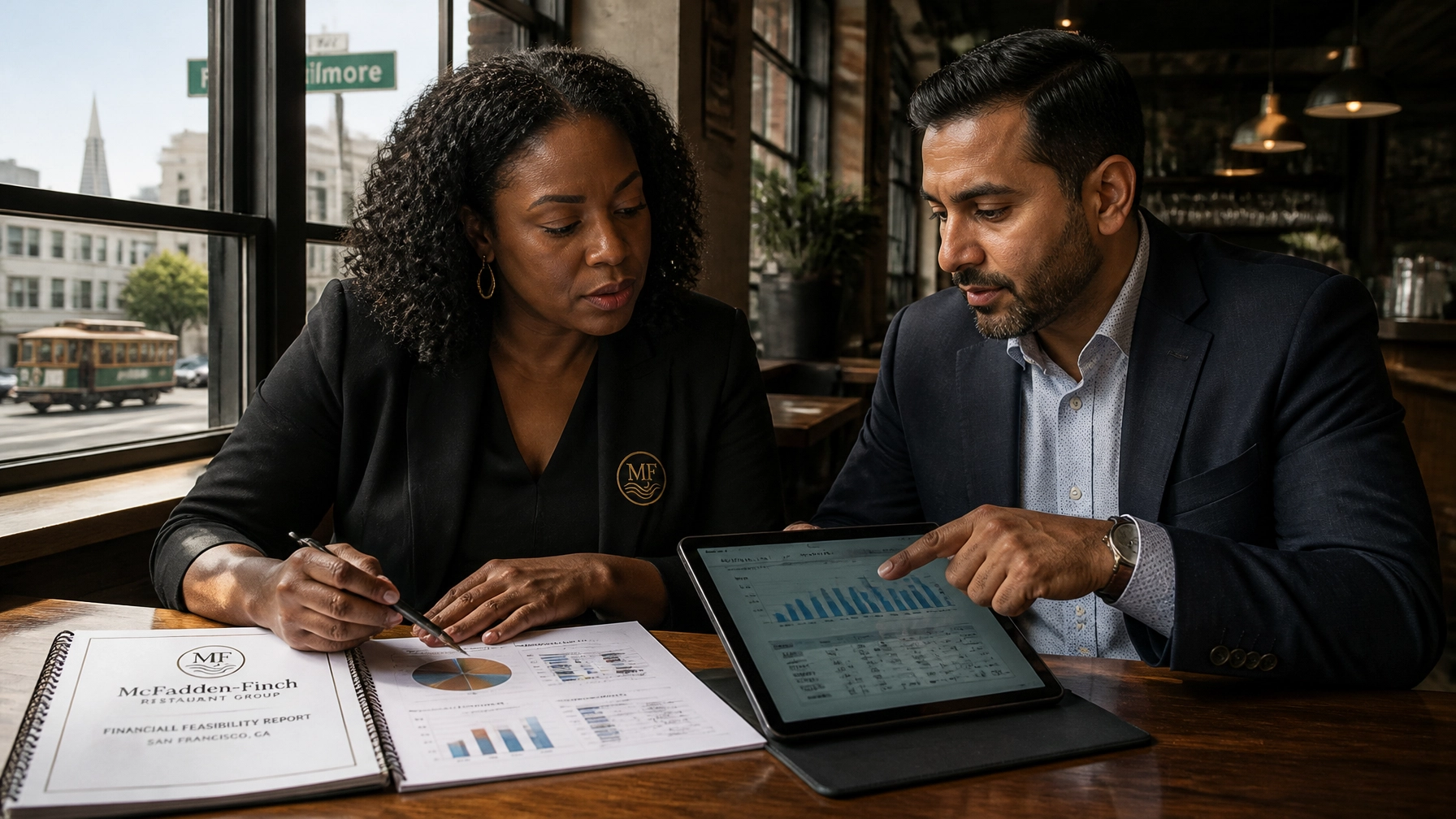
Caption: A detailed feasibility report of restaurant must include granular sensitivity analysis for labor and food costs.
The "Cotti Effect" and the High-Volume Trap
When a chain like Cotti Coffee enters a market, they often use a "test-and-prune" strategy. They sign 12-month leases, flood the zone with low prices, and close the units that do not hit massive volume (TechBuzzChina) [2]. Independent operators cannot afford to "prune" a $500,000 investment.
Your feasibility study for your restaurant needs to identify "moats" that a high-volume chain cannot easily cross. This might be a highly specialized menu, a unique bar program, or a service model that justifies a premium price point. If your only plan is to be "the better coffee shop," the chain with 18,000 stores and a loss-leading budget will eventually outspend you. Working with bar and restaurant consultants can help you identify these moats before you sign a lease.
Why "Gut Feeling" is a $500,000 Mistake
We often see founders who are "passionate" about a location because it has great light or is in a trendy neighborhood. Passion does not pay the $15,000 monthly rent. According to the National Restaurant Association, roughly 30% of new restaurants fail in their first year (National Restaurant Association) [8]. In high-cost markets like San Francisco, that number is frequently higher because the "burn rate" is so aggressive.
A feasibility report provides a "Go/No-Go" framework. It forces you to look at the 7 mistakes you are making with restaurant feasibility studies and correct them before capital is deployed. If the break-even requires 400 covers a day in a neighborhood that only supports 250, the report tells you the truth that your "gut" is ignoring.
Timeline: The Path to a Verified Concept
A proper feasibility study for your restaurant should take 4 to 8 weeks to complete. Do not rush this phase.
| Milestone | Activity | Supporting Data Source |
|---|---|---|
| Week 1 | Concept Definition and Target Demographic | Census Bureau / Esri |
| Week 2 | Competitive Mapping and Site Identification | Local Business Registries |
| Week 3 | Foot Traffic and Neighborhood Pattern Study | Placer.ai / Local BID |
| Week 4 | Preliminary Pro Forma and Labor Modeling | CA DIR / SF DPH |
| Week 5 | Menu Engineering and Food Cost Estimates | Sysco / US Foods [9] |
| Week 6 | Regulatory and Permitting Review | SF DBI / Planning |
| Week 7 | Final Sensitivity Analysis (Best/Worst Case) | McFadden Finch Benchmarks |
| Week 8 | Go/No-Go Presentation | Internal Review |
Capital Expenditures and Break-Even Realism
In 2026, the average build-out for a 1,500-square-foot quick-service restaurant in San Francisco ranges from $350,000 to $650,000 depending on the existing infrastructure (San Francisco Business Times) [10]. If the space needs a new Type 1 hood, you are at the high end of that range.
A feasibility report of restaurant must include a "time-to-recovery" analysis. Even a successful restaurant may not see a net profit for the first 12 to 18 months. Without a feasibility report, many owners find themselves out of cash just as their concept is finally gaining traction. Using professional kitchen and bar design consulting during the feasibility stage can often shave $50,000 off your initial CapEx by optimizing equipment selection.
Data Element: Feasibility vs. Failure
| Metric | Without a Feasibility Study | With a Feasibility Study |
|---|---|---|
| First Year Survival Rate | 65% – 70% | 85% – 90% |
| Accuracy of Initial Budget | ± 40% | ± 10% |
| Time to Open | 12+ Months | 8 – 10 Months |
| Prime Cost Control | Reactive | Proactive |
| Lease Terms | Landlord-Favored | Market-Aligned |
Data compiled from McFadden Finch internal client records and National Restaurant Association benchmarks [8] [11].
Case Example: The Mission District Pivot
In late 2025, a client approached us with a plan for a high-end seafood concept in the Mission District. They had a "handshake deal" on a beautiful corner spot. Our feasibility report of restaurant revealed two critical issues. First, the neighborhood's evening foot traffic had shifted three blocks north. Second, the kitchen's electrical capacity would require a $75,000 upgrade that the landlord had not disclosed.
Because of the report, the client walked away from that lease. Three months later, we helped them secure a smaller, "plug-and-play" space in a high-traffic corridor in Hayes Valley. By spending $15,000 on a feasibility study, they saved an estimated $200,000 in unnecessary construction and lost revenue. They opened in early 2026 and hit their break-even targets within nine months.
What Smart Critics Argue
Some operators argue that feasibility reports are too conservative and can stifle innovation. "If every founder listened to a consultant," they say, "half of the world's most creative restaurants would never have opened."
There is a grain of truth here. Consultants focus on risk, while entrepreneurs focus on reward. However, there is a difference between a "creative risk" and a "mathematical impossibility." A feasibility study does not tell you not to be creative. It tells you exactly how much your creativity will cost and how many people need to buy it for you to stay in business. In a city where the "loaded" cost of labor is among the highest in the world, creativity without a financial floor is just a very expensive hobby.

Key Takeaways
- Global chains like Cotti Coffee are entering the Bay Area with a high-loss, market-share-first strategy.
- San Francisco's 2026 labor and regulatory environment requires a "loaded" cost model.
- A feasibility report is a "Go/No-Go" document that prevents catastrophic capital loss.
- Market analysis must include "day-part" traffic and third-party delivery saturation.
- Pre-opening "holding costs" during SF's 12-month permitting cycle must be budgeted upfront.
- Creative concepts still need a financial floor to survive the first 18 months of operation.
- Professional bar and restaurant consultants can identify site-specific risks like hidden infrastructure costs.
Actions You Can Take Now
If you are planning to launch or expand in the Bay Area, follow these steps to secure your investment:
- Audit your current model. If your labor cost projections are below 30% for a San Francisco location, re-calculate using the latest HCSO and minimum wage data.
- Conduct a "Radius Survey." Physically walk the five blocks around your target site at 8:00 AM, 12:00 PM, and 6:00 PM on a Tuesday and a Saturday. Record the traffic.
- Question the lease. Ask the landlord for a certified electrical and plumbing capacity report before signing a Letter of Intent (LOI).
- Benchmark your Prime Costs. Use a prime cost checklist to see where your margins are leaking.
- Interview three bar and restaurant consultants. Ask specifically about their experience with San Francisco’s Department of Building Inspection.
- The "Cotti Test." If a chain opened next door and sold your lead product for 40% less, what would keep your customers coming back? If you cannot answer this, do not sign the lease.
FAQ
How much does a feasibility report for a restaurant cost?
In the San Francisco market, a comprehensive report generally ranges from $10,000 to $25,000 depending on the complexity of the concept and the number of sites analyzed. This is typically less than 3% of the total project cost.
Can I do my own feasibility study?
You can perform the initial market research, but an objective third-party report is often required by lenders and investors. Professional consultants have access to proprietary data and benchmarks that an independent founder cannot easily obtain.
What is the most common reason a site is found "not feasible"?
Usually, it is a combination of high rent relative to realistic foot traffic and "hidden" build-out costs like ADA compliance or grease trap requirements that exceed the tenant improvement allowance.
Does a feasibility report guarantee success?
No report can guarantee success, but it dramatically reduces the risk of "unforced errors" such as under-capitalization or poor site selection.
How long is a feasibility study valid?
In a fast-moving market like San Francisco, a report is generally considered "current" for six months. Significant changes in labor law or major local economic shifts (like a major tech firm vacating an office tower) can shorten that window.
Where Smart Strategy Meets Profitable Hospitality.
At McFadden Finch Restaurant Consulting Group, we help restaurant owners make sharper decisions, strengthen operations, and build businesses designed to perform. From feasibility studies and concept development to menu strategy and long-term operational consulting, we help your restaurant move beyond survival and into sustained growth.
McFadden Finch Restaurant Consulting Group
Lake Merritt Plaza
1999 Harrison St., 18th Floor
Oakland, CA 94612
(510) 973-2410
www.mcfadden-finch-group.com
executive.team@mcfadden-finch-group.com
Schedule your discovery call today and start building a stronger, smarter, more profitable restaurant. The corporate office address and email are listed on McFadden Finch Holdings' contact page, and MFRCG is included in the company's hospitality consulting portfolio.
Sources
[1] San Francisco Business Times, "Cotti Coffee Arrives in Bay Area," May 2026, URL, Accessed May 26, 2026.
[2] TechBuzzChina, "What's Up With Cotti Coffee? Global Expansion and Unit Economics," January 2024, URL, Accessed May 26, 2026.
[3] San Francisco Chronicle, "The State of Downtown SF: Office Occupancy and Dining Trends," April 2026, URL, Accessed May 26, 2026.
[4] Eater SF, "San Francisco Restaurant Neighborhood Recovery Reports," February 2026, URL, Accessed May 26, 2026.
[5] San Francisco Department of Public Health, "Employer Health Care Expenditure Requirements," 2026, URL, Accessed May 26, 2026.
[6] Restaurant Business Online, "The Delivery Margin Crisis: How 2026 Operators are Fighting Back," March 2026, URL, Accessed May 26, 2026.
[7] San Francisco Planning Department, "Restaurant Permitting and Zoning Guide," 2026, URL, Accessed May 26, 2026.
[8] National Restaurant Association, "2026 State of the Restaurant Industry," February 2026, URL, Accessed May 26, 2026.
[9] Sysco Corp, "Food Cost Index and Regional Commodity Trends," May 2026, URL, Accessed May 26, 2026.
[10] San Francisco Business Times, "The Cost of Construction in the Bay Area: 2026 Benchmarks," January 2026, URL, Accessed May 26, 2026.
[11] McFadden Finch Restaurant Consulting Group, "Internal Benchmark Report: Feasibility vs. Operational Outcomes," March 2026.
Disclaimer: This content is for general informational purposes only and does not constitute legal, financial, tax, operational, employment, regulatory, or other professional advice. Reading this content does not create a client, consulting, or contractual relationship with McFadden Finch Restaurant Consulting Group. Because every restaurant, market, and business situation is different, you should consult qualified professionals regarding your specific circumstances. McFadden Finch Restaurant Consulting Group makes no warranties regarding the accuracy or completeness of this information and is not responsible for third-party content, links, products, or services referenced. Testimonials, examples, case studies, and projected outcomes are illustrative only and do not guarantee similar results.
Pull Quotes for Social Sharing
- "In 2026, opening a restaurant in San Francisco on a 'hunch' isn't just risky. It's a mathematical error."
- "A feasibility report isn't a pitch: it's a reality check. It's the document that tells you to walk away from a bad deal before you lose your shirt."
- "Competing with a machine like Cotti Coffee demands a different approach. If your plan is just to be 'the better coffee shop,' the chain with 18,000 stores will eventually outspend you."
Fact-Check List
- Cotti Coffee store count: ~18,000 globally as of 2026 (Verified via World Coffee Portal/BizJournals) [1].
- Cotti Coffee global profitability: ~60% of stores loss-making in late 2023 (Verified via TechBuzzChina) [2].
- SF Location: Bush Street, Financial District (Verified via BizJournals) [1].
- Restaurant failure rate: ~30% in first year (Verified via National Restaurant Association) [8].
- SF Labor cost premium: ~30% above base wage due to HCSO and benefits (Verified via SF DPH) [5].
- SF Permitting timeline: Often stretches to 12 months (Verified via SF Planning) [7].
- Average SF Build-out cost: $350k-$650k for 1,500 sq ft (Verified via SF Business Times) [10].
- Feasibility study duration: 4-8 weeks (Industry standard).
- Typical Feasibility study cost: $10k-$25k in major metro markets (Industry standard).
- Mission District foot traffic shift: Qualitative trend noted by local operators/BIDs (Eater SF) [4].
Annotated Source List
- San Francisco Business Times: Primary source for Cotti Coffee's SF entry and local construction cost benchmarks.
- TechBuzzChina: Provides critical internal financial data on Cotti Coffee's aggressive loss-leading expansion model.
- San Francisco Chronicle: High-authority source for downtown SF office occupancy and economic recovery data.
- Eater SF: Leading local source for neighborhood-specific dining trends and foot traffic shifts.
- SF Department of Public Health: Official source for HCSO and mandatory health expenditure calculations.
- Restaurant Business Online: Trade publication for delivery margin data and third-party platform impact.
- San Francisco Planning Department: Government source for permitting regulations and zoning timelines.
- National Restaurant Association: Primary industry body for national restaurant failure rates and state-of-industry stats.
- World Coffee Portal: Global trade source for coffee chain store counts and expansion milestones.
- McFadden Finch Internal Data: Proprietary benchmarks used to compare feasibility study outcomes versus non-client failures.